Yardio

Barn, Best Practices - Photography, Canon 60D, Canon 70-200 mm 2.8 IS L Series Lens, Canon Camera, Canon Lens, Canon Live View, Farm, Farmhouse, Flora, Homestead, Light Intensity, Night, Photography & Conceptualizing Beauty, Project 365 - Photo-a-day, Spring, Still Life, Sunset, Vehicle, Vehicle Restoration

Tonight has been an evening of yardio – yard-work and cardio effort. Our lawn is now dethatched, the old grass bagged (and ready for garbage day) and our lawn is fertilized and being watered as I write. For the first time this spring I have sudsed-up our Nissan Altima – I’ve washed it by hand, with brushes and sprayer, first with Palmolive soap to take the dirt off and then with Mother’s Vehicle soap. The Altima is clean. But, its six-year old exterior is in need of detailing – a good go-round with a good glazing polish, buffer and various amounts of elbow grease. If I’d had some Autoglym Bodywork Shampoo the wash would have produced a glossy sheen. My cabinet in the garage holds two things that will brighten this vehicle – Autoglym Super Resin polish and Autoglym High Definition paste wax. Not only will the paint gleam but the relief in the vehicle’s shape will be enhanced optically, in some cases to a degree of optical illusion. The waxing will have to wait until summer break and the chore will become a way to settle towards summer’s calm following a hectic school year. The chore, the time invested and the dazzling outcome are things I look forward to as summer projects.

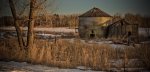
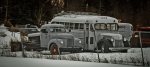
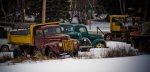
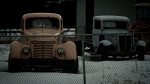
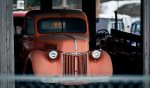
Most photographs presented here are ones taken in the final hour of sunlight last Saturday night; it’s about half past ten heading to eleven o’clock. The river bank at Dunvegan features shadow play with shadows lengthening and darkening to enhance the rolling mounds of hillage above the Peace River. In two photos rusting relics are stored in public view.  The three early sixties GMC half-tons seem ready to share parts in order to cluster into one working whole.  The ready interchangeability of parts between the three trucks points to a need to gather them all rather than only one. Canada Geese move actively at sunset in a farmer’s field feeding. And, a disused barn catches the light of sunset … a dusky day’s end in Alberta’s late spring.

Listening to – J J Heller’s Your Hands, Missy Higgins’ Warm Whispers, Coldplay’s See You Soon, David Gray’s Kathleen, Jem singing Maybe I’m Amazed, Ray LaMontagne’s I Still Care for You and all the way through to John Denver’s Thank God I’m a Country Boy.  The playlist rounds out to the Counting Crows’ Raining in Baltimore and David Gray’s Jackdaw.

Quote to Inspire – “Beauty can be seen in all things, seeing and composing the beauty is what separates the snapshot from the photograph.” – Matt Hardy
Kudos – Northern Actors’ Guild 2012 & Grease Production

Best Practices - Photography, Canon 30D, Canon Camera, Light Intensity, Project 365 - Photo-a-day, School, Spring, Vehicle, Vehicle Restoration
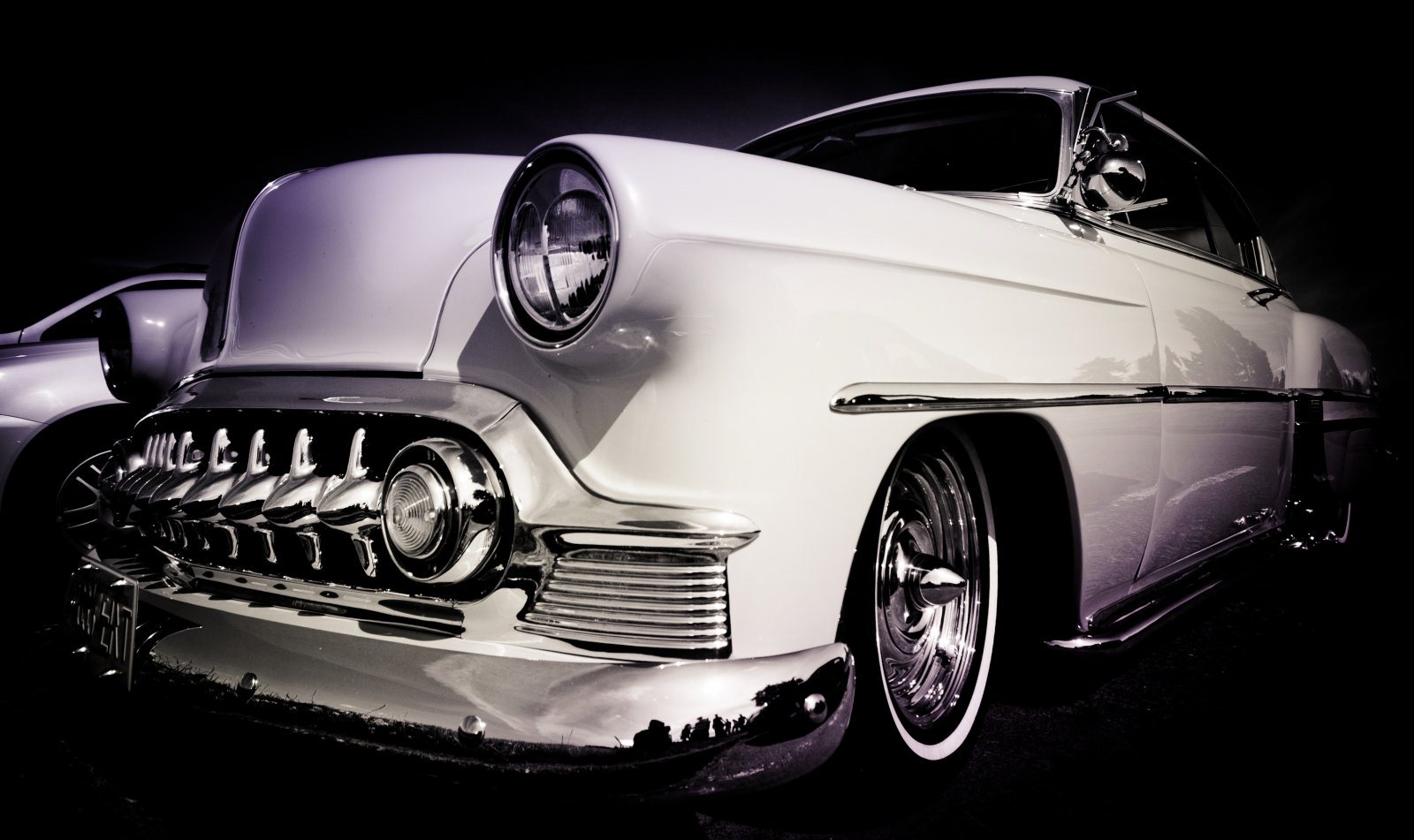
Early Fifties Chevrolet - Parksville, British Columbia

Early Fifties Chevrolet – Parksville, British Columbia

Summer ends – the year is 1959. Grade eleven students return to Rydell High School as seniors, sporting opinions about school, staff and each other. In this final high school year, they are top rung, the school is theirs and they’re able to assume power and status as seniors; they’re a force to be reckoned with. Girls cluster with girls. Guys ‘hang’ with guys. The senior year is about next steps – next steps in and beyond high school, next steps in terms of courtship and couple-hood, next steps …. A new girl enters the arena of school, Sandra Dombrowsky and the social equilibrium of year twelve becomes flux, teetering several relationships toward daring next steps, more permanent next steps.

So begins the musical of Grease with its notable characters – Danny Zucko, Rizzo, Frenchy, Kenickie, Doody and others. And, our student actors have concluded twelve months work in grappling with all that’s involved in bringing this narrative to Life and doing so musically. For our student actors, the coming-on of confidence was notable and palpable within the last few rehearsals. And, it was most notable between the first and last night of performance with student actors coming-into their own and enjoying the business of acting out the Lives and potentialities of their characters. For these student actors, connection and response from the audience was found, understood, seized and used to bring off a performance worthy of any metropolitan theatre. They found their way to an excellent performance and standing ovation last Saturday night. In helping this student endeavor along my role was to capture a series of threshold moments moving the troupe from its final three rehearsals through to three live performances. The images I’ve provided the group draw mainly from their final performance in which they were most in sync with their characters, each other and enjoying it all. I also contributed a print from the first cattails series a few weeks back – I printed it out and had it framed in Peace River by Jill Plaizier of Custom Frameworks; she was able to handle a quick turn-around time and to create a beautiful framing of the print that accentuates its colours.

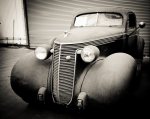
Tonight, while I do not have permission to display student photos on the website, I do wish to celebrate them and their accomplishment with this photo of an early fifties Chevrolet that’s undergone the kind of transformation that Kenickie’s 1940 Dodge Sedan goes through in the film version of Grease; Kenickie and pals begin this section of the musical with “… It’s Systematic … It’s Hydromatic … Why … It’s Greased Lightning.” For me, tonight, I’m at the other end of the project.  I’ve edited some six hundred photographs of the two-thousand or so taken.  I’ve created an Animoto and DVDs for each cast member. I’m providing them each with photos of their best night.  And, I’ve got them a print to frame for hanging upon school walls.

Listening to – while there has been the Grease tunes like Greased Lightning, Grease and You’re the One that I Want, there’s also been David Lindley’s Mercury Blues and then the curiosity referred to by Jimmy Paige as one of those songs that pushed him forward in his guitar work – Rumble by Link Wray and the Wraymen.

Quote to Inspire – “You’ve got to push yourself harder.  You’ve got to start looking for pictures nobody else could take.  You’ve got to take the tools you have and probe deeper.” – William Albert Allard

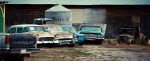
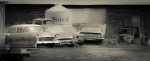
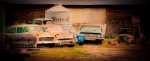
Makeshift Autoyard

Canon 30D, Canon 75-300 mm, Canon Camera, Canon Lens, Farm, Lookback Photos - One Year Ago, Photoblog Intention, Photography & Conceptualizing Beauty, Project 365 - Photo-a-day, Still Life, Summer, Vehicle Restoration

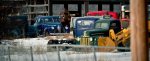
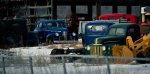
Charles Dickens once wrote a novel about an Old Curiosity Shop, a shop much like that of current second-hand stores or thrift stores in which a store owner collects collectibles, curiosities that satisfy our need to discover things that fit the environment we wish to create for our lives. Tonight, day-long, spring snow flurries bring about a look-back through photos. This photograph surfaced as one provoking the curiosities that rusting relics are at that point before restoration in which appraisal and consideration of possibility occurs – questions stir about what needs done, what the vehicle can become, what it will be like to drive and who will drive it.  Possibility is leveraged as much by reminiscence as by future anticipation. Something of this imaginative aspect regarding a curiosity to be purchased is what Dickens explores in his novel The Olde Curiosity Shop – the nature of how we choose what we will put into our lives. Rusting relics in this rag-tag, makeshift auto-yard have me wondering about the curiosity that these older vehicles hold and highlight the necessity of imagination in investigating the possibility of what any of these vehicles can become. For me, the teal blue 1959 or 1960 Chevrolet reminds of a car that my grandfather drove when I was three or four.  I can only recall being transported in this vehicle two or three times in and around Edmonton and then back to their home on Strathearn Drive – a memory that requires some reaching back.

Listening to – Snow Patrol’s Lifeboats, Radiohead’s High and Dry, Coldplay’s Don’t Panic and Kings of Leon’s Closer; the song that’s been on my mind throughout the post has been The Tragically Hip’s As Makeshift As We Are.

Quotes to Inspire – (1) “Photography can only represent the present. Once photographed, the subject becomes part of the past.” – Bernice Abbott (2) “A photograph is a secret about a secret. The more it tells you the less you know.” – Diane Arbus

Transformation’s Glaze

Best Practices - Photography, Canon 60D, Canon Camera, Canon Lens, Light Intensity, Photoblog Intention, Photography & Conceptualizing Beauty, Project 365 - Photo-a-day, Season, Spring, Still Life, Vehicle, Vehicle Restoration

I’ve just checked. It is still around, that thing that catalyzed so much of the work and time I’ve invested in cars I’ve owned and cars I’ve worked with. I happened on it by chance and by the end of that first day I had received an education in using it. On a Saturday morning in early summer 1982, I drove a green 1969 Pontiac Parisienne to a good friend’s house to see what we were up to that day. He had a project going, a task fueled by his father’s expertise in restoring and rehabilitating old cars.

I found him compounding (using rubbing compound on) the maroon paint of his two-door Dodge Aspen, a new acquisition – his first car. The idea was to remove paint that had dulled and oxidized and then add a layer of glazing resin to seal and maintain the maroon paint in pristine condition. As many things were in those days, this was a Tom Sawyer experience – a project he was engaged in was something I wanted to help with and he had the grace to allow me to do so. In two hours, our combined elbow grease brought out evenly the car’s true maroon colour in the paint. Then we added the glazing resin, something called TR-3 Resin Glaze; we rubbed it into the paint.  We let it powder up and dry. And, then we used terry-towel rags to remove swirls of resin glaze residue.

What happened was remarkable. Our elbow grease, our use of rubbing compound and resin glaze according to instruction produced transformation – a previously dull, tired looking Dodge Aspen now looked new, even better than new. We’d seen this once before and talked about it.  An older gentleman in the house next door, a man confined to a wheelchair had brought about similar transformation to his late sixties Dodge Dart. His candy apple red Dodge Dart was emaculate, the result of patient application of intelligence, initiative and diligence toward visual result.

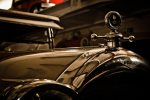
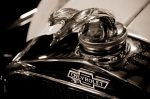
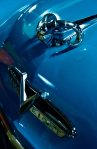
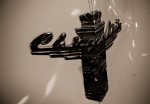
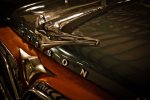
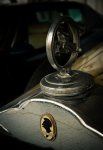
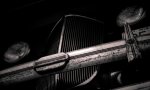
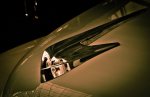
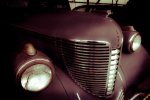
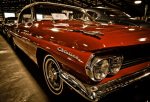
In terms of photographs, not many vehicles these days sport hood ornaments.  Hood ornamentation tends to be associated with higher-end cars … perhaps they always have been.  Hood ornaments accentuate the forward most part of the vehicle and perhaps in their being sculpted remind owner and driver of their vehicle being art, something crafted by others.  Hood ornaments seem to have started out primarily as skilfully fashioned radiator caps; others serve to mark the hood’s center allowing drivers to position the vehicle on the road in relation to designated space between lines. Hood ornaments from several vehicles at the LeMay Car Museum feature as subject for this post’s photos.

Listening to a genius playlist starting from Over the Rhine’s Sleep Baby Jane; it moves on to Patty Griffin’s Mil Besos and then to Dar Williams’ Fishing in the Morning. In terms of audiobooks, I’m continuing to walk and listen to Lady Chatterley’s Lover;  what struck me this morning is commonality of era. After all that the first world war was, the world my grandfather and grandmother would have shared as a young married couple was this same period as that of Constance and Clifford Chatterley, except that my granddad’s wounding at Vimy Ridge led him to become a military instructor for the remainder of the war and then back to Canada to marry the woman who would become my grandmother. Lawrence’s Lady Chatterley’s Lover was a book most likely banned in their time because it dealt with physical sensuality and challenged mainstream morality;  I wonder about their take on the book … was it a book not to be read if you were a person of integrity?

Quote to Inspire – “There is nothing worse than a brilliant image of a fuzzy concept.” – Ansel Adams

325 – 152nd Street East, Tacoma, Washington

Best Practices - Photography, Canon 60D, Canon 70-200 mm 2.8 IS L Series Lens, Canon Camera, Canon Lens, Journaling, Light Intensity, Photoblog Intention, Photography & Conceptualizing Beauty, Project 365 - Photo-a-day, Season, Spring, Still Life, Vehicle, Vehicle Restoration

One of the bigger treats for me in visiting Seattle, Washington this Easter was something my wife and daughter allowed me to do on the Thursday before we returned to Canada, something that they joined me in. That Thursday morning, we drove from Seattle an hour south to Tacoma and using our TomTom GPS were able to navigate to 325 – 152nd Street East to arrive at the LeMay Car Collection/Museum at Marymount.

Imagine a former convent/school resurrected to become storage and showing site for the LeMay collection of cars and trucks, vehicles of the last one hundred years. At the museum, a docent will lead you through each collecting point on the Marymount property. Not only do rusting relics inhabit these spaces, but you also find that the majority of vehicles within these confines will have received restoration or would have been kept in their original pristine condition throughout their years. Beyond this, imagine that your docent has heart and understands well your connection to cars and knows each car’s history intimately. He’s able to tell you all that you didn’t know about each car. Our docent, Mr. Pierce, led us, this way and that, through the maze of cars parked end to end in each of three buildings, a means to house them all. He was introducing each car to us – what the car was about practically, what had been each automaker’s intentions for the vehicle conceptually and how the car came to reside within the LeMay collection.

And, Mr. Pierce allowed me a kind of grace that only a fellow gear-head would ever let you have … he allowed time to photograph the vehicles and for that I will be forever grateful. At two hours in to my tour my wife went to be with my daughter out in our rental car while I rounded off the tour with Mr. Pierce looking up close at some of the first-ever self-propelled vehicles to transport people around the Americas. In terms of next steps, I’m considering becoming a member at the LeMay museum – they may be able to make use of this old-time car jockey who used to dust and polish cars at Edmonton’s Waterloo Mercury.

Listening to – U2’s Magnificent, Coldplay’s Yes and Radiohead’s All I Need.  In terms of audiobooks, the last two morning walks have been a listen through D.H. Lawrence’s Lady Chatterley’s Lover; it’s been more than a couple of year’s since I’ve been through the book and this audio-recording has a good reader –  Maxine Peake.

Quote to Inspire – “Photography does not create eternity, as art does; it embalms time, rescuing it simply from its proper corruption.” – Andre Bazin (1918-1958), French film critic.

About Photography & B-Side Images

Canon 60D, Canon 70-200 mm 2.8 IS L Series Lens, Canon Camera, Canon Lens, Canon Live View, High Dynamic Range (HDR), Photography & Conceptualizing Beauty, Project 365 - Photo-a-day, Still Life, Vehicle, Winter

If you’ve been around the internet in the past five years, consideration of what comprises a perfect average day has surfaced as a means of designing one’s day so that key features in one’s day are found and recognized, so that Life-long goals are actualized and so that people recognize and master control over what happens within their days rather than being mere do-bodies, going from bed to work and back again with little awareness of time, values, meaning and effort, all of which are invested in each day. For me, what to do about photography and pursuing each next, best picture has been the question of the day … through many months. Photography is an activity that you make time for, an activity that you fit into your day, an activity that must, in precedence, rank equally to other activities in your day if you’re to find successes with it. It’s about photographing things you like to photograph, things you’re interested in. It’s about photographing things you don’t normally have access to in your day-to-day existence. It’s about capturing unique qualities in your subject that you and others may perhaps never find again. And, it’s about recognizing the beauty in things and photographing them. In Susan Sontag terms photography is about appropriating and making the thing photographed, yours.  Photography is not an activity easily engaged in. Often the timeframe from image capture through to print and presentation is a separation of tasks that involves days, weeks, months and as I’m still finding, it may involve years. It is work and it is cumulative work – seeing more and more of what the image can become. It is an endeavor engaged in primarily because the print outcome is reward; what is produced is a kind of manna for the viewer to feast upon. In the subjects photographed, while there are seasons and changes we pass through, what’s also beginning to surface as more photographs are created is the commonality or mean of existence, the fundamentals that we need to live and thrive.  And, I note my good fortune in not being fully exposed to lives lived in the absence of these basic ingredients of Life.

The photographs presented here are the other photographs, the b-side images that were not ones selected to tackle consideration of a single theme or idea or subject.  What’s interesting, though, is the repetition of what is subject within photographs – it’s beginning to reveal commonality among our human needs.

Listening to Young the Giant’s Cough Syrup, (a second night’s acclimatization to the tune), Ulrich Schnauss’ Passing By (from Elizabethtown Soundtrack – vol. 2), the Propellerheads’ Take California, Tricky’s Hell Is Around the Corner, Supreme Beings of Pleasure’s Strangelove Addiction, Moby’s Porcelain and the Gotan Project’s Santa Maria (Del Buen Ayre).

Quote to Inspire – Photography, like alcohol,  should only be allowed to those who can do without it.” – Walter Sickert

Tougher & Last Man Standing

Barn, Canon 60D, Canon 70-200 mm 2.8 IS L Series Lens, Canon Camera, Canon Lens, Canon Live View, Farm, High Dynamic Range (HDR), Photoblog Intention, Photography & Conceptualizing Beauty, Project 365 - Photo-a-day, Season, Spring, Still Life, Vehicle, Vehicle Restoration, Winter
Fifties Flatdeck Truck - Nampa, Alberta

Fifties Flatdeck Truck - Nampa, Alberta

A few things make today a tougher go – not the legitimate student response to spring’s arrival and the fever it’s engendering, nor is it those minds that recognize that their attitudes are blocked, stalemated or closed with the past six months of winter’s interior Life at home and school; at this time of year openness in perception, thought and attitude itches in angst to break free of winter’s constraints of living.  These are all within the arena of Life work in early spring in High Level, Alberta.

At this time of year, it’s too easy to say the wrong thing. It’s too easy to get caught-up in oneself and one’s endeavors. It’s too easy to neglect where one’s care needs legitimate directing.  This season is one in which humour can get you into serious trouble while also being a source of tremendous healing and celebration.  It’s a time of year when it’s good to have a bonfire that is shared among others, a bonfire that extends the day into the wee hours of the night.  It’s a time when strength of body and strength of mind carry you forward into this next season that is spring.  At such a bonfire it’s good to have a keeper of the fire, the last man standing for when the last ember dies, someone we know who will see the night through on our behalf when we find that we should direct ourselves home and to sleep.  And, perhaps that’s it, the toughest part of today is that of helping one’s body overcome extended wakefulness as the season changes from winter to spring.

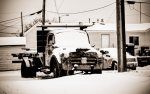
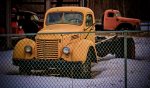
The photograph presented here is that of a late fifties flat-deck truck in Nampa, Alberta.  In Nampa the historical-agricultural museum is in the process of re-locating.  So, farming equipment/implements, vehicles, train cars and buildings are shifting location.  Until the new site is completed these items remain scattered throughout Nampa.  This flat-deck truck sits in someone’s backyard alongside other vehicles and looks to be in readiness for use. This truck has seen perhaps fifty or so years of service and its structure still has integrity.  It seems to be one of the last vehicles standing and seems to have strength associated with preserved shape and ability to function.  Its look is that which we’d find in the wizened face, that face of the last man standing – the keeper of the fire – when we need to direct ourselves to sleep.

Listening to Over the Rhine’s Spark, Joseph Arthur’s In the Sun (with Michael Stipe) and U2’s One;  other songs have included Eric Angus Whyte’s Beggars and Buskers (of Belfast), Liz Longley’s Free and the Steve Miller Band’s Rock’n Me.  My daughter has had me download Young the Giant’s Cough Syrup and Kelly Clarkson’s Stronger (What Doesn’t Kill You);  Demi Lovato’s Skyscraper has also received download tonight.

Quotes to Inspire –  (1) “If I knew how to take a good photograph, I’d do it every time.” –  Robert Doisneau; and, (2) “If I have any ‘message’ worth giving to a beginner it is that there are no short cuts in photography.” – Edward Weston.

Where Are You Going …?

Barn, Canon 60D, Canon 70-200 mm 2.8 IS L Series Lens, Canon Camera, Canon Lens, Canon Live View, Photoblog Intention, Photography & Conceptualizing Beauty, Project 365 - Photo-a-day, Still Life, Vehicle Restoration, Winter

The images I present in this post remind of a time when as a young Dad, I read stories from the Thomas the Tank Engine series to my son and my/our doing so was an enjoyable way to close out each day. Thomas, Percy, Rusty, James et al each had an engineer, each had a conductor, all worked for Sir Topham Hat – each set about to complete a task each day. At the end of each day each engine returned to the engine shed for maintenance and rest. In Sangudo, Alberta, there’s a museum celebrating the vehicles and machinery that were used in the building of the Alaska Highway. Some are scattered within the museum’s yard and some are housed in a roofed shed without walls. The museum has closed and is no longer open to tourists. All vehicles seem to look onto the Alaska Highway they once had a hand in building. The scene is one you might find in a Thomas the Tank Engine story –  vehicles dormant and apparently waiting for a time when they can be re-tasked with new purpose and new life. Curiously, two songs I’m listening to tonight almost personify a state of mind that could lurk, here. One is Dave Matthew’s song Where Are You Going and the other is a Hank William’s song, I’m So Lonesome I Could Cry. Both songs are sung by Martyn Joseph and are found in his Passport Queue album Pq35.

Listening to: Weight of the World, Invisible Angel, Kindness and I Will Follow from Martyn Joseph’s Pq35.

Quote to Inspire: “A family’s photograph album is generally about the extended family—and, often, is all that remains of it.” – Susan Sontag (b. 1933), U.S. essayist. “In Plato’s Cave,” On Photography (1977).

A Slippery, Melting World

Best Practices - Photography, Canon 60D, Canon Camera, Gas Station, Project 365 - Photo-a-day, School, Service Station, Still Life, Weather, Winter

A busy week has me posting photographs almost a week beyond date of image capture. Last Friday’s photowalk took us through High Level’s southern side, a slippery, melting world, a world of water splashing and flowing and soaking through. Photographers captured freeze-frame splashing, the results of big chunks of ice being thrown into puddles.  Others’ photographs were more about water’s ripple and reflection, water moving and water that’s settled.  Beyond this, water misted in the spray generated by vehicles traveling among wet, wet High Level roads.

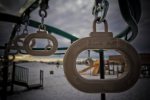
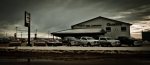
I used my Sigma 10-20 mm in two ways, first to distort line and shape of subjects close by and secondly to photograph landscape traveled through.  The subjects photographed include an RCMP three-quarter ton truck, playground equipment at Spirit of the North Community School, a bog-runner truck … in development, the curbside view of Quality Motors (our local Chrysler, Jeep and Dodge Dealer) and the Extra Foods Gas Bar (part of the Canadian Superstore chain).

Listening to the Steve Miller Band – Rock’n Me, Take the Money and Run and Mercury Blues from the Fly Like an Eagle album;  other songs have included Murray McLauchlan’s Hard Rock Town and Ryan Adam’s Chains of Love.

Quote to Inspire – “Photography takes an instant out of time, altering life by holding it still.” – Dorothea Lange

After Dan Kameka, the Dunvegan Bridge

Canon 60D, Canon 70-200 mm 2.8 IS L Series Lens, Canon Camera, Canon Lens, Canon Live View, High Dynamic Range (HDR), Photoblog Intention, Photography & Conceptualizing Beauty, Project 365 - Photo-a-day, Vehicle, Winter

Dunvegan Bridge HDR 1 (Reduced Size)

Dan Kameka, an artist and photographer in Alberta’s Peace Region has spurred me forward in this never-done photograph that I captured yesterday. I first became acquainted with Dan Kameka’s photography works at Grande Prairie’s Trumpeter hotel; there, I saw two eight-foot photographs, one a retro-green grain elevator (possibly United Grain Growers) and a second image of farming machinery from former times, a beautiful cluster of a Fargo grain truck with granaries now disused in a snow-dusted, winter fallow field.

That was ten years ago. Two years ago I found smaller versions of the same images for sale at Picture Perfect Frame & Gallery in Grande Prairie. In the set of images displayed I found two or three photographs by Dan Kameka that intrigued me because I wondered how they’d been taken. Of special interest was a Dunvegan Bridge photograph which intrigued because the riddle of working out where the photograph was taken from has stayed with me through these two years. The shot I have taken is likely taken at a point close to the location Dan would have used in capturing his image of the Dunvegan Bridge. Yesterday’s never-done was about riddling this through and then daring to navigate to the site which presented its own challenges, a task taking me from my car to the site and back in ninety or so minutes; it’s only been in the last two months that I’ve known how he probably had done it.

About this photo – this photograph associates to another I’ve posted entitled Alberta Fissure.  It is the complement to this image and is taken from a point behind the far left of this image and it looks down the valley from the high left through to the expanse of the valley to the right in this image. This photograph is one of several high dynamic range (HDR) shots I’ve created with automatic exposure bracketing; but it is the first in which cloud cover accentuates significantly adding drama. In this picture I’m impressed with the zoom lens compression of distance. The bridge itself is one kilometre long reaching over the Peace River at a narrower point.  The extrapolation then is that from the point I’m standing at taking the picture to the top of the S-curve on the other side of the valley is a distance of perhaps two to two-and-a-half kilometres. It would take a car travelling at 100 km/h about one minute to travel from the top of the S-curve to the point at which I stood near the highway incline. A significant distance is captured in this photograph.

Thank you Dan for those beautiful, intriguing photographs that capture my wonder and memory; you’ve had a hand in spurring me on not only with this photograph, but with my photography.

Listening to – Sarah Masen’s The Valley, Ziggy Marley’s Love is My Religion and Willard Grant’s Evening Mass.

Quote to Inspire – “There are always two people in every picture: the photographer and the viewer.” – Ansel Adams