
Makeshift Autoyard

Canon 30D, Canon 75-300 mm, Canon Camera, Canon Lens, Farm, Lookback Photos - One Year Ago, Photoblog Intention, Photography & Conceptualizing Beauty, Project 365 - Photo-a-day, Still Life, Summer, Vehicle Restoration

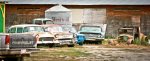
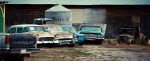
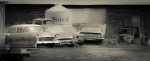
Charles Dickens once wrote a novel about an Old Curiosity Shop, a shop much like that of current second-hand stores or thrift stores in which a store owner collects collectibles, curiosities that satisfy our need to discover things that fit the environment we wish to create for our lives. Tonight, day-long, spring snow flurries bring about a look-back through photos. This photograph surfaced as one provoking the curiosities that rusting relics are at that point before restoration in which appraisal and consideration of possibility occurs – questions stir about what needs done, what the vehicle can become, what it will be like to drive and who will drive it.  Possibility is leveraged as much by reminiscence as by future anticipation. Something of this imaginative aspect regarding a curiosity to be purchased is what Dickens explores in his novel The Olde Curiosity Shop – the nature of how we choose what we will put into our lives. Rusting relics in this rag-tag, makeshift auto-yard have me wondering about the curiosity that these older vehicles hold and highlight the necessity of imagination in investigating the possibility of what any of these vehicles can become. For me, the teal blue 1959 or 1960 Chevrolet reminds of a car that my grandfather drove when I was three or four.  I can only recall being transported in this vehicle two or three times in and around Edmonton and then back to their home on Strathearn Drive – a memory that requires some reaching back.

Listening to – Snow Patrol’s Lifeboats, Radiohead’s High and Dry, Coldplay’s Don’t Panic and Kings of Leon’s Closer; the song that’s been on my mind throughout the post has been The Tragically Hip’s As Makeshift As We Are.

Quotes to Inspire – (1) “Photography can only represent the present. Once photographed, the subject becomes part of the past.” – Bernice Abbott (2) “A photograph is a secret about a secret. The more it tells you the less you know.” – Diane Arbus
Imagination’s Possibility

Best Practices - Photography, Canon 30D, Canon Camera, Lookback Photos - One Year Ago, Photoblog Intention, Project 365 - Photo-a-day, Winter

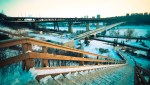
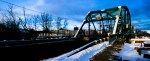
I am posting in a rush. Away from computer and the ability to post photos, the next few days will see me hunting for a new vehicle (truck, SUV or car) in central Alberta. The photographs I present, here, are from the solo photowalk from a few posts back – a circuit on top and through Edmonton’s river valley – there’s the Fifth Street Bridge, two photos of the High Level bridge northeast walkway entrance and then photos of the stairway leading from the Grandin park down to the Royal Glenora skating rink – where Alberta’s Olympic hopefuls train.

A current review of John O’Donohue’s work on imagination and beauty has surfaced intriguing thoughts about our subjective world, our subtle life and the curious role imagination plays in accessing and realizing all we are and can be; perhaps these are key ideas for sorting Life through, well.
“Where do all your unlived lives dwell? Go back to [your] threshold moments and see what you didn’t choose; consider what might have happened [there]. Unchosen, unlived lives continue to live themselves out secretly in accompaniment with us …. [It is important to note that] the way that we [can be] viewed is infinitely more subtle and sophisticated and complex than the one-hit look of the human eye [that others see us with]. The only way that you can come in touch with your other [unchosen, unlived] lives is through the power of the imagination because … your imagination is always interested in what’s left out; it’s interested always in the other side of the question; it’s interested in depth and roundness. The most important question for any human [to ask] is ‘how do ‘you’ see yourself?’ Who do ‘you’ think ‘you’ are? And, what do ‘you’ think is going on in ‘you’? You cannot see that with your superficial mind.You can only sense that with your imagination.” ~ John O’Donohue, Beauty – The Divine Embrace, a Greenbelt lecture.

Listening to F. Scott Fitzgerald’s the Great Gatsby, a first listen to an unabridged recording following a first reading of the novel. Jimmy Gatz, Daisy and Tom Buchanan, Jordan Baker, Mr. Wilson and his wife – there’s much there about settling into lives as men and women, husbands and wives. It also contains an element of the modern, self-made man, the man of the times, a Dale Carnegie man able to win friends and influence people. This narrative is a historical complement to Martin Scorsese’s current Atlantic City narrative, a mini-series about Nucky Thompson, Jimmy Dohmarty, Al Capone et al in Boardwalk Empire, now in season 2.

Much of the day has been listening to Sirius Satellite Radio – the Coffee House, BBC World Service, B.B. King’s Bluesville; Ryan Adams has a new song, Chains of Love, that I’ll be checking into.

Quote to Inspire – “The more you photograph, the more you realize what can and what can’t be photographed. You just have to keep doing it.” – Eliot Porter

Tompkin’s Landing Ice Bridge

Canon 30D, Canon Camera, Lookback Photos - One Year Ago, Photoblog Intention, Project 365 - Photo-a-day, Season, Weather, Winter

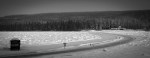
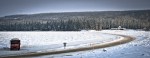
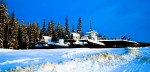
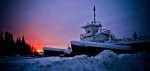
Two bridges have been built to cross the Peace River in northwestern Alberta, one at Dunvegan and another at Fort Vermilion. In our region, wood chips used for making strand board are transported from mills in and around La Crete, a Mennonite settlement in the region, to a strand board plant north of the town of Peace River. Rather than follow a circuitous route back through Fort Vermilion, then High Level and down to Peace River, a road has been carved through the Blue Hills forest and farming community to a place on the river called Tompkins landing. Here, a ferry runs through most of the year, night and day to keep the chip trucks moving and to provide travelers from La Crete access to the highway taking them south to Peace River, Grande Prairie or Edmonton; in size, the ferry can hold four chip trucks in one go across the river.

In late November or early December, with colder temperatures the ferry is pulled from the river and ice clusters. A few brave souls who have the knack for it create a pathway across the ice, watering it daily just as you would an ice rink in your back yard. An old red, seventies three-ton GMC grain truck holds a portable cistern – each day, morning and night someone pumps river water into the cistern and then drives the grain truck across the ice bridge spreading water on the ice surface. The mass of ice increases on top and from the bottom until with sustained colder temperature -20C to -30C, the ice bridge that is formed is four feet thick, able to hold the weight of a chip truck crossing the kilometre wide path.  Ice bridge creation is a practice repeated two hundred kilometres further up the river at Fox Lake, on the edge of Wood Buffalo National Park.

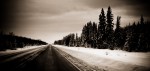
The photographs here present the ice bridge somewhat compressed with a zoom lens; the actual distance across the river is more than a kilometre.  Those driving across the bridge need to travel at a speed of 10 km/h.  The photographs also present a look at a dry-docked ferry.

Listening to Radiohead’s There, There from the Best of Radiohead; other songs have been Unknown Caller from U2’s No Line on the Horizon and finally there’s been Over the Rhine’s Born from Drunkard’s Prayer.

Quote to Inspire – “Different levels of photography require different levels of understanding and skill. A ‘press the button, let George do the rest’ photographer needs little or no technical knowledge of photography. A zone system photographer takes more responsibility. He visualizes before he presses the button, and afterwards calibrates for predictable print values.” – Minor White – [Minor White, Richard Zakia, Peter Lorenz The New Zone System Manual, Morgan & Morgan, Inc., Dobbs Ferry, New York 1978 (Fourth printing), p. 93]

Winter Light’s Tone & Mood

Canon 30D, Canon Camera, Christmas, Light Intensity, Lookback Photos - One Year Ago, Night, Project 365 - Photo-a-day, Season, Winter

High Level Bridge - Edmonton, Alberta

On a Saturday afternoon, in late November or December, 1968, my father took me to Edmonton’s Varscona theater on the corner of 109th Street and Whyte Avenue to watch a newly created film version of a Dickens’ novel he knew well; my father took me to watch Oliver! In the film, I encountered a boy a little older than me, Oliver Twist, as he moved forward into the world without parents, moving from workhouse to funeral home and on into more (or less) corrupt hands (depending on your point of view), navigating by strength of character and goodwill through mishaps, misdeeds, abuse and neglect. Innocence and seeing the world with first eyes are key aspects in this narrative’s presentation, a child acclimating to what the world is about – good and bad.

Safety and what is right are elements of Life that Oliver perceives purely on the basis of tone. Highlighted in the novel is affectation of tone, tone used to achieve an end. Here, Oliver responds to the warmth and apparent sincerity in the charm and charisma proffered by Fagin (sly, cunning con artist) and Master Charlie Bates a.k.a. the Artful Dodger (Fagin protégé, pickpocket and derisively referred to as Master Bates). Their tone and apparent sincerity lead only so far before innocent and perhaps earnest discussion of what’s at play (picking pockets) draws both accountability and deflection of impropriety into/from the situation.

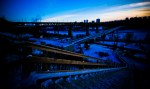
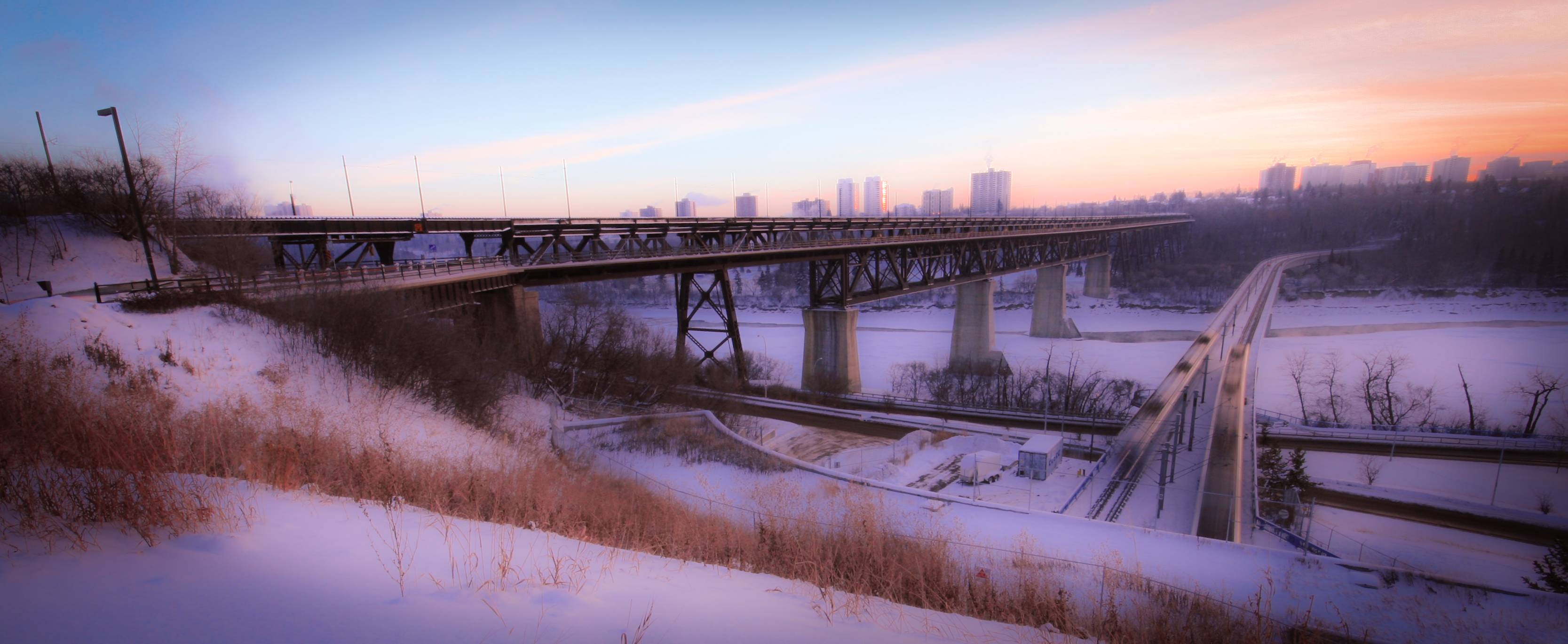
Key among things recalled from watching Oliver! at age seven is how light is used to convey tone and mood. Street scenes in the film occur when light is mistrusted as its intensity diminishes and as color and tone deepen and broaden, enhancing mood. Evening light, the cusp of sunlight declining into sunset, drawing day into night, is much of what the street scenes in Oliver are about. Perhaps director, Carol Reed, draws out broad visual metaphor, here, light’s transition into dark – wholesome Life moving to an arena of growing corruption, of that which is underhanded and unable to be truly ‘seen’. What stays with me after these forty-three odd years is the role that light’s intensity plays in establishing mood; the movie Oliver has had me attending to the tone, colour and atmosphere of winter street scenes as shadows lengthen, sunlight diminishes and we move through that range of colour taking us from day into night. Most often I’ll recognize this same tone driving west on Edmonton’s Whyte Avenue, close to Christmas as the sun draws toward the horizon … the mood is the same. The colours, light, tone and mood found in this December photograph of Edmonton’s High Level bridge are those you’ll find in Oliver!

Listening to Adele’s Set Fire to the Rain from her 21 album; other songs of the day include U2’s Bad from The Unforgettable Fire and Coldplay’s God Put a Smile Upon Your Face from their album A Rush of Blood to the Head.  In the past few days Jack White and The White Stripes have featured in my listening – 300 M.P.H Torrential Outpour Blues (Live) from Under Great White Northern Lights (Live Canadian Tour).  The Verve’s Lucky Man from the Urban Hymns album and  U2’s Love and Peace or Else from How to Dismantle an Atomic Bomb have also been there.

Quote to Inspire – “People think that all cameramen do is point the camera at things, but it’s a heck of a lot more complicated than that!” – Larry in Groundhog Day

Adizes Curve

Canon 30D, Canon Camera, Christmas, Light Intensity, Lookback Photos - One Year Ago, Project 365 - Photo-a-day, Season, Winter

Edmonton's River Valley - Looking Back to Saskatchewan Drive

If you know the Adizes curve you’ll recognize what’s referred to as a learning curve being the initial part of a bell shaped curve moving you from initiation of a new practice to a point of prime where you crest the top of the curve and master practice – new practice has been worked, handled and made best practice. Optimal use of the Adizes curve has you taking on new learning curves as you crest and master prior practice. Doing so, allows you to hang on to current good practice while embracing newer needed practice.

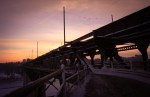
The photograph presented, here, is one taken midway through a five-hour, solo photowalk around Edmonton’s river valley. I’m dealing with new practice.  I’m moving through a metropolitan area and recreational park area and making decisions about photographs I want, committing action to each shot and moving on – it’s a pattern I’m developing. As I start I’m shooting too quickly, not letting my eye look around the frame to see if I’m gathering all that is subject and background. Some of what I’m doing is managing state – balancing my awareness of environment (the hustle and bustle of what’s going on around me as I shoot) with good awareness of what I am seeing in the lens. I settle into the rhythm of practice – walk and find subject, move to find best angle/perspective, set the exposure (f-stop against shutter speed), focus and take the shot; then, when I’ve exhausted my seeing and possibility with a subject I move on. I’m also testing out gear at -20C.  I’m keeping one battery warm, close to my chest underneath fleece and winter jacket; every twenty-minutes or so, I’m swapping out the camera battery (the cold for the warm). I’m carrying a knapsack style camera bag and a tripod bag slung over my body, over the camera bag.  Beyond this, I’m managing comfort in terms of staying warm with fleece underneath jacket and ski pants.

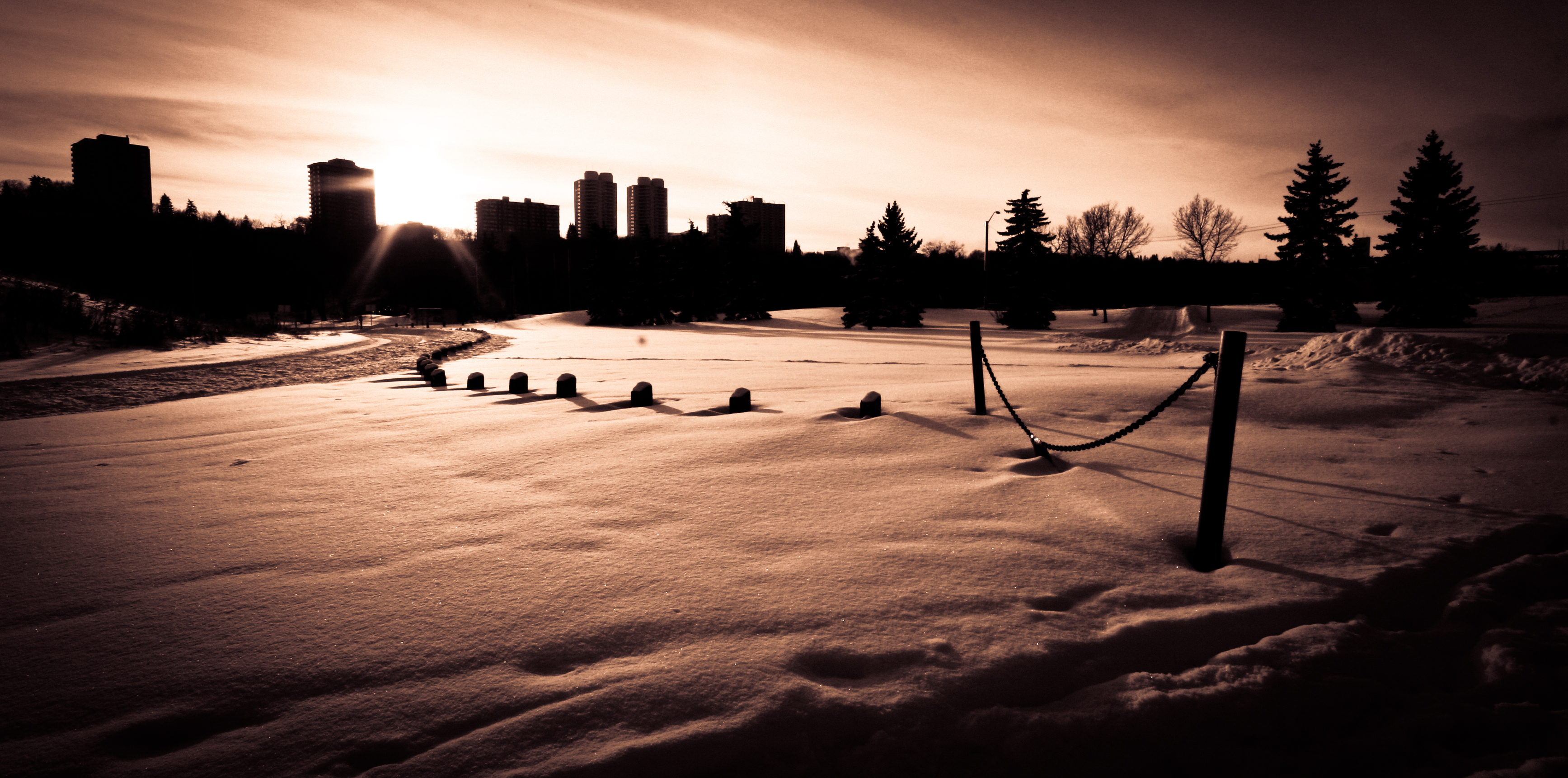
At the mid-point of my walk, having come down into the river valley, I encounter this shot – a silhouette, near the 5th Street Bridge looking back up toward Saskatchewan Drive, a neat leading line of posts preventing vehicles moving where they ought not to go.  I move on. As I take pictures I’m unaware of the need to clean my lens and that snow crystals will shape what I expose. It is days later when I’ve returned home and edit the images that I see them – the result isn’t anything bad, just something that needs cleaning up with software. In this photowalk I began at the High Level Diner, moved east along Saskatchewan Drive, entered the Edmonton City Park (the River Valley), crossed the 5th street bridge, walked through the Alberta Legislature grounds and returned to the University side of the North Saskatchewan River – it has been a first view of the area with my camera, something to repeat and revise. At a pub, formerly Plato’s Pizza, I treat myself to two pints of Boddington’s Pub Ale while I wait for a ride home and I review images.

Listening to … or fretting many Stan Rogers’ tunes tonight; among them have been The Wreck of the Athens Queen, Fisherman’s Wharf and Maid on the Shore; it’s been DADGAD tuning tonight and I’ve also shifted into 9/8 time, in a manner to support a fiddler’s reel or jig – a rhythm Skew Lines‘, Kerri Brown (fiddle, guitar, percussion) helped me find and play in Parksville, British Columbia.

Quote to Inspire – “I like photographs which leave something to the imagination.” – Fay Godwin

Norpine Show and Shine

Canon 30D, Canon Camera, Lookback Photos - One Year Ago, Project 365 - Photo-a-day, Summer, Vehicle, Vehicle Restoration

One technical aspect of William Faulkner’s novel, The Sound and The Fury, is that one narrative is investigated through active eyes of four different people associated with the story. The story receives telling from the perspective of and with the perceptive capability of each character grappling with what occurs as the narrative unfolds. Something similar occurs with perception when editing one photograph and altering minor elements of brightness, saturation and hue – what is seen and what one experiences in response to each configuration is different.

This evening, I’m looking back to a Friday in June, 2011.  It’s after school and a Show and Shine is being held in High Level, Alberta in the Norpine Auto Industrial Supply Retailer parking lot. I’ve got my Canon 30D with me as I depart from school and drive past these pristine vehicles – vintage and current – that someone has enhanced with different rims and tires, that someone has restored and painted, that someone has taken the time to find and connect with memories of a former time. I pull ahead, past Norpine, turning in at the High Level Home Hardware store and park my 2000 GMC Sierra, there. The next three-quarters of an hour is spent photographing cars and trucks from different angles to find good and best shots.

I dialogue with vehicle owners, unleashing  narratives associated with each vehicle we look to. Former students, in their first jobs following high school, show me their acquisitions – a Chrysler 300M and a GMC Sierra half-ton, both decked out with rims, fat tires and glossy shine. There’s room in our dialogue to sort through how I used to present cars in my post-high school days at Waterloo Mercury in Edmonton and what could be achieved with different McGuiar’s waxes for paint and a bottle of brake fluid for tires. I share with them that Autoglym Waxes are what I use these days and that Queen Elizabeth II has given royal warrant to the company because the waxes are used on Royal vehicles; while Hondas and Toyotas use the wax, so to does Aston Martin.

Mounted on my Canon 30D is a Sigma 10-20 mm wide angle lens … with it there’s the opportunity to distort vehicle form in terms of lines and curves … to add the wow factor. One vehicle I come across is this late fifties Ford half-ton painted bittersweet orange and waxed to full gleam to reflect June’s late afternoon sun, clouds and sky.  Editing reveals this image in different ways … see which you enjoy best.

Listening to Over the Rhine and Within Without from their Discount Fireworks album; then it’s on to Mindy Smith singing One More Moment from her album with the same name. Later, it’s on to Babylon II by David Gray from the White Ladder album.

Quote to Inspire – “Photography is an immediate reaction, drawing a meditation.” – Henri Cartier Bresson

Wisconsin Locomotive – Part 2

Canon 30D, Canon Camera, Fog, Lookback Photos - One Year Ago, Night, Project 365 - Photo-a-day, Rail Yard, Weather, Winter

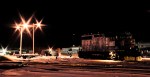
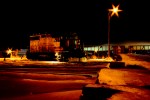
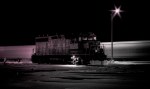
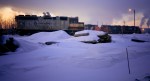
I am including four other photographs of the Wisconsin locomotive engine within the High Level Canadian National rail yard.

My interest in locomotive engines probably began with the matter of watching them pass by at railroad crossings, as a youngster, sitting among family in our 1969, silver-green Pontiac Parisienne; the big thing was to wave to the engineer and pull our arms down as if we were tugging on a rope above us – to our gesture we were sometimes rewarded with the engineer blowing the train’s air horn in our presence,  something that would thrill us, creating big smiles on the faces of everyone. Later, during summers while in university, I served as spotter and brakeman moving hopper cars around rail yards in southern Edmonton. And, now, I still have an interest in trains and locomotives.  I wonder how much of my current interest has been shaped by time enjoyably shared with my son reading Thomas the Tank Engine stories each night or watching the animated VHS video stories or in building different wooden track configurations and moving different engines around my son’s Thomas the Tank Engine track – Thomas, Percy, Rusty et al. Here, in Reverend Wilbert Awdry’s stories, it’s the everyday advice on the practicalities of living and the allegorical component of his stories that continues to hold my attention … there’s value and values there. My son is now eighteen and in university – many good facets of what life is about have been embedded in his character through these stories; these stories have been an enjoyable investment in my son’s future. And, still trains and what they accomplish capture my interest.

Listening to Billy Bragg and Wilco perform Stetson Kennedy from the Mermaid Avenue, Vol. 2 album; then it’s been Black Rebel Motorcycle Club … who would have thought four seminary graduates would minister through music … like this in Ha Ha High Babe.

Quote to Inspire – “I began to realize that the camera sees the world differently than the human eye and that sometimes those differences can make a photograph more powerful than what you actually observed.” – Galen Rowell

Alberta Fissure

Canon 60D, Canon Camera, Fall, Lookback Photos - One Year Ago, Project 365 - Photo-a-day, Still Life

The Peace Valley at Dunvegan

At most points in the geography of Alberta the Peace River is at least one kilometre across.  At various points it will broaden out allowing for islands and sand dunes. The first time I saw what the Peace River was about what I noticed was something this photograph conveys, the river has cut a fissure into the land through time and while the river is most times one kilometre across, the distance from level land on top of the river valley to level land on the top of the other side of the river valley is greater, spanning as much as four and five kilometres. The other thing noticed is that it takes about two kilometres of gradual descent in a vehicle to reach the river from the valley’s crest. This photograph is taken at the start of the descent toward Dunvegan and the Dunvegan suspension bridge looking north.  It’s late on a September Sunday and shadows creep from the west extending eastwards.

Listening to Bill Mallonee & the Vigilantes of Love sing Resplendent from their Audible Sigh album, a message about the nature of resilience borrowing from the narrative of the dustbowl.

Quote to Inspire – “I hate cameras.  They are so much more sure than I am about everything.” – John Steinbeck

Bezanson Backroad …

Canon 60D, Cemetery, Lookback Photos - One Year Ago, Project 365 - Photo-a-day, Summer

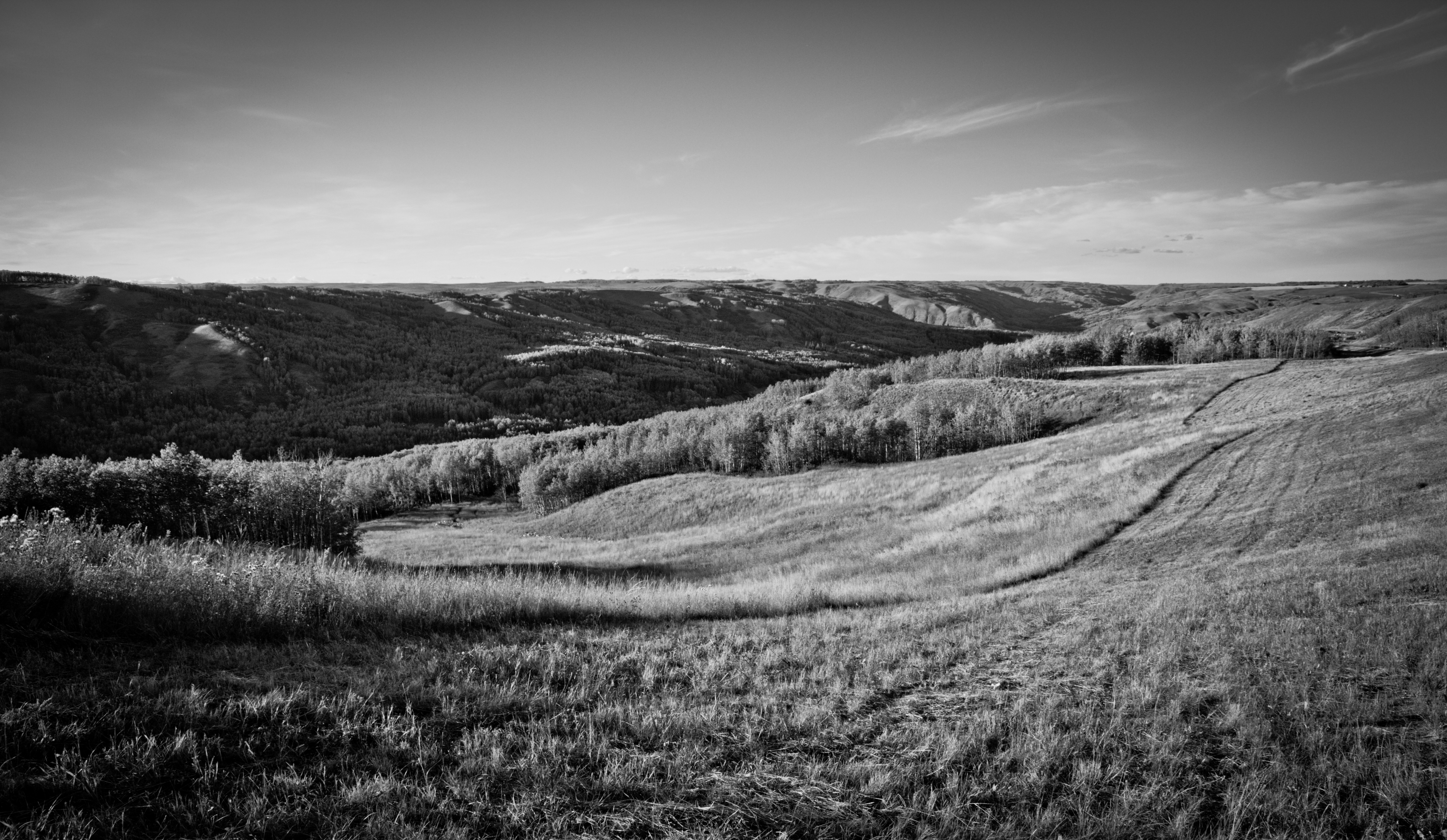
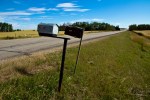
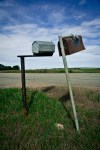
The log built structure in the first black and white photograph is a Presbyterian Church on the back roads between Bezanson and Grande Prairie, Alberta. The other photographs are of a set of mailboxes that you’d find on back roads in rural Alberta, an economical means for both farmers and Canada Post to distribute the mail. Setting the Church and mailboxes in juxtaposition brings out core ideas of message and being in receipt of message;  both seem to suggest that you have to get the message … work is involved, others are involved.  Interesting ….

Listening to Honey and the Moon, from Joseph Arthur’s Redemption’s Son; the song reminds of Stocki’s Rhythm and Soul BBC Radio Ulster broadcast (Sundays at 1:00 p.m. – Alberta MST) in which I first heard Johnny Cash singing a Depeche Mode song – Personal Jesus, hill-billy-fied, on the American IV: The Man Comes Around album (the honky-tonk piano … caught my ear – totally good) … the other tune from this album receiving air-play is Johnny Cash singing Sting’s I Hung My Head.

Quote to Inspire – “We don’t take pictures with our cameras. We take them with our hearts and we take them with our minds, and the camera is nothing more than a tool.” – Arnold Newman

Along the Back Way Home

Canon 60D, Canon Camera, Fall, Farm, Home, Homestead, Lookback Photos - One Year Ago, Project 365 - Photo-a-day

Fairview Homestead - Along the Back Way Home

The as-the-crow flies, back way, return home from Grande Prairie to High Level, Alberta has a driver/photographer deviate from the GPS (Global Positioning Satellite) recommended route at Fairview and move north and east through the back country behind towns like Spirit River, Blue Sky, Berwyn, Grimshaw and Peace River. The route deposits you back on the GPS recommended route, north of Peace River and Dixonville at the corner upon which you’ll find the Weberville Community Hall, twenty minutes from Manning; you’ll chew-off some of the drive time and see land and animals that many will never see – my last trip had three moose standing on the side of the road as I drove by.

Beginning this deviated trek, ten kilometres north from Fairview you’ll find the homestead featured in this photograph on the east side of the road, a former home that is accorded reverence as a starting home for and reminder of the family that broke this land. Visual inspection of the homestead through my camera lens reveals that it was a home in stages.  It had a basic first shape and it received alteration and addition, no doubt to welcome the blessing of a family’s increase in population. Grain grows around the home to with a metre of the building and tree perimeter – care is taken to preserve memory and to utilize the land. The home had been a starting point and reminds of starting points.

Listening through most songs on Joseph Arthur’s Redemption’s Son album – songs standing out are In the Night, Evidence and Nation of Slaves;  my listen through reminds of Joseph Arthur’s tune of blessing sung by Michael Stipe and Joseph Arthur – In the Sun.

Curious Quotes to ponder – “You should never think without an image.” – Aristotle; “The soul can not think without a picture.” – Aristotle.