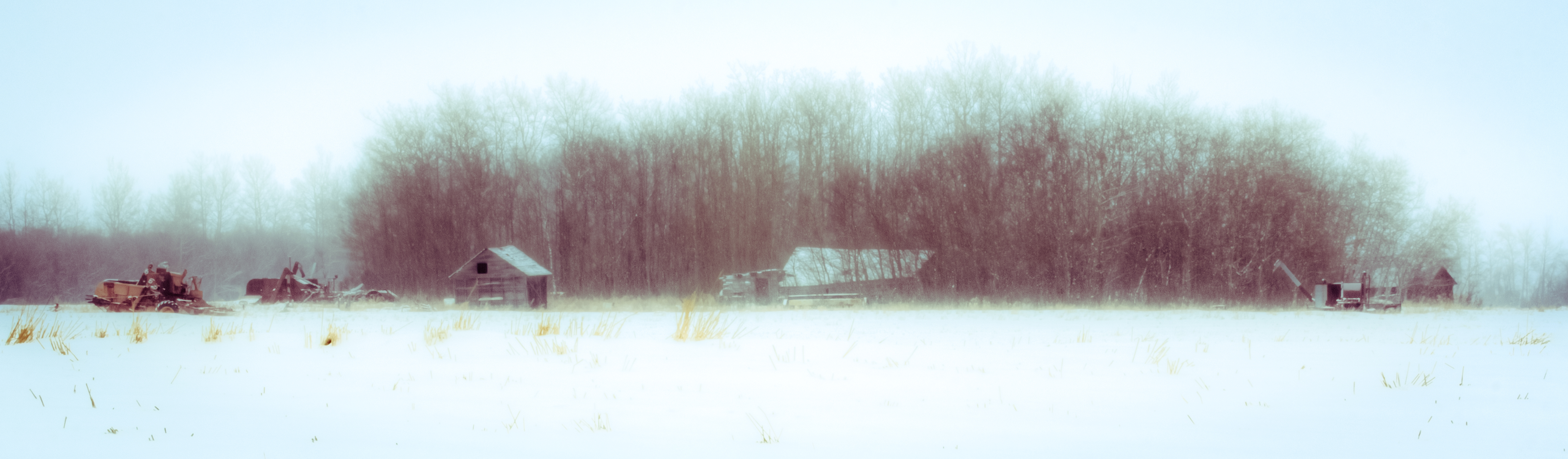
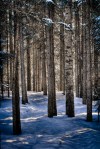
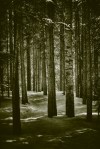
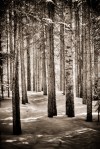
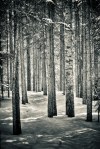


-23C, Leaning North

Best Practices - Photography, Canon 60D, Canon 70-200 mm 2.8 IS L Series Lens, Canon Camera, Canon Lens, Canon Live View, High Dynamic Range (HDR), Light Intensity, Photoblog Intention, Project 365 - Photo-a-day, Season, Still Life, Winter

Saturday – a new treasure of a car, a 2006 Nissan Altima with 35000 km, a vehicle barely finished being broken in, a definite upgrade from my 2000 GMC half-ton, a vehicle that is clean, well maintained and somewhat regal. The opportunity was there to test out the vehicle and to use the day to travel and to look around at the world through my camera lens. The choice leaned heavily toward going south to the Dunvegan Bridge and Grande Prairie; undiscovered landscapes in and around Peace River were to be considered. The choice could also lean into an eastward drive to Fort Vermilion and La Crete; but, I had been in La Crete twice in the previous month.  The choice could also bend westward to Rainbow Lake and Chateh; but, doing so would really require truck or skidoo. Early in the morning, as I steered the Altima toward the highway … the choice became … north.

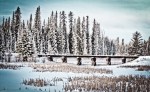
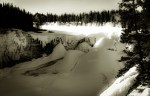
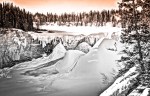
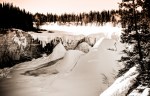
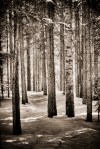
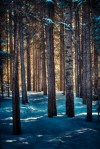
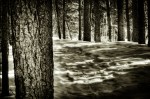
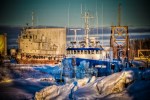
From High Level, Alberta to Enterprise and then Hay River in the Northwest Territories has you using one highway, highway 35 in Alberta which becomes highway 1 in the Northwest Territories, their route south to Edmonton. On Saturday, I made the -23C drive from High Level to Hay River and back stopping wherever my camera lens found interesting opportunities for image capture. On the Alberta side of the drive, a train trestle on the highway’s west side was the first image. A quarter of an hour later, I arrived at Steen River where a cabin along ancestral land of a Dene Tha’ trap line was the next image. Another hour passed, looking right, left, forward and back into the landscape along the road; often I turned the car around to revisit an area and to find photographs. I got to Alexandra Falls and clouds broke to reveal sun shining into trees, onto the highway and onto the Alexandra Falls. Midday’s light was bright and harsh, but for photographs along my ninety minute walk along a snow trampled path in forest atop the west side of the Hay River gorge below the falls; the walk to me from the first falls lookout to the second and third lookouts. Early afternoon found me in Hay River scouting out potential shots for later. After a bite to eat, in late afternoon the sun worked its way into sunset;  several colourful photographs became possible – Buffalo Air’s DC-3s at the Hay River Airport, ships frozen in ice in the west channel below the Great Slave Lake and then photos at the Northern Transportation Company Limited (NTCL) shipyard. The day was colourful and cold, but a good opportunity to see winter’s north by day – one of my never dones.

Listening to – what’s been interesting in the past few days is to listen to CDs; where my 2000 GMC half-ton had a cassette deck and am/fm stereo, the Altima has a CD player.  And, instead of listening to satellite radio which would require some hooking up, I’ve opted to listen to full albums on CD, a significant change from iPod playlists and satellite radio.  Literally, there have been CDs I haven’t referred back to in more than a decade.  Today’s listening has been to a Brian Houston album Mea Culpa and the songs standing out are Hard Man, Dancing with You and Standing Here.  I’ve thought of these songs while thinking of another Brian Houston song – We Don’t Need Religion … a good enlightening tune.

Quotes to Inspire – (1)“There are no rules for good photographs, there are only good photographs.” – Ansel Adams; (2) “I take photographs with love, so I try to make them art objects. But I make them for myself first and foremost – that is important.” – Jacque-Henri Lartique

Past Old to Abundant New

Canon 60D, Canon 70-200 mm 2.8 IS L Series Lens, Canon Camera, Canon Live View, Farm, Farmhouse, High Dynamic Range (HDR), Home, Homestead, Photography & Conceptualizing Beauty, Project 365 - Photo-a-day, Still Life, Winter

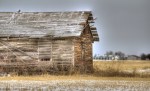
A homestead, a memory anchor, reminds of former times; its past informs our present.  Any of us can look at what is, what we now have and what we now do from the perspective of what was, what we haven’t had and what used to be done.  With realization, shift and tweak the historical becomes present. One attribute associated with progress is that current effort expended in the practice of living is reduced from former effort yielding smaller result. Transition to better practice comes through good understanding of the past. Such learning is usually associated with overcoming mistakes as well as obstacles. John O’Donohue, a former priest, talks of this process in conversion. For him, one’s walk is only possible by being faithful to one’s mistakes, those points of learning that forward you in your walk.

Similar practice is found in jazz as musicians work to add variation to melody and theme. They hear what works. They hear what does not work. While what does not work, the dissonant note or chord, points to what does work, often jazz players incorporate dissonance into music’s landscape; dissonance is heard and grappled with, creating yearning toward primary melody. The variation becomes one among many that takes the listener’s ear through landscape of the piece returning to primary melody alone.  Jacque Loussier works skillfully with Satie’s Gymnopedies Gnossiennes in creating such variations. Dave Brubeck does the same in all of his work; reminiscence here is drawn to those Saturday nights with my father working through Brubeck on his Heintzman grand piano in vertical form.  Songs included Blue Rondo a la Turk, Bru’s Boogie Woogie and Take Five, all the masterful, ingenious work of Dave Brubeck.
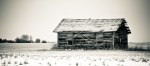
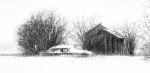
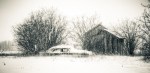
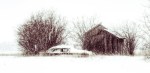
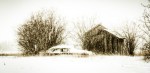
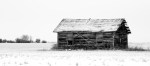
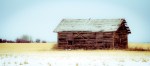
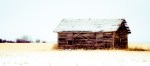
What was and what is, what works and what hasn’t are outcomes found in a Life richly lived.  Mistakes are a part of life; the poignant thing, here, is to let mistakes remain at play within us and to let them inform next action.  Here, in today’s photograph, a third rendering of the Donnelly homestead juxtaposes old homestead against abundant farm operation. I hadn’t thought of it until today, that in the visual memorial that this homestead is, it is in itself a wisdom text, something with story that informs us presently and it does so in the same way a photograph’s narrative will (if we let it).

Listening to – From Don Henley’s Inside Job songs standing out are Annabel, Inside Job, Goodbye to a River (in which he seems to forecast the recession) and For My Wedding; Jesse Cook has been at play with Vertigo, Red and Byzantium Underground from his album Vertigo; as well, Martyn Joseph’s live album, Don’t Talk about Love, has been on my mind with songs like Liberal Backslider, The Good in Me is Dead and Have an Angel Walk with Her.

Quote to Inspire – “For me the printing process is part of the magic of photography. It’s that magic that can be exciting, disappointing, rewarding and frustrating all in the same few moments in the darkroom.” – John Sexton

Collected, Not Yet Discarded – Other Photographs from the Week

Best Practices - Photography, Canon 60D, Canon 70-200 mm 2.8 IS L Series Lens, Canon Camera, Canon Lens, Canon Live View, Combine (Farming), Farm, Farmhouse, Home, Homestead, Light Intensity, Photoblog Intention, Photography & Conceptualizing Beauty, Project 365 - Photo-a-day, Season, Still Life, Vehicle, Vehicle Restoration, Winter

Farms, farm buildings, farm equipment and the occasional treasure of a rusting relic have surfaced within this week’s compiling of photographs.  Rather than let them fall into the discard pile it may be good to give them their due, cluster them into photo gallery format and allow you a look at second, third and even seventh choices.  Below, because this week’s photographs have dealt with farming images, I’m posting the lyrics to Murray MacLauchlan’s Farmer’s Song, a treat to sing and a song that you can find yourself singing with others also around a campfire. Lyrics as found on Lets Sing It http://artists.letssingit.com/murray-mclauchlin-lyrics-farmers-song-2s98rgh#ixzz1nMbsXNcE

Farmer’s Song – Murray McLauchlan

Re-released 9 October 2007 in Songs from the Street: The Best of Murray McLauchlan

Dusty old farmer out working your fields

Hanging down over your tractor wheels

The sun beatin’ down turns the red paint to orange

And rusty old patches of steel

There’s no farmer songs on that car radio

Just cowboys, truck drivers and pain

Well this is my way to say thanks for the meal

And I hope there’s no shortage of rain


Straw hats and old dirty hankies

 Moppin’ a face like a shoe

Thanks for the meal here’s a song that is real

 From a kid from the city to you


The combines gang up, take most of the bread

Things just ain’t like they used to be

Though your kids are out after the American dream

And they’re workin in big factories

Now If I come on by, when you’re out in the sun

Can I wave at you just like a friend

 These days when everyone’s taking so much

There’s somebody giving back in


Straw hats and old dirty hankies

Moppin’ a face like a shoe

Thanks for the meal here’s a song that is real

From a kid from the city to you

Quote to Inspire – “Light glorifies everything. It transforms and ennobles the most commonplace and ordinary subjects. The object is nothing, light is everything.” – Leonard Misone

Listening to – She Walks on Roses by Bill Mallonee & Vigilantes of Love from Audible Sigh, then Mercy of the Fallen by Dar Williams from Beauty of the Rain and then finally Red Clay Halo by Gillian Welch from Time the Revelator.

That Old A&W Shirt and A World Fed

Best Practices - Photography, Canon 60D, Canon 70-200 mm 2.8 IS L Series Lens, Canon Camera, Canon Lens, Canon Live View, Combine (Farming), Farm, Farmhouse, High Dynamic Range (HDR), Home, Light Intensity, Photoblog Intention, Project 365 - Photo-a-day, Winter

Farmhouse, Grain Bins & Combines

Curiosity surrounds this image.  A derelict farmhouse is at geometric center point for farm buildings and as many as four combines from the fifties and sixties – three on the left (one is hidden behind the darker one) and one on the right, in front of the grain bin.  The buildings have not been burnt off the land and the combines no longer work; again, there’s an air of abandonment as well as reverence for what was a family’s starting point.

My cousin, a farmer, in his first decade of marriage would occasionally wear an A&W shirt from its nation-wide hamburger restaurant chain, something likely found and bought from a Goodwill or Value Village or Thrift Store back in the eighties. I’m not sure if his wearing of this shirt was youthful cynicism or if he was making light of the fact that as a farmer he fed the world – all farmers do this … but role/position in what one does for work as farmer sometimes blurs/shifts to the background what farmers accomplish on a global scale. I don’t know if I’ve ever thought about how many people all his grain and all his cattle could keep alive in one year; I wonder if he has?

My cousin and his wife ran a mixed farming operation in partnership with his father and his mother in Rimbey, Alberta, an area of Alberta situated in a golden triangle blessed with the right combination of rain, sun and cloud for their grain crops, an area of the world that supported a sizeable Hereford cattle operation, as well. The Blindman River runs through their property and while summer was an extremely busy season, my cousin likely looked forward to days when friends and relations would visit, allowing him to break away from heavy or mundane routines. On our visits, we’d go back into the wooded ravine and talk. There’d be good-hearted, entertaining, teasing back and forth as we investigated the currency of each other’s lives in playful interrogation.  A good amount of bull-s**t would extend exaggeration into all that our stories could become. On my cousin’s farm, I watched him grow from a boy building model cars, to a youth with a grain elevator job who was dating (… and owning a black, two-door, 1966 Chevelle), to a young spouse, into a farming partner, to a father, and then two decades later into an innovative entrepreneur with patents for frost-free nose pumps.

In recent years I’ve been struck by how close to the land they may actually have been living and how much their success or failure as farmers depended on their ability to rely upon and support their neighbors; help offered and help received is/was really an investment in community and in each other. I am impressed by the humility they exercised in allowing themselves the help offered by neighbors who took care of them and saw them more as family than neighbors. Likewise I am impressed by the care they showed not only to our family, but towards others by putting something positive in their lives when they needed it … even if this was only done by way of good-hearted humour and teasing during an evening board game.

Stories take me back to this era of time when farms such as this one captured in this image were starting points for Canadian families.  One set of Canadian stories about farm-life were W.O. Mitchell’s Jake and the Kid Stories.  The other story that opened out the time toward moving into the fifties was John Grisham’s A Painted House. The farm I know best, though, is that farm my cousin grew up on; and, then I come back to this image and the questions I have about leaving it in this state – it must be memorial, something that draws memory back to what was and who they were that made things happen, feeding the world.

As I’ve searched through my music for songs associated with Canada and with farms I’ve run into Murray McLauchlan, a singer and songwriter whose album I purchased would have been one of the first three albums I ever purchased.  The one that would have pulled my ear to the radio would have been Hard Rock Town, a song I tried to understand in terms of narrative in grade 8, 9 or 10; the other would have been Farmer’s Song, a song that could be sung around a campfire in unison, a song that could be sung in a prairie tavern when everyone’s collected on a Friday or Saturday night.

Listening to – Murray McLauchlan’s Hard Rock Town from his Songs from the Street album and Farmer’s Song, done I think with Murray McLauchlan et al in Lunch at Allen’s Catch the Moon album. Finally, tonight I purchased Ryan Adam’s Chains of Love from his Ashes & Fire album.

Quotes to Inspire – (1) “A photographer without a magazine behind him is like a farmer without fields.” – Norman Parkinson; (2) “Beauty can be seen in all things, seeing and composing the beauty is what separates the snapshot from the photograph.” – Matt Hardy

Parked – Not On the Road

Best Practices - Photography, Canon 60D, Canon Camera, Canon Lens, Canon Live View, Farm, High Dynamic Range (HDR), Photoblog Intention, Photography & Conceptualizing Beauty, Project 365 - Photo-a-day, Vehicle, Vehicle Restoration, Winter

Chevrolet - Parked, Not on the Road

A parked mid-fifties, Chevrolet four door sedan from 1955 or 1956, a Chevrolet that would have been ‘on the road’ in an era Jack Kerouac writes about in his novel with the same title – On the Road.

In the novel, a young World War II veteran, Sal Paradise, newly based in New York embarks on a career as writer, a writer in search of experience just at a time when America wrestles with new identity as world power and war victor. In one sense the book documents the restless, youthful spirit of a nation discovering identity as it moves into an era of prime economic stability.

Key among the era’s cultural entities is the independence of movement brought about by owning and driving a car. A car allows you to see the world.  And, there’s always a car going by; so, if you’ve had a mishap with yours you can thumb a ride from someone else.  Or, you can take a bus.  Again, there’s the idea of a vehicle being something where all riding within it, all have their eyes fixed on the road ahead.  Perhaps that’s part of what Kerouac aims at with message in all the travel – he might be pointing to the road ahead for the nation.  Perhaps the car and occupants image is also about riding along with shared ideologies and intentions … but this is extrapolation.

Needless to say, a variety of vehicles – cars and trucks – move Sal Paradise and his cohorts across the nation from New York to San Francisco and back again … two or three times. A friend with a car is the force initiating Sal into a road trip.  There’s the within vehicle narrative – what’s going on – and there is the travelogue narrative of Sal making sense of the America he finds along the way.  By the end of the book Sal has ridden in and driven many vehicles … he’s been more a passenger than driver, though – one able to observe the goings on rather than being the driver compelled to get where he’s going.  Perhaps there’s something there about stances that can be taken in living life.

Jon Foreman of Switchfoot got me to read Kerouac’s On the Road because of a section of stream of consciousness writing embedded into the novel’s narrative – the ramble and rant of thought-life shared, somewhat soliloquy, somewhat monologue, expression utilizing meter and curious placement of rhyme usually halting abruptly with quirky insight into the issue at-hand – Life and living. Here’s the quote Jon excerpted and placed within a Switchfoot concert that led me to consider a serious read of On the Road: “… the only people for me are the mad ones, the ones who are mad to live, mad to talk, mad to be saved, desirous of everything at the same time, the ones who never yawn or say a commonplace thing, but burn, burn, burn like fabulous yellow roman candles exploding like spiders across the stars and in the middle you see the blue centerlight pop and everybody goes ‘Awww!’” ― Jack Kerouac, On the Road

Listening to – Lucinda William’s Can’t Let Go from Car Wheels on a Gravel Road, The White Stripes’ 300 M.P.H. Torrential Outpour Blues (Live) from Under Great White Northern Lights (Live); it’s also been Last Thoughts on Woody Guthrie (Live) offered by Bob Dylan from The Bootleg Series Vols. 1-3 (Rare and Unreleased) 1961-1991.

Quotes to Inspire – (1) “Anything more than 500 yards from the car just isn’t photogenic.” – Edward Weston; (2) “You don’t take a photograph. You ask, quietly, to borrow it.” – Pentax Advertisement.

Painterly Farm Shed – Canada’s

Best Practices - Photography, Canon 60D, Canon Camera, Canon Lens, Farm, High Dynamic Range (HDR), Light Intensity, Photoblog Intention, Photography & Conceptualizing Beauty, Project 365 - Photo-a-day, Winter

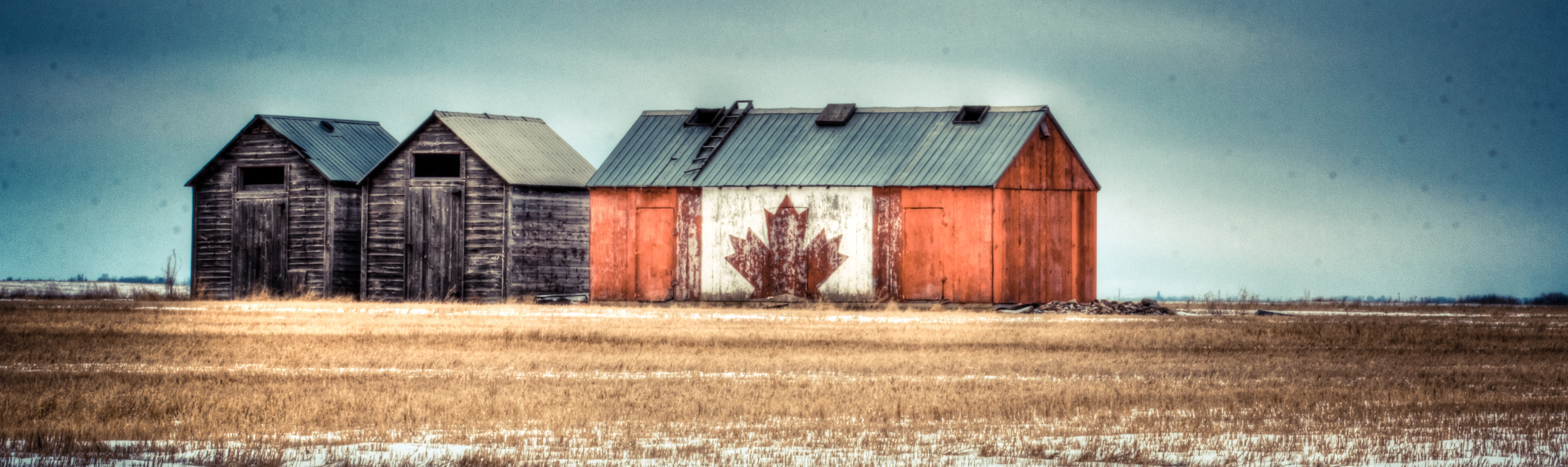
Canada Flag - Shed

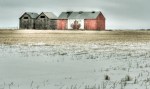
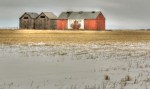
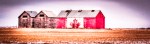
On the drive northward to Peace River from Edmonton, a few kilometres past the turnoff east to MacLennan and High Prairie you’ll find these grain bins and shed on the west side of the road, something unexpected, something to cause you to look into your surroundings, something that could perhaps have been a Canada day project – painting a farm shed with the Canadian flag … for all to see. The shed and grain bins serve as landmark along this road, visually positioning people who travel on it in terms of hours north towards Peace River and minutes before you’ll reach the valley of the Little Smoky River as you head south toward Valleyview.

This image is a High Dynamic Range (HDR) shot created using the camera’s Automatic Exposure Bracketing to fuse three exposures (one darker, one average and one lighter image) of the same shot together into a single image; the intent in creating the shot is to produce greater accuracy and to expose a broader range of what the eye sees naturally in terms of light and shadow. The image is toned mapped, yielding a moody, painterly feel to its rendering. Beyond this, the image seems to emphasize true geometric angles and does not really show much for backdrop but the sky  … it sort of seems like you’re on top of the world … but that’s a few miles north, up where I live.

Listening to – Coming Down from Martyn Joseph’s Vegas album; there’s been U2’s Fez – Being Born and David Gray’s We’re Not Right from the White Ladder album.  Then it’s been Minor Swing from the Chocolat soundtrack.

Quotes to Inspire – (1) “I can look at a fine art photograph and sometimes I can hear music.” – Ansel Adams.  (2) “When people ask what equipment I use – I tell them, my eyes.” – Anonymous.

Donnelly Homestead – Part 2

Best Practices - Photography, Canon 60D, Canon Camera, Canon Lens, Canon Live View, High Dynamic Range (HDR), Home, Homestead, Light Intensity, Photoblog Intention, Photography & Conceptualizing Beauty, Project 365 - Photo-a-day, Still Life, Winter

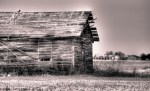
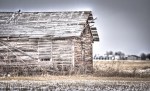
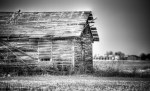
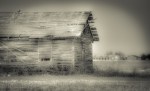
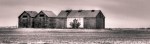
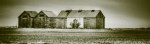
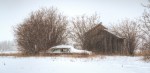
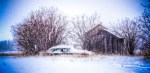
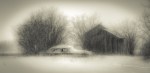
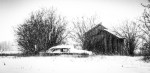
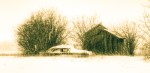
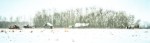
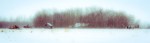
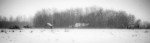
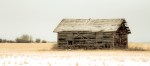
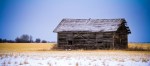
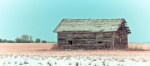
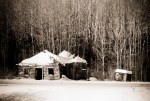
The Donnelly homestead is subject for these photographs, tonight. It’s the second photograph of the homestead I’ve posted in this blog.  The first photograph seemed to polarize reaction from bloggers.  Those viewing the photograph favourably were perhaps familiar with the homestead as landmark within a region they’ve frequented or travelled through; or, perhaps they could relate to winter’s brooding darkness. For others, the black and white image of the building and its textures were very dark and brought forth rejection of the image as something lacking the light and colour associated with Life and Living.

In taking the photograph, again, I’m on a return drive from Edmonton, my time more my own than time with immediate responsibilities and it allowed looking more at what could happen with this photograph. Where January’s photograph is taken near dusk, at day’s end, this photograph has more of spring’s growing light and is shot earlier in the day … about 3:00 p.m.; the light allows for more colour and more possibility with the well-lit subject. Taking the photograph is also about learning a new lens, a Canon 70-200 mm IS Mk II L series lens and using it with live view to sharpen focus (1/3 into the frame … nodal point) and to play with what could be accomplished with depth of field. Shooting close to the ground with this zoom lens compressed distance between the homestead and the trees behind it, a kilometre away. A day later, the fun has been working with different renderings of the photograph. Each rendering of the photograph evokes different response – seeing what’s possible has been some of the fun. Each photograph presented is something I’d be happy to print; yet, there are two that are favourites.

What about you?  Which rendering of this Donnelly homestead appeals to you or attracts you to it?  How would you talk about what is attracting you within the image?

Quotes to Inspire – (1) “In my photography, color and composition are inseparable. I see in color.” – William Albert Allard; (2) “When you photograph people in color, you photograph their clothes. But when you photograph people in Black and white, you photograph their souls!” ― Ted Grant

Listening to – U2’s Get on Your Boots (Justice Remix) from Artificial Horizon, Coldplay’s Cemeteries of London from Viva La Vida, Kings of Leon’s Crawl (first recommended by Nicole Kidman in an iTunes playlist … something she listened to on her daily drive out to the movie set of Australia); then it’s been All I Need from Radiohead’s In Rainbows album.

Success and All Concerned

Best Practices - Photography, Canon 60D, Canon Camera, Canon Lens, Canon Live View, Project 365 - Photo-a-day, Vehicle, Vehicle Restoration, Winter

“Coming together is a beginning. Staying together is progress.  Working together is success.” Leaders use this quote often to enhance organizational teamwork.  Counselors use it to bolster and sustain forward movement among people in relationships who stumble and tumble. The words derive from Henry Ford and their analogy to the work of Life quite likely is taken from first automobiles produced on an assembly line. These words describe that dynamic of steady, determined, hope-directed forward movement towards goals through trial and error and improved performance. The statement articulates the manner of work involved in achieving a productive end through full investment into each learning curve we encounter. We work to understand what’s to be done and how to improve. We act, we work and we utilize feedback about current progress, tweaking action toward better, future performance.

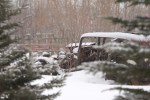
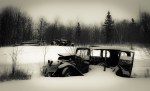
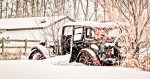
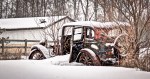
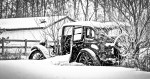
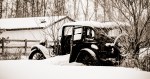
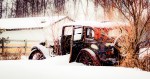
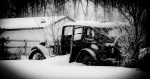
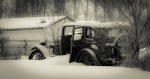
Photography has its learning curves, too.  Good photography is about you learning subject and context and about you working to see them well through your camera’s lens.  Working together is about you and the camera, it’s about you and the subject, and it’s about you and your environment. The vehicle that serves as subject to these photographs is a 1930’s rusting relic, a sedan with wooden spokes that could be a Chevrolet or a Ford or another make. I saw it last Wednesday in my return journey to Sunrise Beach, near Onoway, Alberta, a trip I was making with a friend to investigate the integrity of a second-hand 2000 GMC Yukon as a possible vehicle to replace my written-off 2000 GMC Sierra.

In photography, it may seem at first glance that it is appropriate to point the camera at anything that is in front of you. However, what is also at play is context and environment. The reality is that context and environment are associated with being property and with ownership. Beyond this, context and environment have intention; people identify what each are to be used for. Here, you’d assume that a vehicle put out for public display would not have any issues associated with it if one were to photograph it. Well, in photographing anyone’s property, there’s the matter of what will the photograph be used for and in this case there was perhaps something more akin to rural crime watch being what was at play, something that should have been anticipated. And, the curious owner who questioned me about my actions was both gracious and concerned. In this instance, I knew better … I could have lessened anxieties and awkwardness by introducing myself, stating my photographic intention and asking permission to photograph the vehicle. Working together, in this best practice for photographers and as one whose been influenced by a lineage of photographers would have had and will now have me working proactively to avoid discomfort and uncertainty for others and myself and work toward ensuring good, productive photographic outcomes … even to the point of accepting the possibility of ‘no’ being an answer to my request to photograph a subject. Proactively seeing things through well for all concerned is a key best practice in photography.  This may see me creating a business card that will contain the assurance of contact information for people I deal with.  It may even be worth going further and providing them with photographs of the subject as thank you or to create a calendar with my photographs (as bona fide) for this aspect of public relations and good business practice.

Quotes to Inspire – (1) “A definition of a professional photographer: A ‘pro’ NEVER shows anybody the mistakes.” – Anonymous; (2) “The progress of a photographer can often be marked by the accumulated number of mistakes he or she had made along the way.” – Catherine Jo Morgan (3) “Don’t be stupid and remember where you come from.” – Fr. Tony Ricard, NETCA Teacher Convention 2012

Listening to – Patty Griffin’s Long Ride Home, a song about losing a loved-one from the music-filled movie, Elizabethtown, a song followed by You Can’t Hurry Love, by The Concretes from the same movie soundtrack.

Vase-lens

Best Practices - Photography, Canon 50mm, Canon 50mm Lens, Canon 60D, Canon Camera, Canon Live View, High Dynamic Range (HDR), Night, Photography & Conceptualizing Beauty, Prime Lens, Project 365 - Photo-a-day, Still Life

A vase and a serving dish, both glass, both transparent yet holding colour, both with shape and form and both reflecting light are subjects in the images presented here. Both glass structures are lenses, the vase, a lens revealing entire beauty of the flower held, the serving dish, a lens to the manna that soon will be eaten. The polished surface’s shape and form reflects light. So too does the interior of the glass.  There’s that place where the glass in being shaped curves or twists receiving form. From that point within there’s reflection, a glint of light from within shining back. Analogy extends forward … what structures hold us that allow us to be seen? Would this be a home?  Would this be a marriage? A vase holds the still-life flower, a living thing of beauty while beautiful. Moving past prime, dying, it is discarded. For us, we each have a rich, subtle life, one that few others really know well.  Is friendship the vase-lens structure allowing for revelation of one’s subtle life? Something in this analogy is truth my mother understood.  Her memory via her paintings prods me forward toward unraveling it.

Listening to Bruce Springsteen from the Tunnel of Love album – One Step Up; Bryan Ferry sings Just Like Tom Thumb’s Blues from Dylanesque.  Amiina from the album Kurr provides a tonal, music box sound in Rugla.  Rugla reminds of another ambient mix by Sigur Ros from the Takk album – Glosoli.  Later, I’m listening to Last Thoughts on Woody Guthrie, thoughts Bob Dylan offers – The Bootleg Series, Vols. 1-3 (Rare and Unreleased) 1961-1991.

Quote to Inspire – “Photography is only intuition, a perpetual interrogation – everything except a stage set.” – Henri Cartier-Bresson – Photography Year 1975 – Life Library of Photography, page: 216

Alberta Fissure

Canon 60D, Canon Camera, Fall, Lookback Photos - One Year Ago, Project 365 - Photo-a-day, Still Life

The Peace Valley at Dunvegan

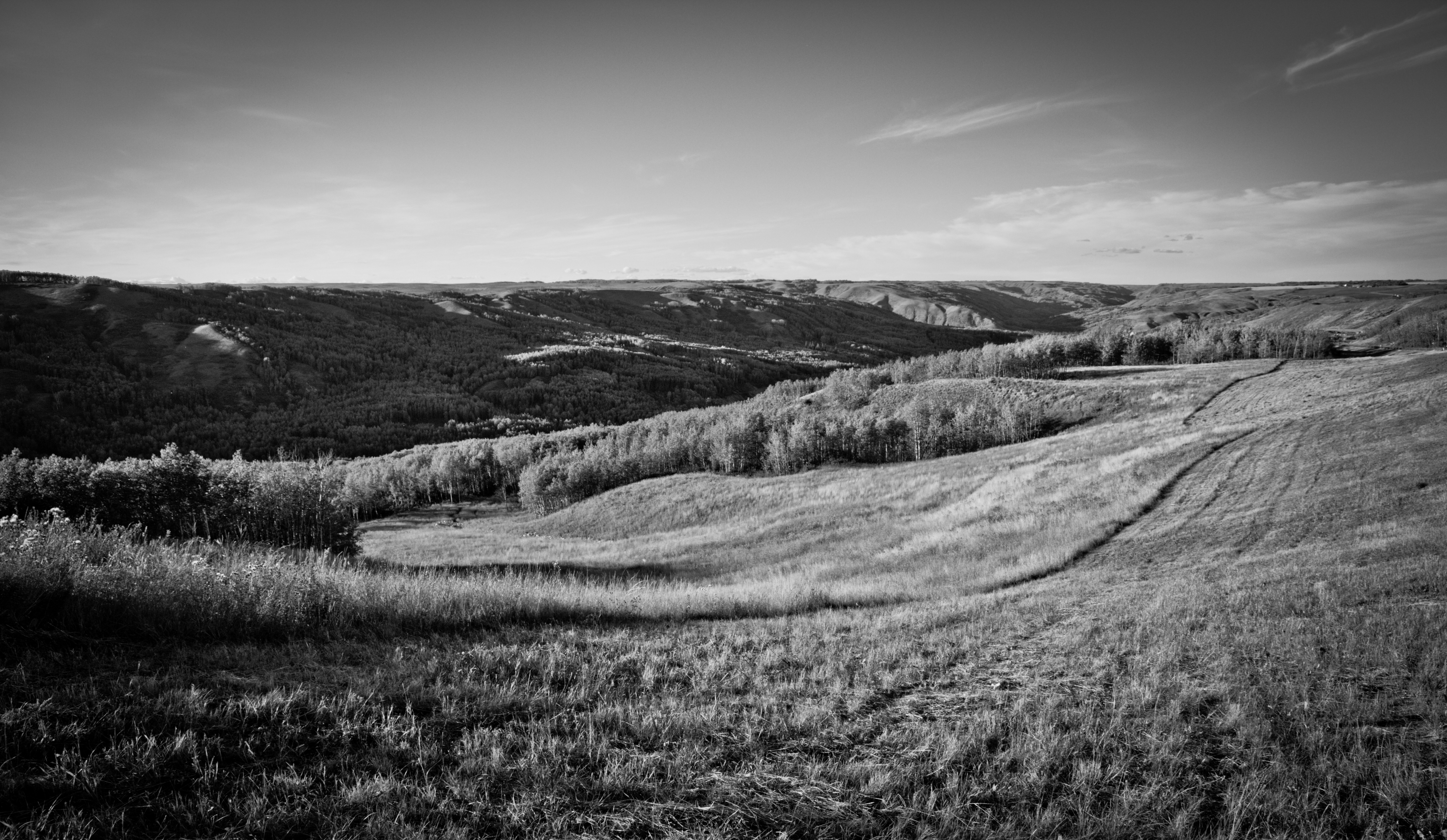
At most points in the geography of Alberta the Peace River is at least one kilometre across.  At various points it will broaden out allowing for islands and sand dunes. The first time I saw what the Peace River was about what I noticed was something this photograph conveys, the river has cut a fissure into the land through time and while the river is most times one kilometre across, the distance from level land on top of the river valley to level land on the top of the other side of the river valley is greater, spanning as much as four and five kilometres. The other thing noticed is that it takes about two kilometres of gradual descent in a vehicle to reach the river from the valley’s crest. This photograph is taken at the start of the descent toward Dunvegan and the Dunvegan suspension bridge looking north.  It’s late on a September Sunday and shadows creep from the west extending eastwards.

Listening to Bill Mallonee & the Vigilantes of Love sing Resplendent from their Audible Sigh album, a message about the nature of resilience borrowing from the narrative of the dustbowl.

Quote to Inspire – “I hate cameras.  They are so much more sure than I am about everything.” – John Steinbeck