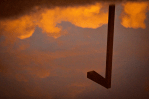
18 June 2012 – 11:30 p.m.. The land of the midnight sun still lights the world in half-light in the moments before it crosses the horizon to create dusk. West – a tumultuous sky billows its clouds in heavy, obscure shapes poised to wet the earth with only a nudge. East – there’s greater interplay and drama between dark, heavy shapes and bright, bread-white clouds catching sun’s light. It’s day’s end as I gather these photographs remnants of a beautiful day. There’s a checkmark shape of lamp posts caught in parking lot puddle mirrors – too many hours being a teacher today.
Listening to – Black Rebel Motorcycle Club’s In Like a Rose, The Black Keys When the Lights Go Out, Radiohead’s Go to Sleep, Ryan Adams’ Starting to Hurtand Pete Yorn’s Pass Me By.
Quote to Inspire – “Which of my photographs is my favourite? The one I’m going to take tomorrow.” – Imogen Cunningham
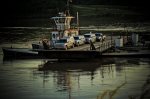
Tompkins’ Landing Ferry – Tompkins’ Landing, Alberta
Aboard the Tompkins’ Landing Ferry 2 – Tompkins’ Landing, Alberta
Aboard the Tompkins’ Landing Ferry – Tompkins’ Landing, Alberta
Sunset at Midpoint of the Peace River – Tompkins’ Landing, Alberta
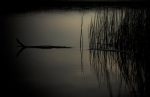
Footner Lake 1, Alberta
Footner Lake 2, Alberta
Footner Lake 3, Alberta
Footner Lake 4, Alberta
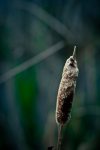
Cattails 5 – Footner Lake, Alberta
Footner Lake 5, Alberta
Footner Lake 6, Alberta
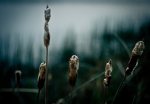
Cattail 1 – Footner Lake, Alberta
Cattail 2 – Footner Lake, Alberta
Cattail 3 – Footner Lake, Alberta
Cattail 4 – Footner Lake, Alberta
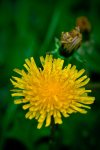
Dandelions – Footner Lake, Alberta
Dandelions 2 – Footner Lake, Alberta
Dandelions 3 – Footner Lake, Alberta
Dandelions 4 – Footner Lake, Alberta
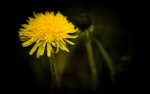
Dandelion – Footner Lake, Alberta
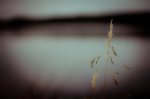
Grass & Flora – Footner Lake, Alberta
Flora – Footner Lake, Alberta
Flora 2 – Footner Lake, Alberta
Elektra Air Tankers – High Level Airport, High Level, Alberta
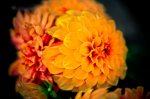
Flower – High Level, Alberta
Forest grows dangerously dry with summer heat. The matter of our region being a tinderbox is an expression used to describe this state in which forest can become prey to lightning strike and neglect by people working with fire. In this setting, rain becomes a welcome visitor calming and cooling our world. Photographically rain serves to reflect the world in unusual ways – doubling what is seen and placing the doubled image in unusual contexts. At night, it is the rain’s reflection of light on surfaces that draws interest.
Life is busy just now. Students in their final year of education anticipate graduation and ceremony and future departure from friends, family and that place that’s been home for them through so many years. Angst is there. Worry is there. Disillusionment about what the world holds is about to occur in more broad and more true strokes than these students have ever encountered before. And, time pushes them and us forward and through different thresholds. It’s totally interesting that the term threshold comes from the act of threshing; the threshold was the place where the act of separating husk from seed occurred. Threshold is that place where former and newer state are in close proximity – what was and what now is. Action is that other important ingredient – the lifting, colliding and splitting, all are percussive, energetic acts that in time yield the seed from the husk that’s held it. Winnowing is the other term, here – the separating and sorting of husk (the now dead, former shell) and seed (the new life holding element). The seed is ready for further use. How will it be used?
The photographs presented here are culled from the last week. There’s the green of Buffalo Head Prairie; there’s the woods between La Crete and Blue Hills. There’s the Peace River and the Tompkins’ Landing Ferry. There’s rain slicked streets of High Level and there’s images from Footner Lake. There’s even an image of a flower from a flower bed on our front lawn.
Listening to – U2’s Mysterious Ways, Coldplay’s God Put a Smile Upon Your Face, David Gray’s Babylon and Radiohead’s High and Dry.
Quote to Inspire – “I didn’t want to tell the tree or weed what it was. I wanted it to tell me something and through me express its meaning in nature.” – Wynn Bullock
Interchangeable, Early Sixties GMC Half Tons – Fairview, Alberta
Dunvegan River Bank – Dunvegan, Alberta
Older Barn – Fairview, Alberta
Canada Geese Feeding at Sundown – Fairview, Alberta
Tonight has been an evening of yardio – yard-work and cardio effort. Our lawn is now dethatched, the old grass bagged (and ready for garbage day) and our lawn is fertilized and being watered as I write. For the first time this spring I have sudsed-up our Nissan Altima – I’ve washed it by hand, with brushes and sprayer, first with Palmolive soap to take the dirt off and then with Mother’s Vehicle soap. The Altima is clean. But, its six-year old exterior is in need of detailing – a good go-round with a good glazing polish, buffer and various amounts of elbow grease. If I’d had some Autoglym Bodywork Shampoo the wash would have produced a glossy sheen. My cabinet in the garage holds two things that will brighten this vehicle – Autoglym Super Resin polish and Autoglym High Definition paste wax. Not only will the paint gleam but the relief in the vehicle’s shape will be enhanced optically, in some cases to a degree of optical illusion. The waxing will have to wait until summer break and the chore will become a way to settle towards summer’s calm following a hectic school year. The chore, the time invested and the dazzling outcome are things I look forward to as summer projects.
Most photographs presented here are ones taken in the final hour of sunlight last Saturday night; it’s about half past ten heading to eleven o’clock. The river bank at Dunvegan features shadow play with shadows lengthening and darkening to enhance the rolling mounds of hillage above the Peace River. In two photos rusting relics are stored in public view. The three early sixties GMC half-tons seem ready to share parts in order to cluster into one working whole. The ready interchangeability of parts between the three trucks points to a need to gather them all rather than only one. Canada Geese move actively at sunset in a farmer’s field feeding. And, a disused barn catches the light of sunset … a dusky day’s end in Alberta’s late spring.
Listening to – J J Heller’s Your Hands, Missy Higgins’ Warm Whispers, Coldplay’s See You Soon, David Gray’s Kathleen, Jem singing Maybe I’m Amazed, Ray LaMontagne’s I Still Care for You and all the way through to John Denver’s Thank God I’m a Country Boy. The playlist rounds out to the Counting Crows’ Raining in Baltimore and David Gray’s Jackdaw.
Quote to Inspire – “Beauty can be seen in all things, seeing and composing the beauty is what separates the snapshot from the photograph.” – Matt Hardy
I have an uncle, my Dad’s younger brother, who was in his career a beloved literature professor at Acadia University in Wolfville, Nova Scotia. As a professor he was well-liked by his students and he knew what students were about and was able to direct them profitably and constructively in their academic careers. At lunchtimes in Edmonton growing up, Dad would read us letters in which his brother would own to his chagrin in the matter of occasionally having to borrow cigarettes from his students. His students esteemed him enough to forego this trespass – he got along with his students that well. What’s brought him to mind tonight is that he was someone who when sitting still at a task for too long got himself up out of his chair or away from his desk and out into his car and go for an hour’s drive and have a look about at his world; the last car of his that I road in was an early eighties Volvo sedan that he had had repainted a metallic green. He loved a drive as did his mother (my grandmother), his wife and daughter. A good drive was always a means to unwind from a day pressing obligations to capacity; he’d arrive back and he would have shifted his state … the world was better for having gone for a drive.
Yesterday, at day’s end I found that I had been sitting at computers, at school and at home, for more than twelve hours combined. And, I found that there was still more to do, more obligations to students and staff and their various undertakings … the work of the work was to stay at it and complete it. But, I wasn’t being productive, more a body realization than anything else … sitting down and sitting still from my day into my evening was not to be had. I pulled my uncle’s trick, I grabbed my camera bag, tripod, down-filled jacket, gloves and hat, and, I got into my car and steered it east from High Level. Twenty minutes from High Level, yielded the opportunity to photograph Canada geese, cranes, swallows and reflection upon water. The evening also yielded the good fortune of stumbling into a former colleague whose career path has mirrored my own; we probably haven’t chatted meaningfully for about five or six years. In half an hour I heard much about her world – her daughters, her husband and their next steps. I finished out the evening with another hour of photography and returned home.
Listening to – the Steve Miller Band’s Rock’n Me, Take the Money and Run and Mercury Blues; Murray McLauchlan’s Farmer’s Song and Hard Rock Town have featured as has Ryan Adams’ Chains of Love. The morning’s walk featured U2’s Magnificent, Eddie Vedder’s Hard Sun among other songs.
Quote to Inspire – “I treat the photograph as a work of great complexity in which you can find the drama. Add to that a careful composition of landscapes, live photography, the right music and interviews with people, and it becomes a style.” – Ken Burns
Water – within the past week I’ve slipped and nearly tumbled on water that’s oozed and frozen into globs of ice on High Level sidewalks during my morning walks. Water has met with gravitational pull and been transported as precipitation from clouds through a distance of kilometres to earth, sprinkling erratically. Water that’s changed state from snow or ice has in its melting been responsible for transport of dust and dirt from sidewalks to drains and through sewage systems. Water has been the key ingredient in transforming dirt into mud and curiously the removal of soil from our bodies is best accomplished with … water. And, within this photo water that is not in motion becomes mirror, an enigma catching my attention as I’m able to focus through its surface to the detail in my subject, the cattails. The water mirror allows cattails to become foreground to the backdrop of clouds of pink sunset, a feat that would not have been possible without this water mirror.
Listening to – Ray Lamontagne’s I Still Care For You, Ryan Adams’ Come Pick Me Up and David Gray’s Fugitive. The David Gray tune from yesterday that’s stuck in my head is We’re Not Right; the other is Shawn Colvin’s take on We All Fall Down. Today, David Gray’s My Oh My plays out to the end of this post.
Quote to Inspire – “In photography there is a reality so subtle that it becomes more real than reality.” – Alfred Stieglitz
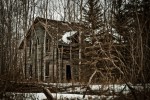
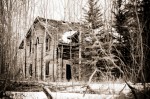
The farming region I knew as a boy is that which lies west of Ponoka, Alberta – land homesteaded and broken by people who received land grants following their participation in the Canadian war effort during the second world war. Perhaps participation in war, an ordeal survived and won as a collective has made this clustering of soldiers who became farmers quite pragmatic with regard to helping each other out, and particularly so in relation to disused items. Word of an item no longer used will make its way around the region and the person who can use that item will connect with its current possessor. Terms will be agreed to, cash or services in kind will trade hands and the item will be put to good use. While I have seen such transaction occur with many smaller things – cars, trucks, tractors and farming equipment – the photograph presented here reminds me that in two instances I have seen houses as big as this one transported to new locations, set on new foundations and made use of.
The photographs draw me back to my childhood as a boy in the sixties and skulking around the old, disused farm house across the way from my aunt and uncle’s home near Rimbey, Alberta. My exploration of the house revealed a wooden basement foundation instead of a foundation made of cement (what I was used to). It also revealed a dirt basement floor and seemed to be used mainly as a cold cellar for canned goods and the like. My cousin and I explored other houses no longer used; they seemed to have been left medias res (in the middle of things). Beds and dressers would be left in rooms. The rooms would usually have painted walls, but in some wallpaper revealed tastes of a former time. Some homes served much like sheds these days where old furniture or clothes that have gone out of fashion can be stored. Some had floors rotted through, the result of annual flooding. Some homes revealed children’s toys of a former time. Exploration always revealed the lives lived within the four walls of the house.
Moving forward – I wonder about the house in the photograph. It is huge. It is well-made. It still retains its structure. The plant growth surrounding the house cannot be more than fifteen years in the growing. So, whoever left it made their departure quite recently in terms of the age of houses. Thinking back to houses I’ve seen moved, I wonder about why similar efforts have not been taken to add new life and new purpose to this farm house. Surely it could have been used a while back as a house to help a young family starting out. And, perhaps more importantly, doing so would have been a part of a farm family’s moving forward and their de-cluttering from what is no longer needed of the past. The curiosity is that there is something that holds this house in its present location … and that’s where its story is.
Listening to Shuttertime with Sid and Mac episode XXI and good discussion on the practices associated with landscape photography; I continue to be impressed by the opinions, persuasion, logic and knowledge these two Edmonton-based, Canon photographers possess. Dave Matthews Band’s Steady As We Go and Dreamgirl, David Gray’s This Year’s Love, Patty Griffin’s Rain, Dar Williams’ The One Who Knows and Mindy Smith’s One More Moment surface as music holding my attention.
Quote to Inspire – “In my view you cannot claim to have seen something until you have photographed it.” – Emile Zola
Distances travelled within Canada’s vast landscape are huge. Travel along its roadways demands commitment to best use of drive time between point of origin and destination so you get where you are going and so you enjoy where you got yourself to. Within this travel predicament kinaesthetic awareness of the road counts as much as visual presentation in terms of road familiarity. Curves, drops, bumps and inclines inform you in your travel along the road. Artists depicting the predicament of Canadian travel often poke fun at vacations enjoyed from a car’s interior as the terrain passes by as much as it is something enjoyed at the destination’s endpoint. A better way to see more of Canada’s landscape is accomplished looking through a camera lens; doing so requires you to stop your vehicle, stow it safely along the roadside, get out of it and interact more substantially with the environment you encounter.
An iconic rendering of Canada’s roadscape is what the image presented here is about. I’ve photographed a portion of the up-and-down incline leading up to Twin Lakes along Alberta’s Highway 35, one hundred and fifty kilometres south from High Level en route toward Edmonton. In distance, the incline covers five kilometres of road surface and rises onto a land mass noted for the temperature change that occurs from bottom of the incline to its crest. In winter a double-digit temperature change can occur and is accompanied by a marked change in weather travelled through. Ascending or descending, driving this incline is a tricky endeavor in winter, something compounded by snow. While one aspect of this image favours the artist’s tongue-in-cheek take on ‘Windshield Time’, the manner in which most Canadians see their Canada rolling past them, the image also recalls lives of former students who as new (and perhaps impatient) drivers were trekking through this bit of terrain on second- or third-ever tries; one bright future ended in a vehicle roll-over. Another life was impacted by partial paralysis. It’s this portion of road in this image that seems to surprise drivers … even experienced ones. Last November, descending the incline in snow was an activity more akin to skiing than rolling forward in a half-ton truck.
Listening to: Gillian Welch’s I Dream a Highway from her Time – The Revelator album, Lucinda Williams’ Car Wheels on a Gravel Road from her album of the same name and High and Dry from Radiohead’s The Best of Radiohead.
Quote to Inspire: “No man has the right to dictate what other men should perceive, create or produce, but all should be encouraged to reveal themselves, their perceptions and emotions, and to build confidence in the creative spirit.” ― Ansel Adams
Different economic forces press on the development of Alberta’s natural resources. The fall-out can mean that resource development is postponed for better days. Twenty minutes north from Whitecourt, Alberta, down a long, winding hill into a valley, a sawmill sits in disuse waiting its return to operation. In my northward return drives to High Level through this year, I’ve been meaning to capture this image. On Sunday I found myself with time enough to halt my Nissan Altima along the side of the road and allow myself opportunity for looking through my Canon 70-200 mm F 2.8 lens.
Listening to: All This Time, Liberal Backsliderand This Is Usfrom Martyn Joseph’s Thunder and Rainbows album on my return journey to High Level. My trip southward to Edmonton allowed for a six hour listen to Susan Sontag’s collection of essays in an audiobook version of On Photography, a good articulation and wrestling with photography issues.
Quote to Inspire – “To photograph is to appropriate the thing photographed. It means putting oneself into a certain relation to the world that feels like knowledge—and, therefore, like power. A now notorious first fall into alienation, habituating people to abstract the world into printed words, is supposed to have engendered that surplus of Faustian energy and psychic damage needed to build modern organic societies. But print seems a less treacherous form of leaching out the world, of turning it into a mental object, than photographic images, which now provide most of the knowledge people have about the look of the past and the reach of the present. What is written about a person or an event is frankly an interpretation, as are handmade visual statements, like paintings and drawings. Photographed images do not seem to be statements about the world so much as pieces of it, miniatures of reality that anyone can make or acquire.”– Susan Sontag (b. 1933), U.S. essayist. “In Plato’s Cave,” On Photography, Farrar, Straus (1977).
Playground Equipment – Spirit of the North Community School, High Level, Alberta
Bog Runner Project Vehicle … In Development – High Level, Alberta
Curbside – Quality Motors, High Level, Alberta
Extra Foods – Gas Bar, High Level, Alberta
A busy week has me posting photographs almost a week beyond date of image capture. Last Friday’s photowalk took us through High Level’s southern side, a slippery, melting world, a world of water splashing and flowing and soaking through. Photographers captured freeze-frame splashing, the results of big chunks of ice being thrown into puddles. Others’ photographs were more about water’s ripple and reflection, water moving and water that’s settled. Beyond this, water misted in the spray generated by vehicles traveling among wet, wet High Level roads.
I used my Sigma 10-20 mm in two ways, first to distort line and shape of subjects close by and secondly to photograph landscape traveled through. The subjects photographed include an RCMP three-quarter ton truck, playground equipment at Spirit of the North Community School, a bog-runner truck … in development, the curbside view of Quality Motors (our local Chrysler, Jeep and Dodge Dealer) and the Extra Foods Gas Bar (part of the Canadian Superstore chain).
Listening to the Steve Miller Band – Rock’n Me, Take the Money and Run and Mercury Blues from the Fly Like an Eagle album; other songs have included Murray McLauchlan’s Hard Rock Town and Ryan Adam’s Chains of Love.
Quote to Inspire – “Photography takes an instant out of time, altering life by holding it still.”– Dorothea Lange
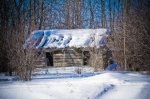
Lone Barn – Alberta Highway 737, near Figure Eight Lake
Homestead – Near Lone Barn & Figure Eight Lake, Alberta Highway 737
Inuksuk – Highway 685 … Others Have Been Here, too
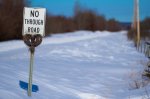
No Through Road with Heart Wreath
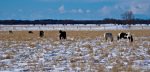
Fairview Lamas and Horses in Spring Sunlight – Rendering 2
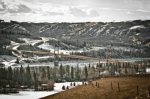
Dunvegan Bridge – B-side Photograph 1
Dunvegan Bridge – B-side Photograph 2
Dunvegan Bridge – B-side Photograph 3
Sunday – photographs that I’d intended to post linger on my computer’s desktop in a file of edited images. The week has been busy with obligations taking me into my nights. The first image is one of a barn located in a muskeg bog, just south of Figure Eight Lake on Alberta Highway 737; it is out of the weather and close to a water source; no house or homestead is in the immediate vicinity. One could have burned down. Or, perhaps the barn is associated with the homestead in the second image; this homestead is treed in and built on higher ground a kilometre further south on the west side of the same highway. In another image an inuksuk has been assembled at the southwesternmost corner of someone’s farmland alongside Alberta Highway 685, stating to all comers that others have stood right there, where they now stand. Within metres of the inuksuk, a heart-shaped wreath is fastened below a ‘no through road’ sign, perhaps inviting people to come and investigate. The next photograph presents a second rendering of the Fairview horses and lamas in spring’s sunlight; there’s a glow of sunlight from the animals. Beyond this, are the other b-side renderings of the Dunvegin bridge, photographed last weekend.
Listening to Tonic’s rendition of Fleetwood Mac’s Second Hand News, then there’s Sister Hazel’s take on Gold Dust Woman and Shawn Colvin performs The Chain, all songs are part of Legacy: A Tribute to Fleetwood Mac’s Rumours’ album.
Quote to Inspire – “I treat the photograph as a work of great complexity in which you can find drama. Add to that a careful composition of landscapes, live photography, the right music and interviews with people, and it becomes a style.” – Ken Burns
















 In My Back Pocket - Photography
You must be logged in to post a comment.