

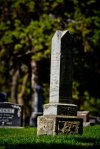
Beyond Yoric

Backlight, Canon 60D, Canon 70-200 mm 2.8 IS L Series Lens, Canon Camera, Canon Live View, Cemetery, Flora, Light Intensity, Photography & Conceptualizing Beauty, Spring, Still Life

Imagine in your walking that you come upon a local cemetery, one you know well because it’s where your family has been buried through the ages. Imagine also that it’s getting to be a crowded place and that the sexton (gravedigger) has need to prepare a new grave.  You’ve been away. So, you chat to catch-up on the news. The sexton’s efforts bring forth the skull of someone known to you and your family.  The sexton is able to provide narrative about that skull and the soul which inhabited it – tales of good, mainly the good and memorable that connects to you.  It’s the skull of someone known to you as a child and your memories tumble forth in your mind’s chatter.  Your curiosity interrupts you.  You know this region well. Your conversation shifts to the newly needed plot and for whom it is being prepared. Someone’s died. Someone you have known. That’s pretty much how young Hamlet in Shakespeare’s play comes upon Ophelia’s death, the death of a young lady from court that Hamlet should perhaps have wedded. There’s regret.  Hamlet finds that she’s brought about her own end – likely from the confusion and obscurity relating to his intentions towards her. Her death is part of something bigger that’s happening, the unraveling and exposure of the truth.

Globally, the play is about addressing abusive power and control and is as much about organizational wrongdoing as it is about personal or individual wrongdoing.  The plot seeks to confirm wrongdoing and to set things right from the top down and doing so requires elaborate and subtle means of addressing wrongs. People get hurt along the way, most notably those who surround the throne; by the end of the play Ophelia’s father, Polonnius, dies as does her brother, Laertes.

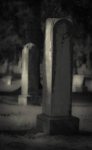
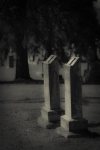
Death and change have been a part of Life in the past few weeks. In some ways it seems we are left reeling or perhaps numb in moving on from what’s been at play.  In other ways the lesson to take away is that change does occur and it’s needed if Life and Lives are to improve. Hamlet, the sexton, Yoric (Hamlet Senior’s jester), Ophelia and the funeral come to mind with these photos of grave markers. It astounds me to consider what any of these Lives (as represented by these grave markers) has been comprised of, even only those lives memorialized by rock within these photos. Each Life has seen the bad and good in our history.  Each have been at play within history.  And, each has found a way to make a go of living Life.  I am struck by how often the cross is representative of the Life that has been lived.

Listening to – Dave Matthews & Tim Reynolds perform Gravedigger, then its Anna Begins by the Counting Crows and You Might Die Trying by the Dave Matthews Band;  Coldplay’s What If and Jack Johnson’s Rodeo Clowns also have featured in this evening’s listening.

Quote to Inspire – “A great photograph is a full expression of what one feels about what is being photographed in the deepest sense, and is, thereby, a true expression of what one feels about life in its entirety.” – Ansel Adams

Dusk’s Golden Hour

Backlight, Best Practices - Photography, Canon 60D, Canon 70-200 mm 2.8 IS L Series Lens, Canon Camera, Canon Live View, Cemetery, Flora, Home, Light Intensity, Night, Photography & Conceptualizing Beauty, Project 365 - Photo-a-day, Spring, Sunset

Within a busy week opportunity for travel along former routes of home permits departure from the whirring, buzzing, routinized rhythm and press of town Life. An hour upon the road gathers me to others and I listen and we talk, good, informing chatter. The gathering, done, permits time beyond meeting to slow down and attend to what I see in that dusky golden hour of half-light. My look-round occurs through the lens attached to my Canon 60D. At the Anglican Cemetery in Fort Vermilion, Alberta I begin; many of the grave markers are granite headstones. Others, painted or stained wooden crosses, seem more temporary. Perhaps maintenance of this tentative grave marker highlights practice in looking after those who have gone before us.

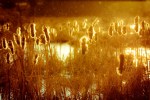
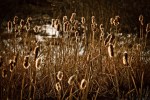
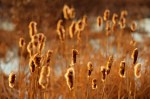
I point my car northward toward High Level. My drive from home out to Fort Vermilion has given me windshield time, time to look out from my car’s windows and to note the snowless earth that is warming, thawing and drying. As we move into summer, hours of sunlight will extend backward into earlier mornings and forward into later evenings. Summer solstice will see the sun dip below the horizon at 11:45 p.m. and reappear at 2:30 a.m., the time between being a protracted period of half-light that photographers refer to as their golden hour when the intensity of light drops off and the quality of light and what is lit changes. At its darkest, there will be a gray eeriness. Tonight, I’ve been able to catch cattails within our current golden hour (at about 9:45 p.m. the sun has just dipped below the horizon). Shallow depth of field permits focus and highlight of subject and the generalization of shapes that pattern into the background.

Listening to – two female voices; first, seeing Aimee Mann within my iTunes catalogue sparked curiosity toward her work with Til Tuesday – I’ve purchased two different versions of Voices Carry.  Then, in relation to psalm 23, I was curious as to whether or not Sarah Masen was able to have her album, The Dreamlife of Angels, made available through iTunes.  It’s been about ten years since Stocki first played it on Rhythm and Soul; at the time, a major record deal was not in the offing. But, now her album is something I’ve just found and it’s about time.  Sarah is an intelligent lyricist; her song The Valley references psalm 23, making you think, and a curiously interesting tune called Hope is worth the listen.  What else – The Five Blind Boys of Alabama will feature at Edmonton’s Winspear Centre along with Over the Rhine on June 10th.  Good schtuff … if you’re to take it in.

Quote to Inspire – “You don’t take a photograph, you make it.” -Ansel Adams

An Hour Away

Best Practices - Photography, Canon 60D, Canon 70-200 mm 2.8 IS L Series Lens, Canon Camera, Canon Lens, Canon Live View, Farm, Flora, Light Intensity, Photography & Conceptualizing Beauty, Project 365 - Photo-a-day, Spring, Sunset

I have an uncle, my Dad’s younger brother, who was in his career a beloved literature professor at Acadia University in Wolfville, Nova Scotia. As a professor he was well-liked by his students and he knew what students were about and was able to direct them profitably and constructively in their academic careers. At lunchtimes in Edmonton growing up, Dad would read us letters in which his brother would own to his chagrin in the matter of occasionally having to borrow cigarettes from his students. His students esteemed him enough to forego this trespass – he got along with his students that well. What’s brought him to mind tonight is that he was someone who when sitting still at a task for too long got himself up out of his chair or away from his desk and out into his car and go for an hour’s drive and have a look about at his world; the last car of his that I road in was an early eighties Volvo sedan that he had had repainted a metallic green. He loved a drive as did his mother (my grandmother), his wife and daughter. A good drive was always a means to unwind from a day pressing obligations to capacity; he’d arrive back and he would have shifted his state … the world was better for having gone for a drive.

Yesterday, at day’s end I found that I had been sitting at computers, at school and at home, for more than twelve hours combined. And, I found that there was still more to do, more obligations to students and staff and their various undertakings … the work of the work was to stay at it and complete it. But, I wasn’t being productive, more a body realization than anything else … sitting down and sitting still from my day into my evening was not to be had. I pulled my uncle’s trick, I grabbed my camera bag, tripod, down-filled jacket, gloves and hat, and, I got into my car and steered it east from High Level. Twenty minutes from High Level, yielded the opportunity to photograph Canada geese, cranes, swallows and reflection upon water. The evening also yielded the good fortune of stumbling into a former colleague whose career path has mirrored my own; we probably haven’t chatted meaningfully for about five or six years. In half an hour I heard much about her world – her daughters, her husband and their next steps. I finished out the evening with another hour of photography and returned home.

Listening to – the Steve Miller Band’s Rock’n Me, Take the Money and Run and Mercury Blues;  Murray McLauchlan’s Farmer’s Song and Hard Rock Town have featured as has Ryan Adams’ Chains of Love.  The morning’s walk featured U2’s Magnificent, Eddie Vedder’s Hard Sun among other songs.

Quote to Inspire – “I treat the photograph as a work of great complexity in which you can find the drama.  Add to that a careful composition of landscapes, live photography, the right music and interviews with people, and it becomes a style.” – Ken Burns

Soul Cage

Best Practices - Photography, Canon 60D, Canon 70-200 mm 2.8 IS L Series Lens, Canon Camera, Canon Live View, Light Intensity, Photography & Conceptualizing Beauty, Podcast, Project 365 - Photo-a-day, Shuttertime with Sid and Mac, Spring, Still Life

On this morning’s walk I chose music over prose.  The brooding plot of D.H. Lawrence’s Lady Chatterley’s Lover in all the consideration before action seems quite bleak and maybe the story is written intentionally so that renewal in physical sensuality is highlighted against the mundane existence of day-to-day life.

Music suited me better in the initiation of the day. Robbie Robertson played first, then Bruce Cockburn and U2, then on to Roxy Music and The Tragically Hip, all on my genius playlist beginning with Sweet Fire of Love. Then, in combination with thought about this photograph Sting begins on a song called The Soul Cages. For as much as the song’s lyrics refer to our humanoid condition here on earth I was drawn to consider whether or not a camera is another soul cage. I’m thinking that a camera is a tool that cages the soul within the photograph produced in that it  encapsulates a moment of time, recording Life status and history in whatever condition we or the world were in – good or bad.

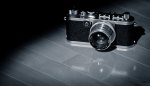
The camera photographed here is a Leica.  A while back, Maciek Sokulski encouraged his Shuttertime with Sid and Mac podcast listeners to purchase an older camera, one that causes you to think about photography beyond the digital means, a camera with which to use your honed knowledge/skills of photography and to exercise expertise and skill in creating good photographs without waste.  This Leica is my father’s from the early sixties.  It is a camera that was used technically in the production of plastic and was used as part of the process to view at a microscopic level the grade/quality of plastics at an Edmonton plastics plant.  It is a Leica without a viewfinder and is something my brothers and I should try out one of these days to see how it shoots. Maybe we will give it a try this summer.

Listening to – Robbie Robertson’s Soap Box Preacher, Amanda Marshall’s Sitting On Top of the World, Jann Arden’s The Sound Of, U2’s I Fall Down, Joan Osborne’s Man in the Long Black Coat and Neil Young’s When God Made Me.

Quote to Inspire – “Photography is a way of feeling, of touching, of loving.  What you have caught on film is captured forever … it remembers little things, long after you have forgotten everything.” – Aaron Siskind

Water Mirror

Backlight, Best Practices - Photography, Canon 60D, Canon 70-200 mm 2.8 IS L Series Lens, Canon Camera, Canon Lens, Canon Live View, Fauna, Light Intensity, Photoblog Intention, Photography & Conceptualizing Beauty, Project 365 - Photo-a-day, Spring, Still Life, Sunset
Cattails within Reflection

Cattails within Reflection

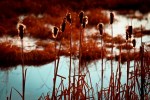
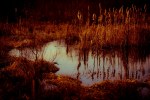
Water – within the past week I’ve slipped and nearly tumbled on water that’s oozed and frozen into globs of ice on High Level sidewalks during my morning walks. Water has met with gravitational pull and been transported as precipitation from clouds through a distance of kilometres to earth, sprinkling erratically. Water that’s changed state from snow or ice has in its melting been responsible for transport of dust and dirt from sidewalks to drains and through sewage systems. Water has been the key ingredient in transforming dirt into mud and curiously the removal of soil from our bodies is best accomplished with … water. And, within this photo water that is not in motion becomes mirror, an enigma catching my attention as I’m able to focus through its surface to the detail in my subject, the cattails. The water mirror allows cattails to become foreground to the backdrop of clouds of pink sunset, a feat that would not have been possible without this water mirror.

Listening to – Ray Lamontagne’s I Still Care For You, Ryan Adams’ Come Pick Me Up and David Gray’s Fugitive. The David Gray tune from yesterday that’s stuck in my head is We’re Not Right;  the other is Shawn Colvin’s take on We All Fall Down.  Today, David Gray’s My Oh My plays out to the end of this post.

Quote to Inspire – “In photography there is a reality so subtle that it becomes more real than reality.” – Alfred Stieglitz

Perspective – Where to Stand

Backlight, Best Practices - Photography, Canon 60D, Canon 70-200 mm 2.8 IS L Series Lens, Canon Camera, Canon Lens, Canon Live View, Fauna, High Dynamic Range (HDR), Light Intensity, Photoblog Intention, Photography & Conceptualizing Beauty, Project 365 - Photo-a-day, Spring, Still Life

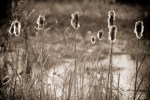
A cube or a box – the physical structure of the spaces we tend to inhabit for the majority of our days are cubes or boxes. There’s the cube or box of home. There’s the cube or box of work. As human beings it’s important that we find the third and fourth cubes beyond our work environment and beyond the home, the third and fourth elements of our day that balance out contact with work and withdrawal from endeavor. The analogy works forward in terms of thinking outside the box, breaking from routine and locating yourself in activities in the world to gain perspective on your world. Add a camera to the equation and the analogy drills down a step – you’re gaining perspective on the world you live in in much more concrete terms. Photography allows for that look at your broader context. Photography orients you to the beauty you’ll find that’s only minutes away. In fifteen minutes, I’d driven east and found these cattails at day’s end on a warmer spring day well into melt.

Listening to – The Five Blind Boys of Alabama and their rendition of Run On For A Long Time, Feed A Man by Billy Bragg & Wilco,  Shakedown on 9th Street by Ryan Adams, Buffalo by Kathleen Edwards, Fully Completely by The Tragically Hip,  Wonderwall by Ryan Adams, Eh Hee by Dave Matthews & Tim Reynolds, You Might Die Trying by the Dave Matthews Band, U2’s Wake Up Dead Man and Jack Johnson’s Rodeo Clowns.

Quote to Inspire – “A good photograph is knowing where to stand.” – Ansel Adams

Transformation’s Glaze

Best Practices - Photography, Canon 60D, Canon Camera, Canon Lens, Light Intensity, Photoblog Intention, Photography & Conceptualizing Beauty, Project 365 - Photo-a-day, Season, Spring, Still Life, Vehicle, Vehicle Restoration

I’ve just checked. It is still around, that thing that catalyzed so much of the work and time I’ve invested in cars I’ve owned and cars I’ve worked with. I happened on it by chance and by the end of that first day I had received an education in using it. On a Saturday morning in early summer 1982, I drove a green 1969 Pontiac Parisienne to a good friend’s house to see what we were up to that day. He had a project going, a task fueled by his father’s expertise in restoring and rehabilitating old cars.

I found him compounding (using rubbing compound on) the maroon paint of his two-door Dodge Aspen, a new acquisition – his first car. The idea was to remove paint that had dulled and oxidized and then add a layer of glazing resin to seal and maintain the maroon paint in pristine condition. As many things were in those days, this was a Tom Sawyer experience – a project he was engaged in was something I wanted to help with and he had the grace to allow me to do so. In two hours, our combined elbow grease brought out evenly the car’s true maroon colour in the paint. Then we added the glazing resin, something called TR-3 Resin Glaze; we rubbed it into the paint.  We let it powder up and dry. And, then we used terry-towel rags to remove swirls of resin glaze residue.

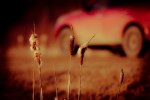
What happened was remarkable. Our elbow grease, our use of rubbing compound and resin glaze according to instruction produced transformation – a previously dull, tired looking Dodge Aspen now looked new, even better than new. We’d seen this once before and talked about it.  An older gentleman in the house next door, a man confined to a wheelchair had brought about similar transformation to his late sixties Dodge Dart. His candy apple red Dodge Dart was emaculate, the result of patient application of intelligence, initiative and diligence toward visual result.

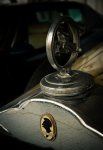
In terms of photographs, not many vehicles these days sport hood ornaments.  Hood ornamentation tends to be associated with higher-end cars … perhaps they always have been.  Hood ornaments accentuate the forward most part of the vehicle and perhaps in their being sculpted remind owner and driver of their vehicle being art, something crafted by others.  Hood ornaments seem to have started out primarily as skilfully fashioned radiator caps; others serve to mark the hood’s center allowing drivers to position the vehicle on the road in relation to designated space between lines. Hood ornaments from several vehicles at the LeMay Car Museum feature as subject for this post’s photos.

Listening to a genius playlist starting from Over the Rhine’s Sleep Baby Jane; it moves on to Patty Griffin’s Mil Besos and then to Dar Williams’ Fishing in the Morning. In terms of audiobooks, I’m continuing to walk and listen to Lady Chatterley’s Lover;  what struck me this morning is commonality of era. After all that the first world war was, the world my grandfather and grandmother would have shared as a young married couple was this same period as that of Constance and Clifford Chatterley, except that my granddad’s wounding at Vimy Ridge led him to become a military instructor for the remainder of the war and then back to Canada to marry the woman who would become my grandmother. Lawrence’s Lady Chatterley’s Lover was a book most likely banned in their time because it dealt with physical sensuality and challenged mainstream morality;  I wonder about their take on the book … was it a book not to be read if you were a person of integrity?

Quote to Inspire – “There is nothing worse than a brilliant image of a fuzzy concept.” – Ansel Adams

325 – 152nd Street East, Tacoma, Washington

Best Practices - Photography, Canon 60D, Canon 70-200 mm 2.8 IS L Series Lens, Canon Camera, Canon Lens, Journaling, Light Intensity, Photoblog Intention, Photography & Conceptualizing Beauty, Project 365 - Photo-a-day, Season, Spring, Still Life, Vehicle, Vehicle Restoration

One of the bigger treats for me in visiting Seattle, Washington this Easter was something my wife and daughter allowed me to do on the Thursday before we returned to Canada, something that they joined me in. That Thursday morning, we drove from Seattle an hour south to Tacoma and using our TomTom GPS were able to navigate to 325 – 152nd Street East to arrive at the LeMay Car Collection/Museum at Marymount.

Imagine a former convent/school resurrected to become storage and showing site for the LeMay collection of cars and trucks, vehicles of the last one hundred years. At the museum, a docent will lead you through each collecting point on the Marymount property. Not only do rusting relics inhabit these spaces, but you also find that the majority of vehicles within these confines will have received restoration or would have been kept in their original pristine condition throughout their years. Beyond this, imagine that your docent has heart and understands well your connection to cars and knows each car’s history intimately. He’s able to tell you all that you didn’t know about each car. Our docent, Mr. Pierce, led us, this way and that, through the maze of cars parked end to end in each of three buildings, a means to house them all. He was introducing each car to us – what the car was about practically, what had been each automaker’s intentions for the vehicle conceptually and how the car came to reside within the LeMay collection.

And, Mr. Pierce allowed me a kind of grace that only a fellow gear-head would ever let you have … he allowed time to photograph the vehicles and for that I will be forever grateful. At two hours in to my tour my wife went to be with my daughter out in our rental car while I rounded off the tour with Mr. Pierce looking up close at some of the first-ever self-propelled vehicles to transport people around the Americas. In terms of next steps, I’m considering becoming a member at the LeMay museum – they may be able to make use of this old-time car jockey who used to dust and polish cars at Edmonton’s Waterloo Mercury.

Listening to – U2’s Magnificent, Coldplay’s Yes and Radiohead’s All I Need.  In terms of audiobooks, the last two morning walks have been a listen through D.H. Lawrence’s Lady Chatterley’s Lover; it’s been more than a couple of year’s since I’ve been through the book and this audio-recording has a good reader –  Maxine Peake.

Quote to Inspire – “Photography does not create eternity, as art does; it embalms time, rescuing it simply from its proper corruption.” – Andre Bazin (1918-1958), French film critic.

Broad Strokes – Three Dimensions

Best Practices - Photography, Canon 60D, Canon 70-200 mm 2.8 IS L Series Lens, Canon Camera, Canon Lens, Light Intensity, Night, Photoblog Intention, Photography & Conceptualizing Beauty, Project 365 - Photo-a-day, Spring, Still Life, Sunrise

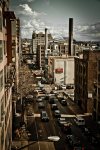
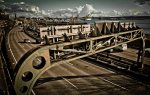
Visually, Seattle clusters in broad strokes among three dimensions. There’s the up and down of tall, tall buildings. There’s the Seattle you find more of to your right and to your left, more buildings, more streets, more sidewalks. Seattle extends in front of you, behind you and way over in every direction – bridges curve with the landscape and cross huge expanses of land and water. Seattle is a walker’s city. Distances around the city core are manageable walking distances. Navigating the downtown core is straightforward. The terrain offers up and down, a good walker’s workout. And, fresh air blows up from the ocean through the city. Movie-wise I recognized the city watching an eighty’s movie only last weekend; Seattle is the setting within the movie, An Officer and A Gentleman. And, during our time in Seattle, we were able to see the Lake Union lake cottage set of the house used by Tom Hanks’ character in the movie Sleepless in Seattle; we’d taken the Ducks’ tour and saw many of Seattle’s highlights. The Seattle night photos remind much of U2’s music video presentation of their album No Line on the Horizon and specifically to City of Blinding Lights, a reference more directly referring to Paris, France; the appellation could just as easily refer to the Seattle that I’ve seen at night.

Listening to a preview of Jack White’s Blunderbuss album; it’s holding true to Jack White sound; it’s good and it’s fresh Jack White.

Quote to Inspire – “There will be times when you will be in the field without a camera.  And, you will see the most glorious sunset or the most beautiful scene that you have ever witnessed.  Don’t be bitter because you can’t record it. Sit down, drink it in, and enjoy it for what it is!” – Degriff

Moonrise over Elliot Bay

Best Practices - Photography, Canon 60D, Canon 70-200 mm 2.8 IS L Series Lens, Canon Camera, Home, Night, Photography & Conceptualizing Beauty, Project 365 - Photo-a-day, Spring, Still Life, Sunrise

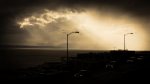
Coming to Seattle from just south of the 60th parallel, I had expected the earth’s sunrise and sunset to be more in tandem with what happens for us in our north. I was surprised to find the sun rising much earlier than it was back home. On Saturday, our travel day home from Seattle, Washington to Edmonton, Alberta I was able to gather photo gear quietly without disturbing my wife and daughter and head out quite early to snap photos. While I captured images from Seattle’s downtown, two of the shots I’m liking deal with the moonrise at sunrise across Elliot bay. And, while there are five images presented there are only two images dealt with.  One image plays with different lighting presets and composition while the other, the final one is pretty much straight out of the camera. Our waitress at the Andaluca restaurant caught the sight on her early morning jaunt to work. The sight was rare, something to see.

Quote to Inspire – “To me, photography is an art of observation.  It’s about finding something interesting in an ordinary place … I’ve found it has little to do with the things you see and everything to do with the way you see them.” – Elliot Erwitt

Listening to Pink Floyd’s Wish You Were Here album following a documentary on Pink Floyd that explored their reunion for the global Live 8 Concert;  they’d been apart for some twenty odd years … two of those members have passed on. In the song Wish You Were Here that I’m listening to, Stephane Grappelli accompanies Pink Floyd. Interesting!