Winter Light’s Tone & Mood

Canon 30D, Canon Camera, Christmas, Light Intensity, Lookback Photos - One Year Ago, Night, Project 365 - Photo-a-day, Season, Winter

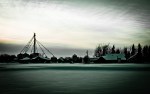
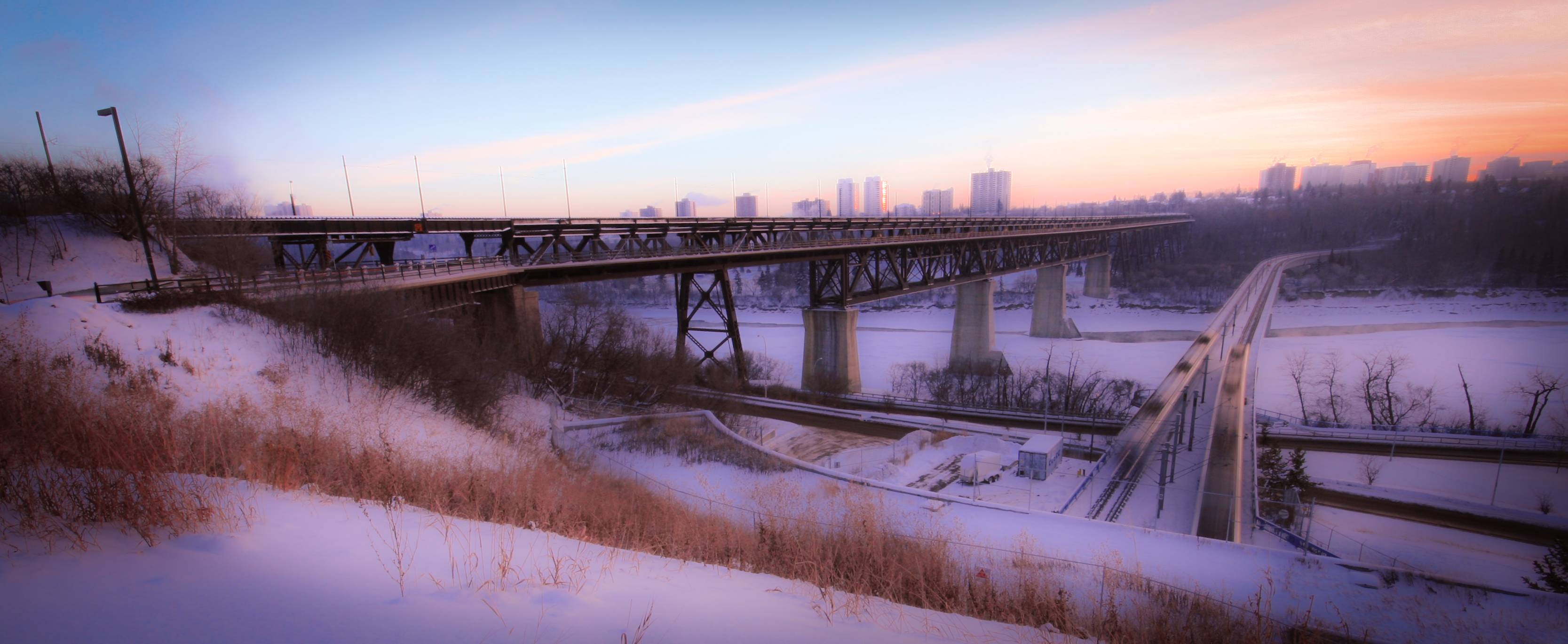
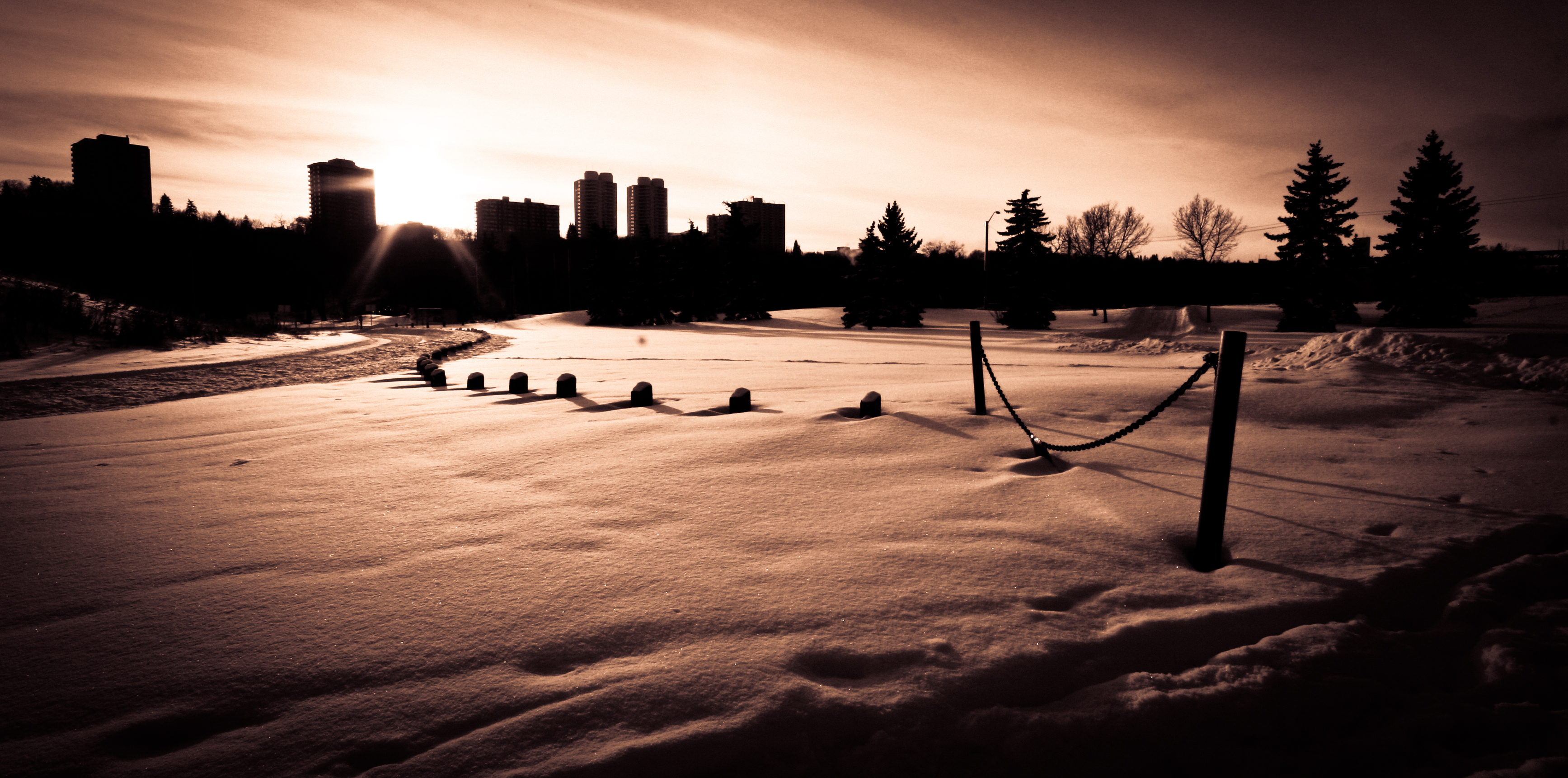
High Level Bridge - Edmonton, Alberta

On a Saturday afternoon, in late November or December, 1968, my father took me to Edmonton’s Varscona theater on the corner of 109th Street and Whyte Avenue to watch a newly created film version of a Dickens’ novel he knew well; my father took me to watch Oliver! In the film, I encountered a boy a little older than me, Oliver Twist, as he moved forward into the world without parents, moving from workhouse to funeral home and on into more (or less) corrupt hands (depending on your point of view), navigating by strength of character and goodwill through mishaps, misdeeds, abuse and neglect. Innocence and seeing the world with first eyes are key aspects in this narrative’s presentation, a child acclimating to what the world is about – good and bad.

Safety and what is right are elements of Life that Oliver perceives purely on the basis of tone. Highlighted in the novel is affectation of tone, tone used to achieve an end. Here, Oliver responds to the warmth and apparent sincerity in the charm and charisma proffered by Fagin (sly, cunning con artist) and Master Charlie Bates a.k.a. the Artful Dodger (Fagin protégé, pickpocket and derisively referred to as Master Bates). Their tone and apparent sincerity lead only so far before innocent and perhaps earnest discussion of what’s at play (picking pockets) draws both accountability and deflection of impropriety into/from the situation.

Key among things recalled from watching Oliver! at age seven is how light is used to convey tone and mood. Street scenes in the film occur when light is mistrusted as its intensity diminishes and as color and tone deepen and broaden, enhancing mood. Evening light, the cusp of sunlight declining into sunset, drawing day into night, is much of what the street scenes in Oliver are about. Perhaps director, Carol Reed, draws out broad visual metaphor, here, light’s transition into dark – wholesome Life moving to an arena of growing corruption, of that which is underhanded and unable to be truly ‘seen’. What stays with me after these forty-three odd years is the role that light’s intensity plays in establishing mood; the movie Oliver has had me attending to the tone, colour and atmosphere of winter street scenes as shadows lengthen, sunlight diminishes and we move through that range of colour taking us from day into night. Most often I’ll recognize this same tone driving west on Edmonton’s Whyte Avenue, close to Christmas as the sun draws toward the horizon … the mood is the same. The colours, light, tone and mood found in this December photograph of Edmonton’s High Level bridge are those you’ll find in Oliver!

Listening to Adele’s Set Fire to the Rain from her 21 album; other songs of the day include U2’s Bad from The Unforgettable Fire and Coldplay’s God Put a Smile Upon Your Face from their album A Rush of Blood to the Head.  In the past few days Jack White and The White Stripes have featured in my listening – 300 M.P.H Torrential Outpour Blues (Live) from Under Great White Northern Lights (Live Canadian Tour).  The Verve’s Lucky Man from the Urban Hymns album and  U2’s Love and Peace or Else from How to Dismantle an Atomic Bomb have also been there.

Quote to Inspire – “People think that all cameramen do is point the camera at things, but it’s a heck of a lot more complicated than that!” – Larry in Groundhog Day
Adizes Curve

Canon 30D, Canon Camera, Christmas, Light Intensity, Lookback Photos - One Year Ago, Project 365 - Photo-a-day, Season, Winter

Edmonton's River Valley - Looking Back to Saskatchewan Drive

If you know the Adizes curve you’ll recognize what’s referred to as a learning curve being the initial part of a bell shaped curve moving you from initiation of a new practice to a point of prime where you crest the top of the curve and master practice – new practice has been worked, handled and made best practice. Optimal use of the Adizes curve has you taking on new learning curves as you crest and master prior practice. Doing so, allows you to hang on to current good practice while embracing newer needed practice.

The photograph presented, here, is one taken midway through a five-hour, solo photowalk around Edmonton’s river valley. I’m dealing with new practice.  I’m moving through a metropolitan area and recreational park area and making decisions about photographs I want, committing action to each shot and moving on – it’s a pattern I’m developing. As I start I’m shooting too quickly, not letting my eye look around the frame to see if I’m gathering all that is subject and background. Some of what I’m doing is managing state – balancing my awareness of environment (the hustle and bustle of what’s going on around me as I shoot) with good awareness of what I am seeing in the lens. I settle into the rhythm of practice – walk and find subject, move to find best angle/perspective, set the exposure (f-stop against shutter speed), focus and take the shot; then, when I’ve exhausted my seeing and possibility with a subject I move on. I’m also testing out gear at -20C.  I’m keeping one battery warm, close to my chest underneath fleece and winter jacket; every twenty-minutes or so, I’m swapping out the camera battery (the cold for the warm). I’m carrying a knapsack style camera bag and a tripod bag slung over my body, over the camera bag.  Beyond this, I’m managing comfort in terms of staying warm with fleece underneath jacket and ski pants.

At the mid-point of my walk, having come down into the river valley, I encounter this shot – a silhouette, near the 5th Street Bridge looking back up toward Saskatchewan Drive, a neat leading line of posts preventing vehicles moving where they ought not to go.  I move on. As I take pictures I’m unaware of the need to clean my lens and that snow crystals will shape what I expose. It is days later when I’ve returned home and edit the images that I see them – the result isn’t anything bad, just something that needs cleaning up with software. In this photowalk I began at the High Level Diner, moved east along Saskatchewan Drive, entered the Edmonton City Park (the River Valley), crossed the 5th street bridge, walked through the Alberta Legislature grounds and returned to the University side of the North Saskatchewan River – it has been a first view of the area with my camera, something to repeat and revise. At a pub, formerly Plato’s Pizza, I treat myself to two pints of Boddington’s Pub Ale while I wait for a ride home and I review images.

Listening to … or fretting many Stan Rogers’ tunes tonight; among them have been The Wreck of the Athens Queen, Fisherman’s Wharf and Maid on the Shore; it’s been DADGAD tuning tonight and I’ve also shifted into 9/8 time, in a manner to support a fiddler’s reel or jig – a rhythm Skew Lines‘, Kerri Brown (fiddle, guitar, percussion) helped me find and play in Parksville, British Columbia.

Quote to Inspire – “I like photographs which leave something to the imagination.” – Fay Godwin

Tasking New Purpose

Canon 30D, Canon Camera, Night, Project 365 - Photo-a-day, Still Life, Summer, Vehicle, Vehicle Restoration

1953 Ford F-100 - High Level, Alberta

Someone’s project, this mauve and mint green 1953 Ford F-100 resides in the industrial area lot across from the Viterra grain elevator, a vehicle waiting for its next drive, more utility upon pavement. The mood of this photograph attracts. Its subject waits upon an earthly creator with abundant resources to transform ‘what was’ into ‘what will be,’ a creator who will set new purpose for this vehicle – breathing life into it, again. What this vehicle will become depends upon the creative imagination of those who will bring restoration.

Listening to U2 sing about INXS lead singer Michael Hutchence in Gone, from Best of 1990-2000 [B-Sides]; then it’s Gillian Welch singing Revelator from her Time – The Revelator album; finally it is Dar Williams singing Mercy of the Fallen from her album The Beauty of the Rain.

Quote to Inspire – “Photography can only represent the present.  Once photographed, the subject becomes part of the past.” – Bernice Abbott

Norpine Show and Shine

Canon 30D, Canon Camera, Lookback Photos - One Year Ago, Project 365 - Photo-a-day, Summer, Vehicle, Vehicle Restoration

One technical aspect of William Faulkner’s novel, The Sound and The Fury, is that one narrative is investigated through active eyes of four different people associated with the story. The story receives telling from the perspective of and with the perceptive capability of each character grappling with what occurs as the narrative unfolds. Something similar occurs with perception when editing one photograph and altering minor elements of brightness, saturation and hue – what is seen and what one experiences in response to each configuration is different.

This evening, I’m looking back to a Friday in June, 2011.  It’s after school and a Show and Shine is being held in High Level, Alberta in the Norpine Auto Industrial Supply Retailer parking lot. I’ve got my Canon 30D with me as I depart from school and drive past these pristine vehicles – vintage and current – that someone has enhanced with different rims and tires, that someone has restored and painted, that someone has taken the time to find and connect with memories of a former time. I pull ahead, past Norpine, turning in at the High Level Home Hardware store and park my 2000 GMC Sierra, there. The next three-quarters of an hour is spent photographing cars and trucks from different angles to find good and best shots.

I dialogue with vehicle owners, unleashing  narratives associated with each vehicle we look to. Former students, in their first jobs following high school, show me their acquisitions – a Chrysler 300M and a GMC Sierra half-ton, both decked out with rims, fat tires and glossy shine. There’s room in our dialogue to sort through how I used to present cars in my post-high school days at Waterloo Mercury in Edmonton and what could be achieved with different McGuiar’s waxes for paint and a bottle of brake fluid for tires. I share with them that Autoglym Waxes are what I use these days and that Queen Elizabeth II has given royal warrant to the company because the waxes are used on Royal vehicles; while Hondas and Toyotas use the wax, so to does Aston Martin.

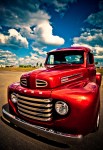
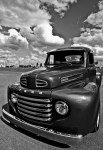
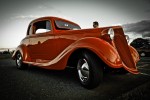
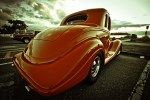
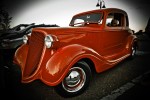
Mounted on my Canon 30D is a Sigma 10-20 mm wide angle lens … with it there’s the opportunity to distort vehicle form in terms of lines and curves … to add the wow factor. One vehicle I come across is this late fifties Ford half-ton painted bittersweet orange and waxed to full gleam to reflect June’s late afternoon sun, clouds and sky.  Editing reveals this image in different ways … see which you enjoy best.

Listening to Over the Rhine and Within Without from their Discount Fireworks album; then it’s on to Mindy Smith singing One More Moment from her album with the same name. Later, it’s on to Babylon II by David Gray from the White Ladder album.

Quote to Inspire – “Photography is an immediate reaction, drawing a meditation.” – Henri Cartier Bresson

Wisconsin Locomotive – Part 2

Canon 30D, Canon Camera, Fog, Lookback Photos - One Year Ago, Night, Project 365 - Photo-a-day, Rail Yard, Weather, Winter

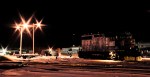
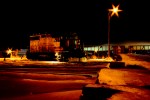
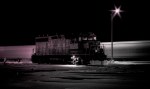
I am including four other photographs of the Wisconsin locomotive engine within the High Level Canadian National rail yard.

My interest in locomotive engines probably began with the matter of watching them pass by at railroad crossings, as a youngster, sitting among family in our 1969, silver-green Pontiac Parisienne; the big thing was to wave to the engineer and pull our arms down as if we were tugging on a rope above us – to our gesture we were sometimes rewarded with the engineer blowing the train’s air horn in our presence,  something that would thrill us, creating big smiles on the faces of everyone. Later, during summers while in university, I served as spotter and brakeman moving hopper cars around rail yards in southern Edmonton. And, now, I still have an interest in trains and locomotives.  I wonder how much of my current interest has been shaped by time enjoyably shared with my son reading Thomas the Tank Engine stories each night or watching the animated VHS video stories or in building different wooden track configurations and moving different engines around my son’s Thomas the Tank Engine track – Thomas, Percy, Rusty et al. Here, in Reverend Wilbert Awdry’s stories, it’s the everyday advice on the practicalities of living and the allegorical component of his stories that continues to hold my attention … there’s value and values there. My son is now eighteen and in university – many good facets of what life is about have been embedded in his character through these stories; these stories have been an enjoyable investment in my son’s future. And, still trains and what they accomplish capture my interest.

Listening to Billy Bragg and Wilco perform Stetson Kennedy from the Mermaid Avenue, Vol. 2 album; then it’s been Black Rebel Motorcycle Club … who would have thought four seminary graduates would minister through music … like this in Ha Ha High Babe.

Quote to Inspire – “I began to realize that the camera sees the world differently than the human eye and that sometimes those differences can make a photograph more powerful than what you actually observed.” – Galen Rowell

Wisconsin Locomotive

Canon 30D, Canon Camera, Gas Station, Lookback Photos - One Year Ago, Project 365 - Photo-a-day, Winter

Wisconsin Locomotive - High Level's Canadian National Railyards

High Level’s industrial area intrigues.  Within the two kilometres that comprise its service road are perhaps fifty businesses, ones that mediate between our hinterland frontier and the world at large.  The location is active.  Rarely on this section of road would ten minutes go by without some activity, a vehicle driving by, logging trucks being unloaded, rail cars being loaded, grain trucks pulling in to the Viterra elevator or larger transport trucks pulling in to Neufeld Petroleum (Petro Canada) for fuel. The area contains the Emergency Medical Services, an auto-body collision repair shop, loading bays of a trucking company and much more. And, then, something novel occurs.  A Wisconsin locomotive with Wisconsin map painted on its side arrives and idles overnight in High Level’s Canadian National (C.N.) rail yard. The engine is regal with its cab being painted maroon and yellow and sporting a Wisconsin Rail badge on either side of its cab. Later, I learn that C.N. bought out and operates Wisconsin Rail in the United States.

Listening to Run on for a Long Time by The Five Blind Boys of Alabama (Spirit of the Century) and Wisdom by David Gray (E.P.’s 92-94).

Quote to Inspire – “If your pictures aren’t good enough, you’re not close enough.” – Robert Capa

Looking Back – Late Winter Photos

Canon 30D, Canon Camera, Farm, Light Intensity, Lookback Photos - One Year Ago, Project 365 - Photo-a-day, Weather, Winter

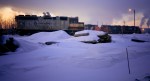
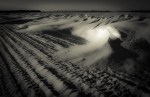
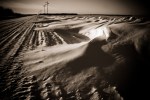
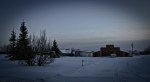
One year ago, late on a Sunday afternoon in February I travelled east from High Level on range roads that service farms in this region. While graders had cleared these roads snow had begun to drift into them from the north. The sun’s light was direct and bright, intense as it was reflected back from the snow. And, the wind blew. From a distance, the shapes of the snow’s drifts were a repetitive pattern blown into the roads – evidence of the wind’s work; more irregular shapes were found as result of the particular way the wind swept through an area. On my return home I photographed Gibson’s farm, 10km east of High Level – a landmark that has served to orient me to how close I was to High Level in my trips in from Garden River, Fox Lake, Fort Vermilion and beyond. After many seasons in many years, my camera allowed me finally to see more of what the Gibson’s farm was about.

Reminded of W.O. Mitchell and his novel, Who Has Seen the Wind – a novel about growing up, a story with teachers and students ….  Here’s its poem starting point.

Who Has Seen the Wind? – Christina Georgina Rosetti (1834-1894)

Who has seen the wind?

Neither I nor you.

But when the leaves hang trembling,

The wind is passing through.

Who has seen the wind?

Neither you nor I.

But when the trees bow down their heads,

The wind is passing by.

Listening to Dar Williams’ album The Beauty of the Rain, an album I was drawn to after learning the tablature for her song of the same name.  The circumstances of a friend have recalled a song from the album – Fishing in the Morning.

Quote to Inspire – “To photograph truthfully and effectively is to see beneath the surfaces and record the qualities of nature and humanity which live or are latent in all things.” – Ansel Adams.

Hudson Terraplane

Canon 30D, Canon Camera, Lookback Photos - One Year Ago, Project 365 - Photo-a-day, Season, Summer, Vehicle

During evening meals as I and my brothers grew up my father would look back to his boyhood days and share stories and facts about the world surrounding him. Talk would often revolve about different outings and that his mum, my grandmother loved a Sunday drive in the landscape surrounding Moncton, New Brunswick where he grew up. It did her good to be with her family and to see the world beyond her home. A blue 1938 Pontiac transported them – a few years ago my aunt showed me a picture of the car with my Dad and his younger brother eating picnic sandwiches sitting in shade on the car’s running boards. Cars do double as portable homes or perhaps rooms and during transport they group a family together. Everyone has common vision, all staring down the road with the driver.  Cars become a place to catch-up on things, a place to talk things through, places to share news – in transport, you’d not be the same person getting out of the car as you were getting in to it.

While cars did seem to be a family thing, a fact that I continue to be amazed at is that my father only learned to drive after completing his Ph.D. at the age of twenty-five or twenty-six; perhaps he anticipated family as his next step. And, maybe there’s some truth in that because during his university years at Mount Allison (Sackville, Nova Scotia) and at St. Mary’s College (London, U.K.), he hadn’t needed a car but had been able to make his way around Europe on train, by bus, on bicycle or hiking.  And, it seemed that such travel was much more of a social thing with much more grace being there as fellow-travellers or friends in the act of travel.  Perhaps there was that common purpose of travel in that former time – to ‘see’ the world (which also meant to experience it).

Dad had ideas about cars, about how long they should be driven before a new one should be bought.  He had ideas and biases about good and better cars. He enjoyed a car that had what he would term ‘pep.’  It’s tempting to look at the cars Dad has owned and driven as associating to different points of development among our family – a 57 Ford Consul (marriage), a 64 Pontiac Beaumont (the family populates), a 69 Pontiac Parisienne (the family’s middle years), a 76 Chevrolet Caprice Classic with 74 Ford Gran Torino (the family’s later middle years), an 81 Oldsmobile Cutlass Supreme (kids almost ready to move out), an Oldsmobile Delta 88 with Dodge Aries K Car (first years of empty-nest), two Nissan Maximas (later empty nest and retirement) and a Nissan Altima (later years of retirement).  You could almost use the technology available at each stage to chronicle the evolution of cultural norms within society … possible Masters thesis for someone.

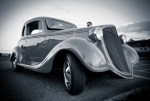
On occasion, cars – what they were about, their history and their potential for each aspiring driver in our family – would be the center of discussion at evening meals. One vehicle Dad commented on with regard to its history was a car alluded in terms of character name in the Disney/Pixar movie, Cars.  Paul Newman provided voice-over for that car, now animated, Doc Hudson. Last summer I got to see a Hudson Terraplane, not one from the fifties or forties, but a Hudson Terraplane from the thirties, a pet project for an autobody repairman and tow-truck driver from Nanaimo.  These photographs are taken at the end of July, 2011.

Quote to Inspire – “The question is not what you look at but what you see!” – Henry David Thoreau

Listening to John Mayer sing Route 66 from the Cars Soundtrack; the same soundtrack has Rascal Flatts singing Life is a Highway.  After that it has been listening to Tom Cochrane and Red Rider in the Edmonton Symphony Sessions recorded at Edmonton’s Jubilee Auditorium – Avenue A, Bird on a Wire, Big League and Boy Inside the Man … all, good, good tunes.

Those Who Go Before Us …

Canon 30D, Canon Camera, Cemetery, Home, Lookback Photos - One Year Ago, Project 365 - Photo-a-day, Still Life, Winter

Cemeteries, for most people, are places of foreboding – we understand that we too shall end-up, here. Beyond the fact that we usually find ourselves at cemeteries on the other side of saying goodbye to loved ones and good friends, cemeteries also point us to the consideration of the life we are living. At our life’s end, we may be more in a state of regret having conformed our lives to the expectations of others, failing fully to step up and into the Life that is truly ours. On the other hand, on our death bed, it would certainly be something to smile, roguishly, and to own to others that we’d certainly taken ‘a good squeeze out of life.’ My wife’s friend from church, Herman Peters, passed away a week or two ago and his funeral and eulogy embraced his feisty, roguish approach to Life and seeing it through well. Herman’s eulogist, throughout his eulogy, would often lean over and look at Herman within his casket and ask, “Do you think it would be okay if I tell them about the time we did…?”  Wow!  What a way to go! Good schtuff, Herman – thank you to who you have been to all others and the friend and elder you’ve been to my wife. John O’Donohue and his Greenbelt lecture on the Imagination have been much on my mind as I’ve considered this photograph, tonight.

Listening to Pierce Pettis sing Love Will Always Find Its Way from his album,Everything Matters; other good, good songs include Neutral Ground and Just Like Jim Brown (She is History).

Quote to Inspire – “No place is boring, if you’ve had a good night’s sleep and have a pocket full of unexposed film.” – Robert Adams, Darkroom & Creative Camera Techniques, May 1995

Rocky Lane - Cemetery Headstones

A House Does Not Make A Home

Canon 30D, Canon Camera, Farm, Home, Homestead, Lookback Photos - One Year Ago, Photoblog Intention, Project 365 - Photo-a-day, Winter

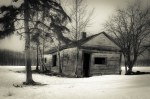
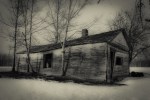
Home and homesteads are the subject of this evening’s perusal through photographs. In the U2 canon, Paul Hewson (Bono), the younger of two siblings asserts lyrically that ‘a house does not make a home,’ something he’s needed his father (Bob Hewson – Catholic) to understand about their shared life, a life without a mother who’s passed on (when Bono was 16 years of age). His lyrics point to the heart of home life – the void Bono’s encountered and what should be there. Another song from the U2 canon references yearning for his mother (Iris Elizabeth Hewson – Protestant) and her example – there’s vertiable duality in his ‘I will follow‘ lyrics  – Bono surfaces his mother, here, as well as redemption through saviour and salvation. The essence that’s there, throughout these songs, is that much of what home is about revolves around the care and direction we receive from that parent who is our mother. Here, in tonight’s photographs, more than you’d expect, home is the key anchoring ingredient to Life on our frontier (yours too).

Listening to much of U2’s All That You Can’t Leave Behind album – New York (a secondary home-base for U2 and anchor), Grace (that awkward yet overcoming force/intention) and Kite (that song made gospel in Joey Ramone’s deathbed hearing).

Quote to Inspire (and to chuckle at) – “I shutter to think how many people are underexposed and lacking depth in this field.”