Beaverlodge was the place. On an Alberta February afternoon, I had traveled west from Grande Prairie with my camera – to Hythe, back up to the McNaughton homestead, and then to the Halcourt Church. The sun had been out for most of the afternoon. Towards the supper hour, clouds began to drown out sunlight, the sky becoming grey-white, then overcast, and then darkening. The shots I had taken were of the prairie landscape, often old farmsteads, often derelict buildings no longer used yet still holding the memory of Lives lived by farming families. Often, through the years I would notice that a farmer had cleared buildings from the land. Nostalgic views would disappear.
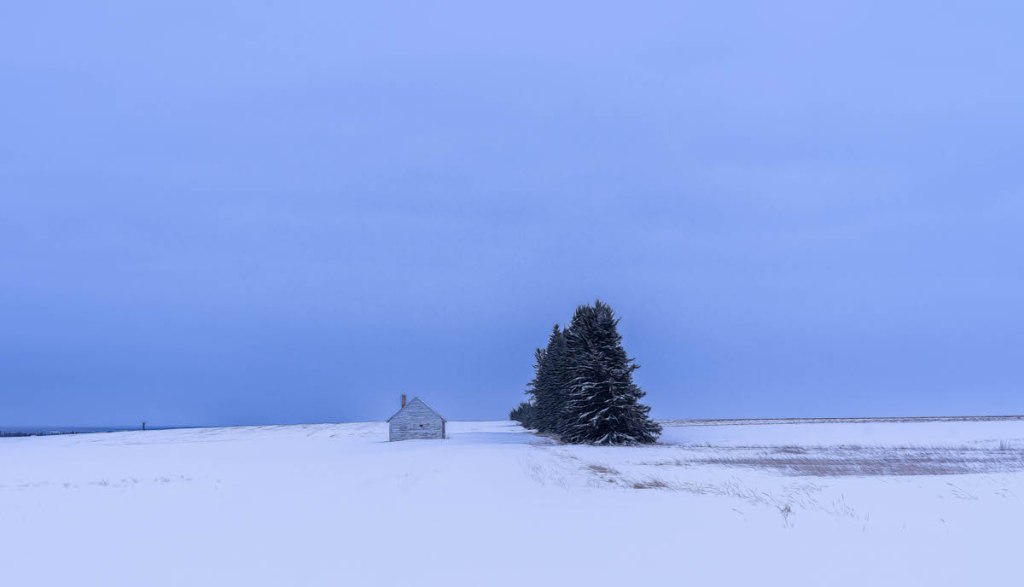
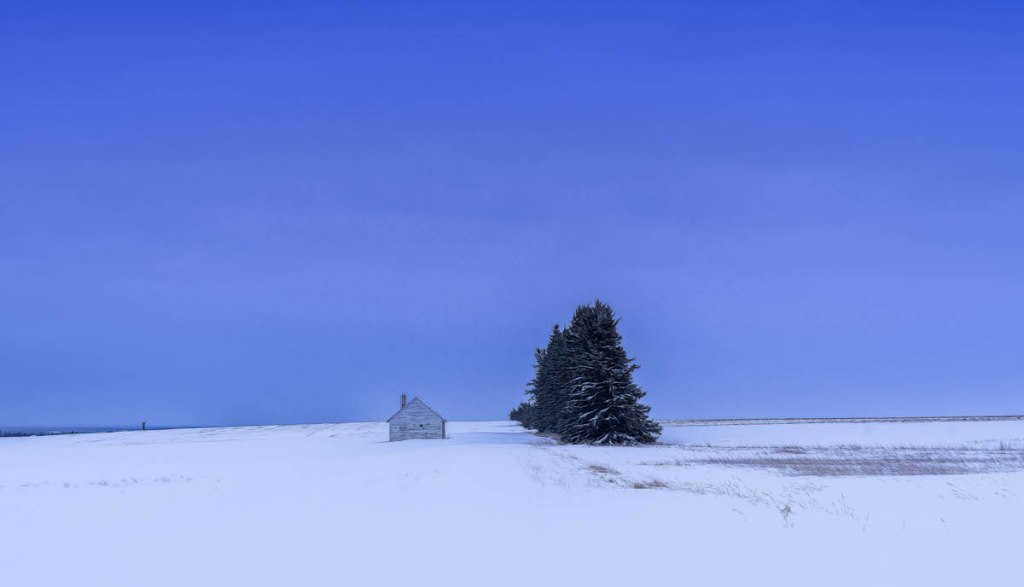
Light waning, I drove back through Beaverlodge, eastward intending to begin my return drive north. I took a chance and turned left (north). I drove up a hill on a Beaverlodge street that would become a highway. On the other side of this hill, I found the Beaverlodge experimental farm. On the east side of this road before the next highway junction, I gathered these images – a lone house alongside a living snow fence – a row of trees to prevent blowing snow; they are set upon the ark of a horizon line.
Listening to – Of Mice and Men’s ‘Dirty Paws,’ Jason Isbell and the 400 Unit’s ‘What’ve I done to help?’ and ‘Be Afraid,’ and Bruce Cockburn’s ‘Strange Waters.’
Quote to Inspire – ‘The pictures are there, and you just need to take them.’ – Robert Capa
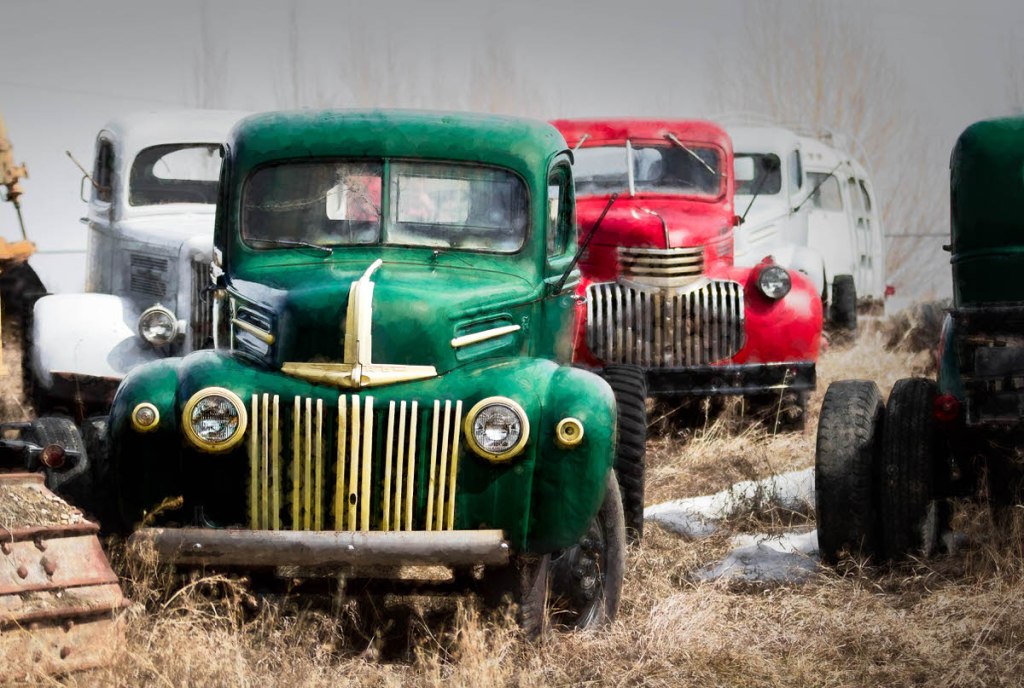
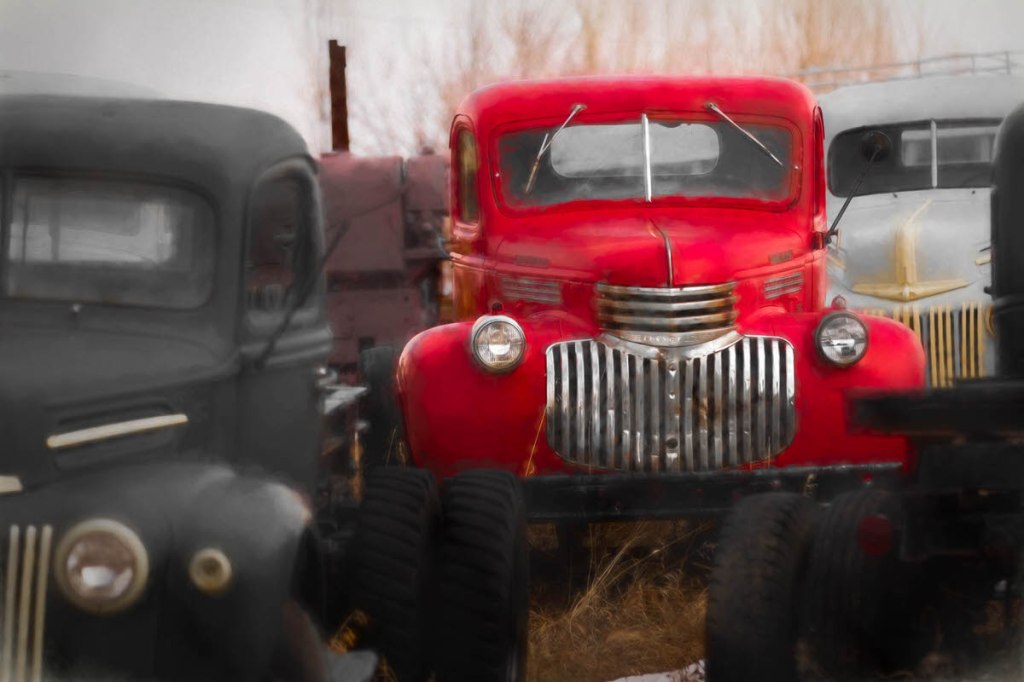
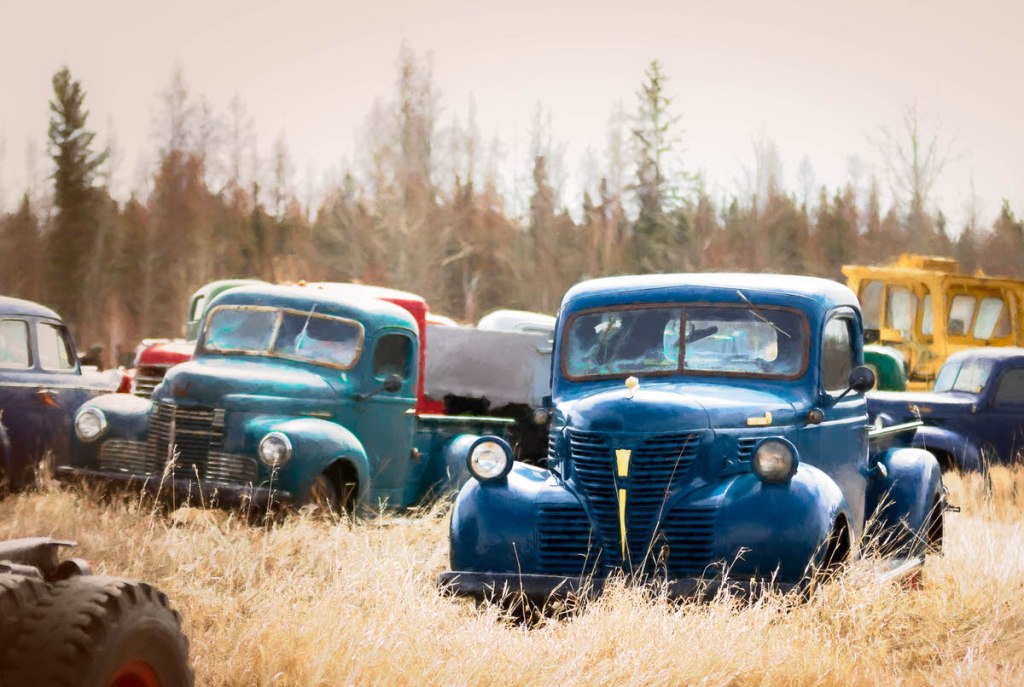
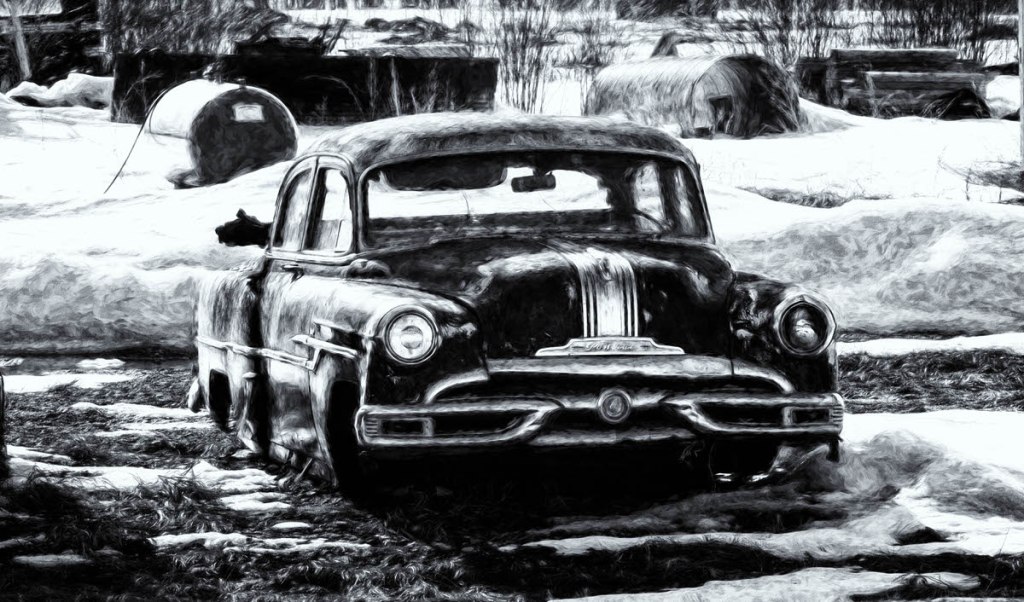
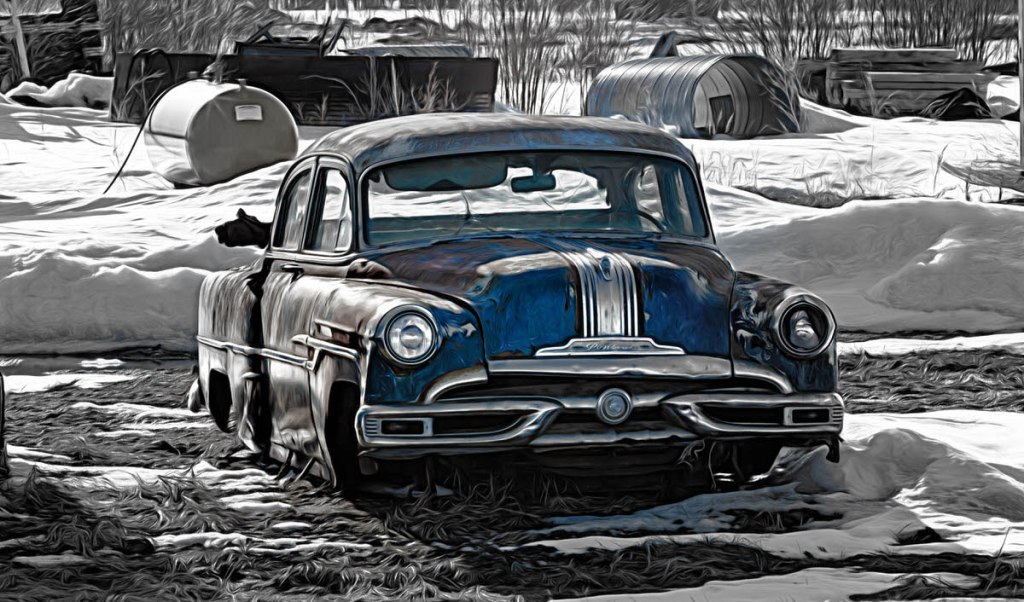
A re-edit and reworking of vehicle images from this blog, photos captured a decade ago, are presented here – line, shape, and size draw my attention, as does consideration of vehicle ride, feel, weight and driveability. Nostalgia may describe my desire to see and photograph these vehicles. However, these vehicles are from former eras. My interest is also in the post-war world of mom and dad, uncles and aunts, grandparents, and the time preceding me – their time engages my imagination.
The trucks were part of an army of vehicles that played a role in constructing the Mackenzie highway that serves northern Alberta and the Northwest Territories. They had been part of the vehicle collection of the Mackenzie Highway Truck Museum at Sangudo, Alberta. The museum vehicles have since been auctioned off long after the photographs were taken, and the museum structure itself has been dismantled and taken away. I am reminded here that my educator-grandfather worked different administrative roles in the highway’s construction during his summer teaching breaks. The early fifties Pontiac (a Chieftain or Pathfinder) continues to sit along the Mackenzie highway on its west side at Grimm’s Service Station in Manning, Alberta. My Pontiac interest derives from a two-door 1969 Pontiac Parisienne that transported our family through eleven years, the vehicle my parents taught me to drive in. A ‘car-guy’ interest also draws me to find aesthetic commonality or influence between the older and newer Pontiacs.
This text revision occurred on Friday, 18 August 2023. Wildfires in the Northwest Territories threaten communities and have burned through some communities. Yesterday, the city of Yellowknife was added to the list of communities being evacuated, and it is possible that wildfires could reach the city this weekend. The Mackenzie highway, referred to above, is the exodus route for NWT residents relocating to Grande Prairie, Fort McMurray, Edmonton and Calgary evacuation centers. These residents of the NWT are travelling through High Level today, gassing up, finding food and carrying on. It is indeed a hard thing they do: leave all that home is behind, take those things most precious with you, and not know what’s next. You are in our thoughts today. We wish you well.
Listening to – Snow Patrol’s ‘Chasing Cars‘ and ‘Berlin,’ Kathleen Edwards’ ‘Take It With You When You Go,’ and Bruce Springsteen’s ‘Ghosts.’
Quote to Inspire – “Photography has no rules; it is not a sport. It is the result which counts, no matter how it is achieved (Bill Brandt).”
Sunwapta Falls, Jasper National Park, Alberta, Canada
This image is a reworking of a summer photograph from a few years back. I’m liking where the image got to in terms of edits. About the day – I remember the camaraderie of other photographers chatting with me, from other parts of the world sharing chatter about their images, and showing the image captured on the back of their camera’s screens. On the right of this image – a group of fool-hardy photographers has stepped out beyond the fence above the gorge that drops perhaps 10-15 metres. I’m glad they got to go home safely.
Listening to – the Verve’s ‘Bittersweet Symphony,’ Dave Matthews and Tim Reynolds’ live take on ‘Bartender,’ Ryan Adams’ ‘Wonderwall,’ and Martyn Joseph’s ‘Arizona Dreams.’
Quote to Inspire – “A photograph is like a recipe – memory the finished dish.” – Carrie Latet
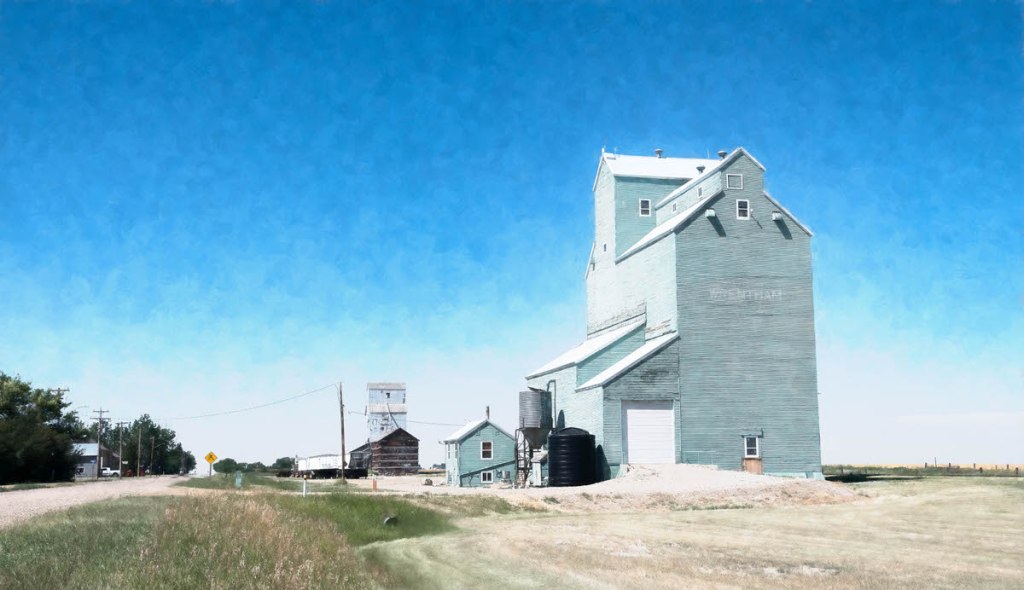
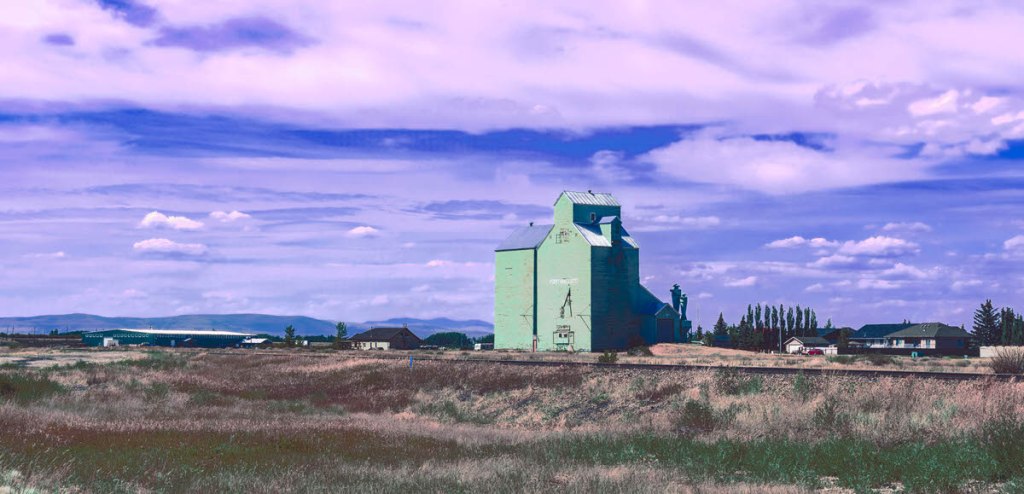
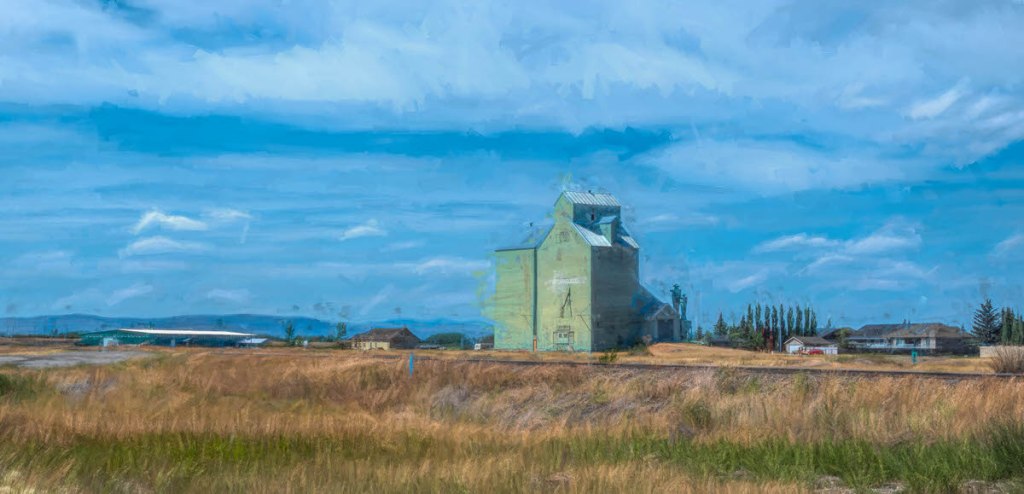
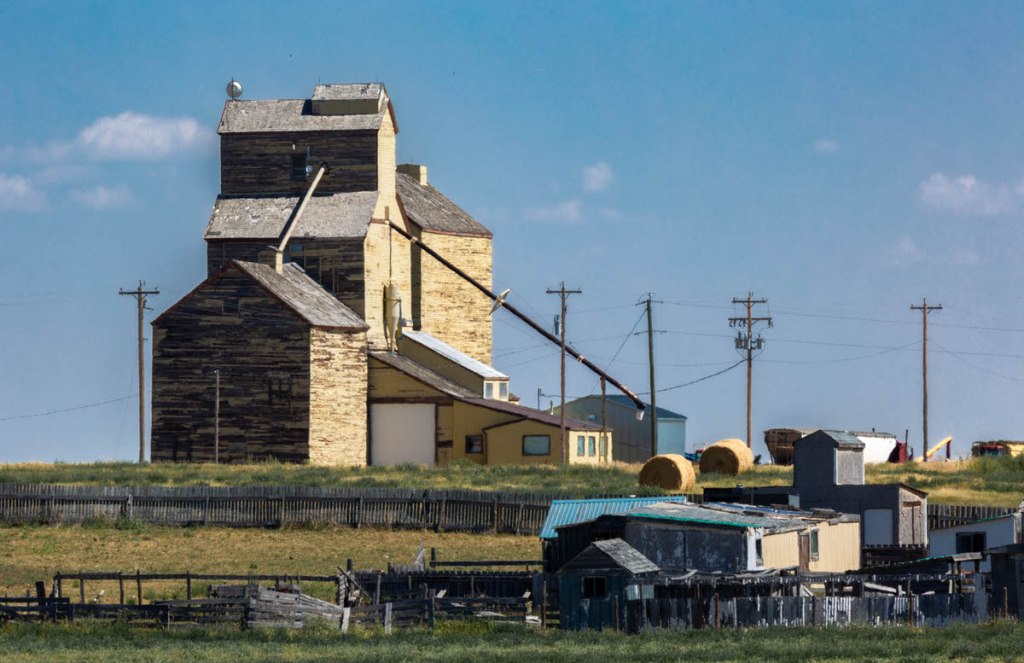
Wrentham, Alberta – Grain Elevator 1Wrentham, Alberta – Grain Elevator 2Warner, Alberta – Grain ElevatorFort MacLeod, Alberta – Grain Elevator 1Fort MacLeod, Alberta – Grain Elevator 2Skiff, Alberta – Grain Elevator 1Skiff, Alberta – Grain Elevator 2
I drove south and east from Lethbridge, Alberta with Wheat Kings as point of departure.
Listening to – The New Customs ‘McCarthy’s’ and Mariel Buckley’s take on ‘Ahead by a Century.’
Quote to Inspire – ‘The camera sees more than the eye, so why not make use of it?’ – Edward Weston
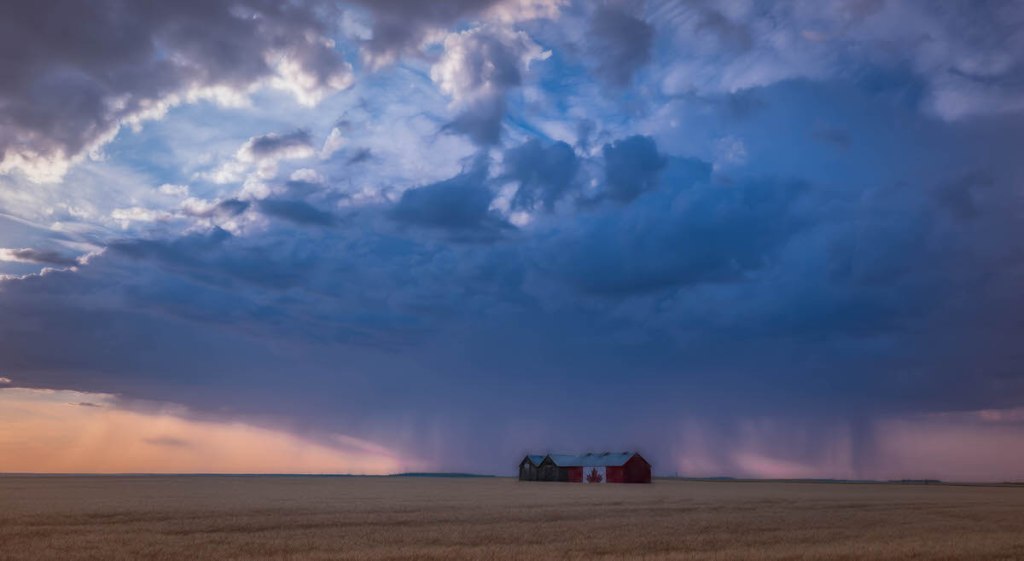
Canadian Grain Bin – Summer Shower 1Canadian Grain Bin – Summer Shower 2Canadian Grain Bin – Summer Shower 3
On summer’s return drive home – near Guy, Alberta, Canada
Listening to – Pat Green’s version of U2’s ‘Trip Through Your Wires’ with Joe Ely, Birdy’s ‘Quietly Yours,’ and 100 Mile House’s ‘1952 Vincent Black Lightning.’
Quote to Inspire – ‘When words become unclear, I shall focus with photographs. When images become inadequate, I shall be content with silence (Ansel Adams).’
One of my summer reads has been Thomas King’s ‘Indians on Vacation.’ It’s my second time through. I’m seeing more of the dynamic of a close-to-retirement husband and wife on vacation, away from the norms of their day-to-day Life, in the capital of the Czech Republic, Prague. Bird Mavrias and Mimi Bullshield are indigenous (Mimi – Blackfoot, Bird Cherokee, and Greek). They live in Toronto. In one sense, the vacation draws them away from the norms of their everyday lives, lives in which their indigeneity and that of indigenous persons within Canada are at issue. As well, it draws them out from their daily lives in Toronto.
While the proposed purpose of their trip is to search for evidence of Mimi’s Uncle Leroy and his European travels as part of an ‘Old West’ show and the medicine/memory bundle he would have carried, Mimi and Bird explore Prague – museums, walkabouts, the Charles bridge and more. While each is present to each site they investigate, each point of interest, as touchstone, leverages memory, the residue of significant happenings in their Lives – narratives of things done, not done, incomplete, and yet to complete. Each memory becomes a current stepping stone for what has brought them to Prague, each spilling out in response to what they encounter, and each often associates to unfinished/incomplete works in their lives.
Mimi and Bird move through Prague as ‘near-to-be’ retirees. They observe, they chat, they chuckle … they pull each other along, they love each other. Mimi has a moment in one of the museums, where she recalls a by-the-way kind of fact, ‘you know, they did that [ … ] at residential schools.’ The statement comes across with sober, unflinching anger. It is one inconceivable act (a haunting, repulsive consideration in this read) among the many that surfaced in Canada’s Truth and Reconciliation hearings. ‘So, we’re in Prague …’ begins most chapters. In structure, it’s a re-orienting phrase that allows Bird to recap and move forward in his telling of what’s next. Occasionally, perhaps often, the statement is a way for Bird to step into his day. It often comes across as resignation – a way of saying, yes this all happened. But, it comes across with resolve too – I still choose to move forward.
Prague’s Charles Bridge seems significant. It is a medieval, sandstone structure and along either side of the bridge are statues of saints, the Madonna, the crucifix, and Calvary – there are thirty-one statues they encounter strolling from one side to the other. In one sense, the statues may act as the grandfathers do in terms of Tipi poles – anchoring points for wisdom to be lived out in action. Perhaps the intention is to contrast the saints encountered in Prague with those encountered at residential schools.
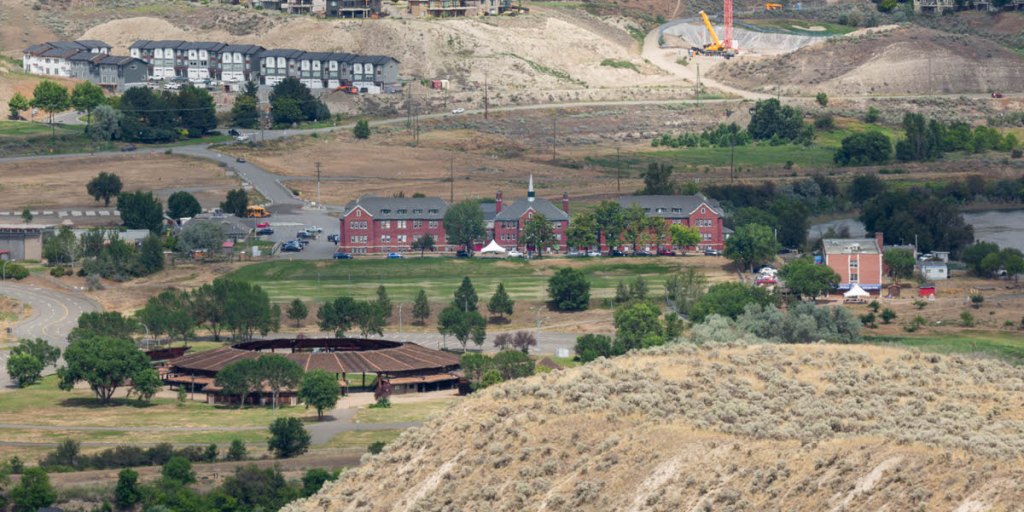
The Kamloops Indian Residential School – Summer, 2022
In my grappling with what residential schools were and all I am coming to know about their history and Canada’s history, I note that ten years ago the dominant word used would have been colonization and reference would have been made to colonizers. Now, ten years on, we seem to be in a time acknowledging the guilt of wrongdoing by the government and those running residential schools. Now there are Calls to Action that follow from the hearings of the Truth and Reconciliation Commission. One action taken as a step forward occurred this past summer. Pope Francis came to Canada and Maskwacis in Alberta and apologized to residential school survivors for how members of the Catholic Church co-operated in the cultural destruction of Indigenous Life.
The Kamloops Indian Residential School – Summer, 2022
My learning about residential schools came about as an educator beginning my teaching career at a school, on-reserve within a fly-in community. In the early nineteen nineties, my wife and I taught at a First Nation school in northern Alberta. As we began our first teaching year, there, an addition was being built onto the school. Students and staff weathered the inconveniences of learning and teaching in a school while a part of it was under construction. We completed our year well.
As we returned to school in the following year, the school’s renovation was complete. Classrooms would make do with existing furniture until new desks, chairs, and tables would arrive once the ice bridge allowed transport trucks across the river to the community. In that last week of August before the start of school in our renovated school, there was an occurrence. Staff were at the school into the evening with their work, readying the school and classrooms for learning, assembling the year’s plans for teaching. It might have been 8:00 p.m. and staff that had been at school began to leave for home, their teacherages.
One of our educational assistants, indigenous and fluent in his Cree language and culture, walked past one of the new classrooms, one that would be used for a kindergarten class, a class meant to acquaint students with the routines of school and to help them work in a bilingual Cree and English learning environment. No one was in this classroom as our educational assistant walked by. School corridor lights were starting to be turned off. The classroom’s lights had been shut off. As our educational assistant walked past, the classroom door opened … on its own. This event was significant and troubled the educational assistant. He took the information to community elders. We, as a staff, heard about the event days later.
Elders were concerned and did not want to send children to school. One of the elders asserted that the incident had to do with the souls of students who have died. A Jesuit priest who served the community was called upon and asked to perform an exorcism of the school using the burning of sweetgrass and holy water. We did begin the school year, but it took six weeks to gather most students into a regular pattern of daily attendance. All that happened in the fall of 1992, in a new school within a First Nation in its first years of self-government.
The Kamloops Indian Residential School – Summer, 2022
There is a learning point for me, here, though – something I had not grasped until 29 May 2021. From the time of the door opening in our new school and the community’s response to it, I grew to understand more and more about the residential school survivor experience. Through time survivors and counselors who worked with survivors would tell me little bits of what had gone on with residential schools and about impacts. As a teacher, attention would be drawn to the matter of taking children away from their parents and being without parent examples through their time at residential school as a dynamic impacting the parenting choices of residential school survivors – a void of parenting knowledge. My understanding began to grow about something called ‘Residential school syndrome,’ something similar to post-traumatic stress disorder. Here, the First Nation we worked with, back then, is to be commended for one of the primary goals they asserted for their teachers – in all that teachers did and would undertake in their teaching, teachers were to work from a stance of ‘good understanding’ when working with students and their parents.
But, there was more. A newer revelation came my way. I had not yet grasped this other potentiality for First Nation parents and families. On 29 May 2021, the Tk’emlups te Secwépemc First Nation in Kamloops, British Columbia disclosed that the remains of approximately two-hundred children were found buried at the Kamloops Indian Residential School. In hearing this news, I understood something significantly more disturbing than what had been my understanding about survivors and their families. While Indigenous children were taken from their families to school, it sometimes was the case that children did not return home. In the case of the Kamloops residential school, these two-hundred children are now considered missing children because their deaths are undocumented.
Michelle Good’s novel, ‘Five Little Indians,’ opens out the experience(s) of residential school survivors. What is more, though, parts of the novel have the reader consider that it was sometimes the case that a child’s parents were never informed of their child’s death. Children did not always return home to their parents and family from residential school.
In northern Alberta, at the school we taught at all those years ago, the kindergarten door opening in front of our educational assistant at a newly built school now had a deeper significance. At that time, the elders had considered that the souls of children who had not returned home from residential school were responsible for the classroom door opening. In May 2021, with the Kamloops residential school disclosure of graves surrounding the school, I was now able to understand more of the reality behind the elders’ concerns in sending students, their children to school.
The Kamloops Indian Residential School – Summer, 2022
Listening to: Bob Dylan’s ‘Dignity,’ John Prine’s ‘Summer’s End,’ Bruce Springsteen’s ‘One Step Up,’ and Blue Rodeo’s ‘Hasn’t Hit Me Yet;’ also a good listen to Gord Downie’s ‘Secret Path for Chanie Wenjack.’ Listening as well to Northern Cree’s ‘Straight Song,’ ‘A Song for TJ,’ and ‘Wah-Yo, Always Pray It Will Take You a Long Way.’
Quotes to Consider – “The residential school experience is one of the darkest, most troubling chapters in our collective history.” — Justice Murray Sinclair, the commission chairman, in his final remarks on the report.
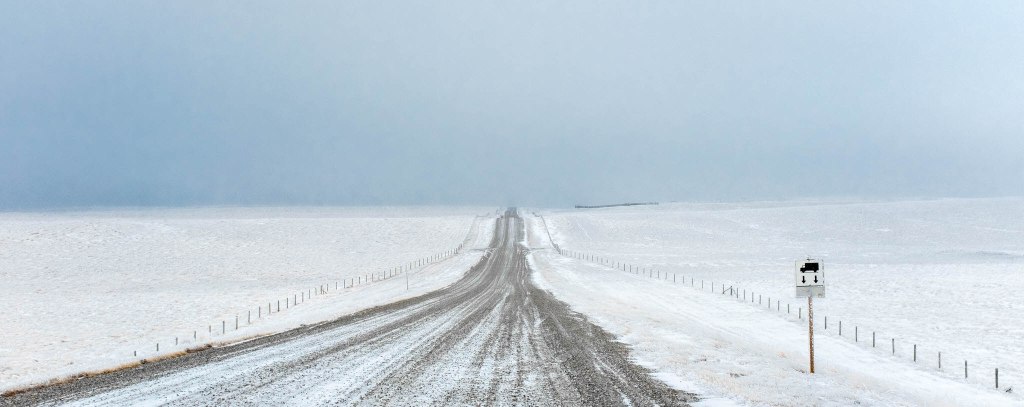
Three weeks back, amid mileage and a COVID pivot, on a road west in Southern Alberta, I was able to stop, get out of my truck, frame this image and two others, and return to my truck and motor on. Many elements make this image come together, not the least of which is the encounter of colour within a monochromatic image. Liking it.
Quote to Consider / Inspire – “One should not only photograph things for what they are, but for what else they are.” – Minor White, Frames Magazine, February 2021.
Listening to – Kathleen Edwards’ ‘Take It With You When You Go’ and Appalachian Road Show’s ‘Don’t Want to Die in the Storm.’
A COVID pivot provides minimalist moments among the modulation and ramble of foothills roads in southernmost Alberta.
Quote to Consider / Inspire – “Photography, as we all know, is not real at all. It is an illusion of reality with which we create our own private world.” – Arnold Newman, Frames Magazine, January 2021
Listening to – Jools Holland & Kylie Minogue’s take on the Clash’s ‘Should I Stay or Should I Go.’
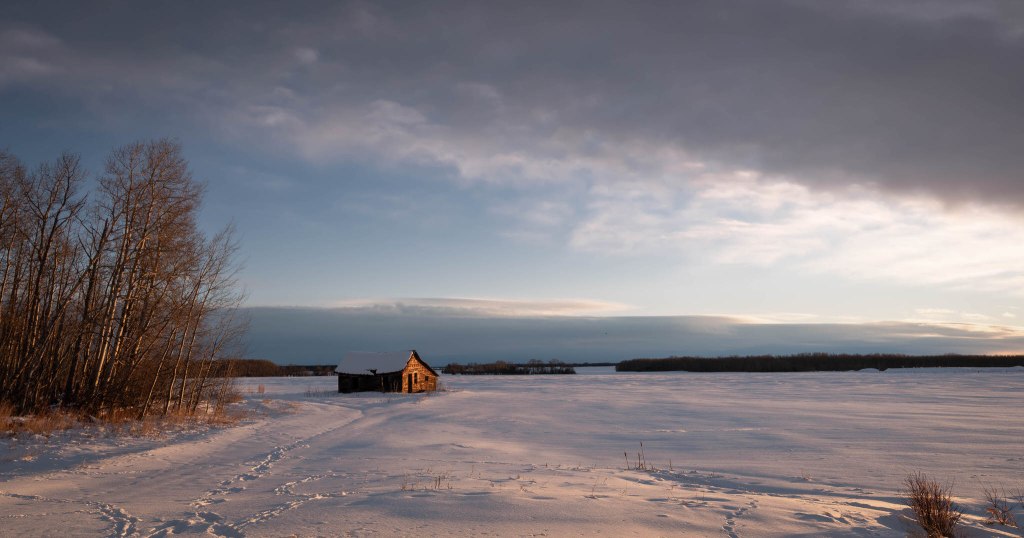
Liking this bit of winter morning light, directional light, side-light – intensity and shadows – falling on snow and an Alberta homestead, the first image in a long while.
Quote to Consider / Inspire – “… I believe that the real challenge of photography lies not in finding something or someplace exotic and beautiful to photograph, but in revealing the hidden beauty in what most people would consider mundane.” – Howard Grill, The Challenge of Photography, Frames Magazine, February 2021.
Listening to – Ian Tyson’s ‘Yellowhead to Yellowstone,’ Galen Huckins’ ‘The Kennicott,’ Roo Panes’ ‘A Message to Myself,’ and Hollow Coves’ ‘Adrift.’
Winter’s morning light and a homestead near Fairview, Alberta
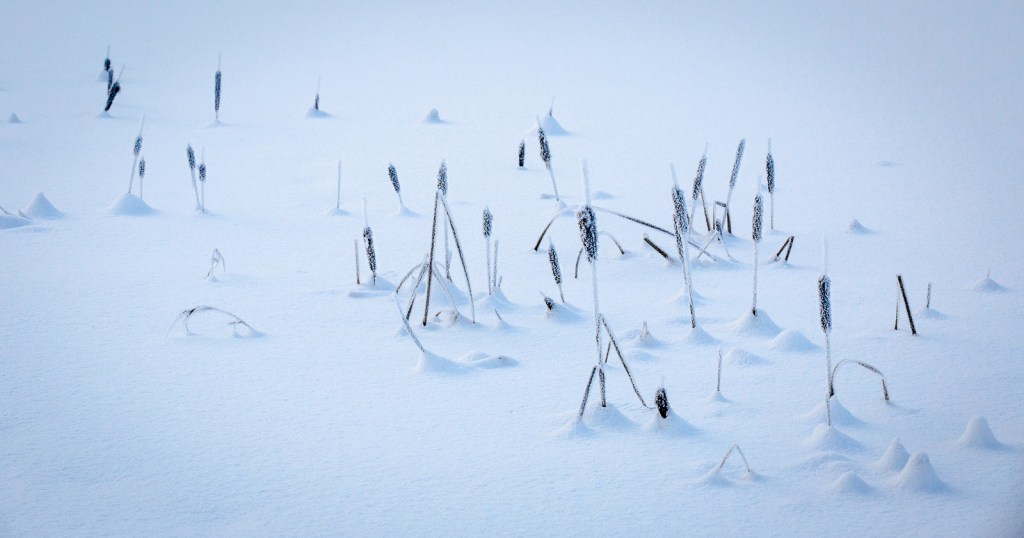
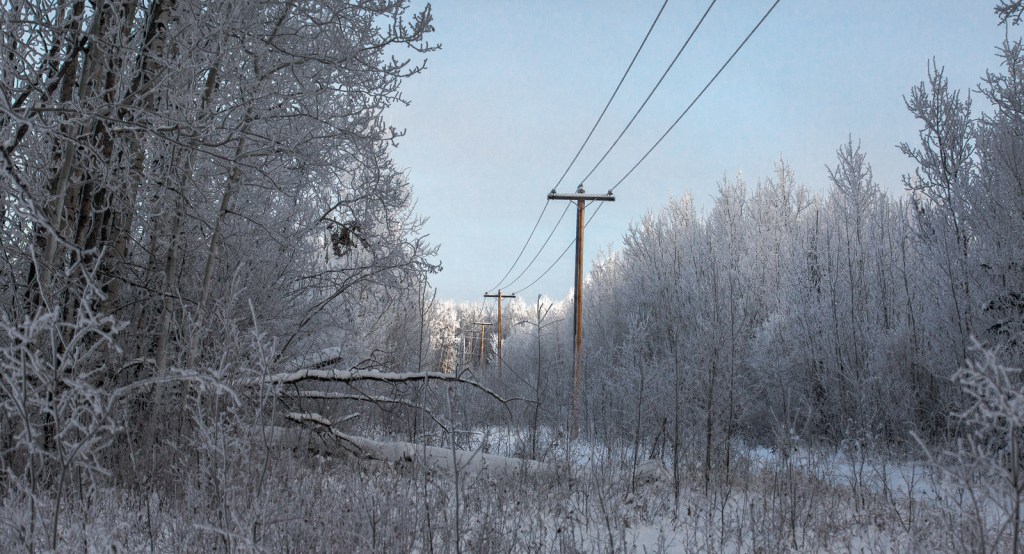
We left the house, my daughter, my wife and me, to investigate the snowy, colder (-20C+) world surrounding our High Level, Alberta community. I gave my daughter and wife a camera each to use, and off we went. Having spent so much time inside at Christmas, it was good to be outside in the air and within the landscape, seeing and thinking through photos and working again with camera, lens and settings. It was good. Our feet and hands were cold to start, but image-making made us move and explore; interest in our landscape took hold in each of us. An hour’s plodding perambulations kept us warm, and we were several images richer and had enjoyed the camaraderie of family endeavour by the time we went home. At home, we got to look at the photos and where edits could take us. Here are a couple of images.
Quotes to Consider / Inspire: (1) ‘The only photographer you should compare yourself to is the one you used to be (unknown).’ (2) ‘Don’t shoot what it looks like. Shoot what it feels like (David Alan Harvey).’ (3) ‘I wish that all of nature’s magnificence, the emotion of the land, the living energy of place could be photographed (Annie Leibovitz).’
Listening to: Arvo Pärt’s ‘Spiegel im Spiegel,’ Blue Suede’s ‘Hooked on a Feeling,’ U2’s ‘Magnificence,’ Angus & Julia Stone’s ‘Big Jet Plane,’ Rob Thomas’ ‘Little Wonders,’ Louis Armstrong’s ‘What a Wonderful World,’ Norman Greenbaum and ‘Spirit in the Sky,’ Bob Dylan’s ‘Shelter from the Storm,’ José González’s ‘Stay Alive’ and Junip’s ‘Don’t Let It Pass.’
















 In My Back Pocket - Photography
You must be logged in to post a comment.