













Imagine in your walking that you come upon a local cemetery, one you know well because it’s where your family has been buried through the ages. Imagine also that it’s getting to be a crowded place and that the sexton (gravedigger) has need to prepare a new grave. You’ve been away. So, you chat to catch-up on the news. The sexton’s efforts bring forth the skull of someone known to you and your family. The sexton is able to provide narrative about that skull and the soul which inhabited it – tales of good, mainly the good and memorable that connects to you. It’s the skull of someone known to you as a child and your memories tumble forth in your mind’s chatter. Your curiosity interrupts you. You know this region well. Your conversation shifts to the newly needed plot and for whom it is being prepared. Someone’s died. Someone you have known. That’s pretty much how young Hamlet in Shakespeare’s play comes upon Ophelia’s death, the death of a young lady from court that Hamlet should perhaps have wedded. There’s regret. Hamlet finds that she’s brought about her own end – likely from the confusion and obscurity relating to his intentions towards her. Her death is part of something bigger that’s happening, the unraveling and exposure of the truth.
Globally, the play is about addressing abusive power and control and is as much about organizational wrongdoing as it is about personal or individual wrongdoing. The plot seeks to confirm wrongdoing and to set things right from the top down and doing so requires elaborate and subtle means of addressing wrongs. People get hurt along the way, most notably those who surround the throne; by the end of the play Ophelia’s father, Polonnius, dies as does her brother, Laertes.
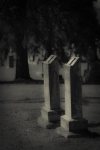
Death and change have been a part of Life in the past few weeks. In some ways it seems we are left reeling or perhaps numb in moving on from what’s been at play. In other ways the lesson to take away is that change does occur and it’s needed if Life and Lives are to improve. Hamlet, the sexton, Yoric (Hamlet Senior’s jester), Ophelia and the funeral come to mind with these photos of grave markers. It astounds me to consider what any of these Lives (as represented by these grave markers) has been comprised of, even only those lives memorialized by rock within these photos. Each Life has seen the bad and good in our history. Each have been at play within history. And, each has found a way to make a go of living Life. I am struck by how often the cross is representative of the Life that has been lived.
Listening to – Dave Matthews & Tim Reynolds perform Gravedigger, then its Anna Begins by the Counting Crows and You Might Die Trying by the Dave Matthews Band; Coldplay’s What If and Jack Johnson’s Rodeo Clowns also have featured in this evening’s listening.
Quote to Inspire – “A great photograph is a full expression of what one feels about what is being photographed in the deepest sense, and is, thereby, a true expression of what one feels about life in its entirety.” – Ansel Adams




 In My Back Pocket - Photography
You must be logged in to post a comment.