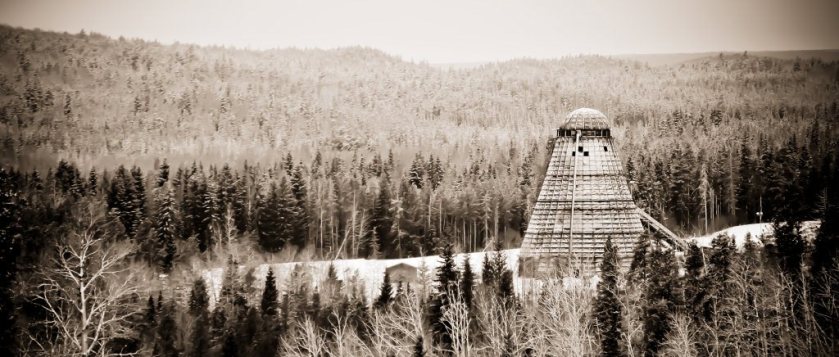
Saw Mill - Whitecourt
Different economic forces press on the development of Alberta’s natural resources. The fall-out can mean that resource development is postponed for better days. Twenty minutes north from Whitecourt, Alberta, down a long, winding hill into a valley, a sawmill sits in disuse waiting its return to operation. In my northward return drives to High Level through this year, I’ve been meaning to capture this image. On Sunday I found myself with time enough to halt my Nissan Altima along the side of the road and allow myself opportunity for looking through my Canon 70-200 mm F 2.8 lens.
Listening to: All This Time, Liberal Backslider and This Is Us from Martyn Joseph’s Thunder and Rainbows album on my return journey to High Level. My trip southward to Edmonton allowed for a six hour listen to Susan Sontag’s collection of essays in an audiobook version of On Photography, a good articulation and wrestling with photography issues.
Quote to Inspire – “To photograph is to appropriate the thing photographed. It means putting oneself into a certain relation to the world that feels like knowledge—and, therefore, like power. A now notorious first fall into alienation, habituating people to abstract the world into printed words, is supposed to have engendered that surplus of Faustian energy and psychic damage needed to build modern organic societies. But print seems a less treacherous form of leaching out the world, of turning it into a mental object, than photographic images, which now provide most of the knowledge people have about the look of the past and the reach of the present. What is written about a person or an event is frankly an interpretation, as are handmade visual statements, like paintings and drawings. Photographed images do not seem to be statements about the world so much as pieces of it, miniatures of reality that anyone can make or acquire.” – Susan Sontag (b. 1933), U.S. essayist. “In Plato’s Cave,” On Photography, Farrar, Straus (1977).




 In My Back Pocket - Photography
You must be logged in to post a comment.