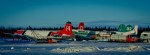
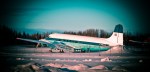
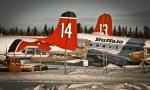
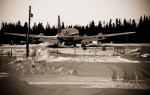
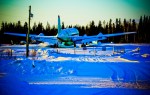
As you drive past Hay River’s Airport and look both to the run way and to aircraft parking/storage areas, it can seem that you have returned to a former time. Buffalo Airways has several Douglas DC-3s lining the airfield awaiting use in transport in and around the Northwest Territories. They are colourful workhorse aircraft – usually bright green on white or orange on white, easy to see and easy to be seen in. The reminiscence of former times is there for me with these aircraft. As research chemist, my father did a lot of flying between Canada and Europe with the parent and subsidiary plastics companies – Britain, Montreal, Toronto and Edmonton. On one of his early business trips in the sixties one of the gifts he brought back for me was that of a blue and white dye-cast model of a Douglas DC-3 advertising BOAC Airways, a plane model I would play with in my childhood and something kept still as remembrance of my early years.
Listening to Over the Rhine from the Ohio Disc 2; songs standing out are Long Lost Brother, She and Nobody Number One.
Quote to Inspire – “When I first became interested in photography, I thought it was the whole cheese. My idea was to have it recognized as one of the fine arts. Today I don’t give a hoot in hell about that. The mission of photography is to explain man to man and each man to himself.” – Edward Steichen, quoted in Penelope Niven’s ‘Steichen: A Biography’.
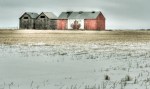
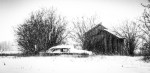
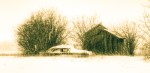
Farms, farm buildings, farm equipment and the occasional treasure of a rusting relic have surfaced within this week’s compiling of photographs. Rather than let them fall into the discard pile it may be good to give them their due, cluster them into photo gallery format and allow you a look at second, third and even seventh choices. Below, because this week’s photographs have dealt with farming images, I’m posting the lyrics to Murray MacLauchlan’s Farmer’s Song, a treat to sing and a song that you can find yourself singing with others also around a campfire. Lyrics as found on Lets Sing It http://artists.letssingit.com/murray-mclauchlin-lyrics-farmers-song-2s98rgh#ixzz1nMbsXNcE
Farmer’s Song – Murray McLauchlan
Re-released 9 October 2007 in Songs from the Street: The Best of Murray McLauchlan
Dusty old farmer out working your fields
Hanging down over your tractor wheels
The sun beatin’ down turns the red paint to orange
And rusty old patches of steel
There’s no farmer songs on that car radio
Just cowboys, truck drivers and pain
Well this is my way to say thanks for the meal
And I hope there’s no shortage of rain
Straw hats and old dirty hankies
Moppin’ a face like a shoe
Thanks for the meal here’s a song that is real
From a kid from the city to you
The combines gang up, take most of the bread
Things just ain’t like they used to be
Though your kids are out after the American dream
And they’re workin in big factories
Now If I come on by, when you’re out in the sun
Can I wave at you just like a friend
These days when everyone’s taking so much
There’s somebody giving back in
Straw hats and old dirty hankies
Moppin’ a face like a shoe
Thanks for the meal here’s a song that is real
From a kid from the city to you
Quote to Inspire – “Light glorifies everything. It transforms and ennobles the most commonplace and ordinary subjects. The object is nothing, light is everything.” – Leonard Misone
Listening to – She Walks on Roses by Bill Mallonee & Vigilantes of Love from Audible Sigh, then Mercy of the Fallen by Dar Williams from Beauty of the Rain and then finally Red Clay Halo by Gillian Welch from Time the Revelator.
A parked mid-fifties, Chevrolet four door sedan from 1955 or 1956, a Chevrolet that would have been ‘on the road’ in an era Jack Kerouac writes about in his novel with the same title – On the Road.
In the novel, a young World War II veteran, Sal Paradise, newly based in New York embarks on a career as writer, a writer in search of experience just at a time when America wrestles with new identity as world power and war victor. In one sense the book documents the restless, youthful spirit of a nation discovering identity as it moves into an era of prime economic stability.
Key among the era’s cultural entities is the independence of movement brought about by owning and driving a car. A car allows you to see the world. And, there’s always a car going by; so, if you’ve had a mishap with yours you can thumb a ride from someone else. Or, you can take a bus. Again, there’s the idea of a vehicle being something where all riding within it, all have their eyes fixed on the road ahead. Perhaps that’s part of what Kerouac aims at with message in all the travel – he might be pointing to the road ahead for the nation. Perhaps the car and occupants image is also about riding along with shared ideologies and intentions … but this is extrapolation.
Needless to say, a variety of vehicles – cars and trucks – move Sal Paradise and his cohorts across the nation from New York to San Francisco and back again … two or three times. A friend with a car is the force initiating Sal into a road trip. There’s the within vehicle narrative – what’s going on – and there is the travelogue narrative of Sal making sense of the America he finds along the way. By the end of the book Sal has ridden in and driven many vehicles … he’s been more a passenger than driver, though – one able to observe the goings on rather than being the driver compelled to get where he’s going. Perhaps there’s something there about stances that can be taken in living life.
Jon Foreman of Switchfoot got me to read Kerouac’s On the Road because of a section of stream of consciousness writing embedded into the novel’s narrative – the ramble and rant of thought-life shared, somewhat soliloquy, somewhat monologue, expression utilizing meter and curious placement of rhyme usually halting abruptly with quirky insight into the issue at-hand – Life and living. Here’s the quote Jon excerpted and placed within a Switchfoot concert that led me to consider a serious read of On the Road: “… the only people for me are the mad ones, the ones who are mad to live, mad to talk, mad to be saved, desirous of everything at the same time, the ones who never yawn or say a commonplace thing, but burn, burn, burn like fabulous yellow roman candles exploding like spiders across the stars and in the middle you see the blue centerlight pop and everybody goes ‘Awww!’” ― Jack Kerouac, On the Road
Listening to – Lucinda William’s Can’t Let Go from Car Wheels on a Gravel Road, The White Stripes’ 300 M.P.H. Torrential Outpour Blues (Live) from Under Great White Northern Lights (Live); it’s also been Last Thoughts on Woody Guthrie (Live) offered by Bob Dylan from The Bootleg Series Vols. 1-3 (Rare and Unreleased) 1961-1991.
Quotes to Inspire – (1) “Anything more than 500 yards from the car just isn’t photogenic.” – Edward Weston; (2) “You don’t take a photograph. You ask, quietly, to borrow it.” – Pentax Advertisement.
“Coming together is a beginning. Staying together is progress. Working together is success.” Leaders use this quote often to enhance organizational teamwork. Counselors use it to bolster and sustain forward movement among people in relationships who stumble and tumble. The words derive from Henry Ford and their analogy to the work of Life quite likely is taken from first automobiles produced on an assembly line. These words describe that dynamic of steady, determined, hope-directed forward movement towards goals through trial and error and improved performance. The statement articulates the manner of work involved in achieving a productive end through full investment into each learning curve we encounter. We work to understand what’s to be done and how to improve. We act, we work and we utilize feedback about current progress, tweaking action toward better, future performance.
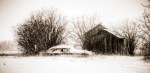
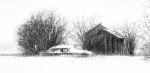
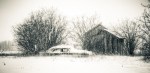
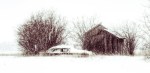
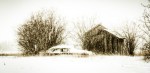
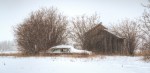
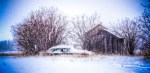
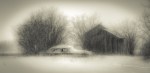
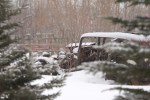
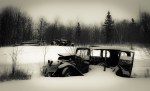
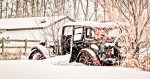
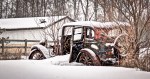
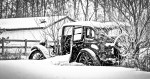
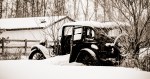
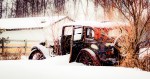
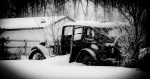
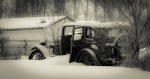
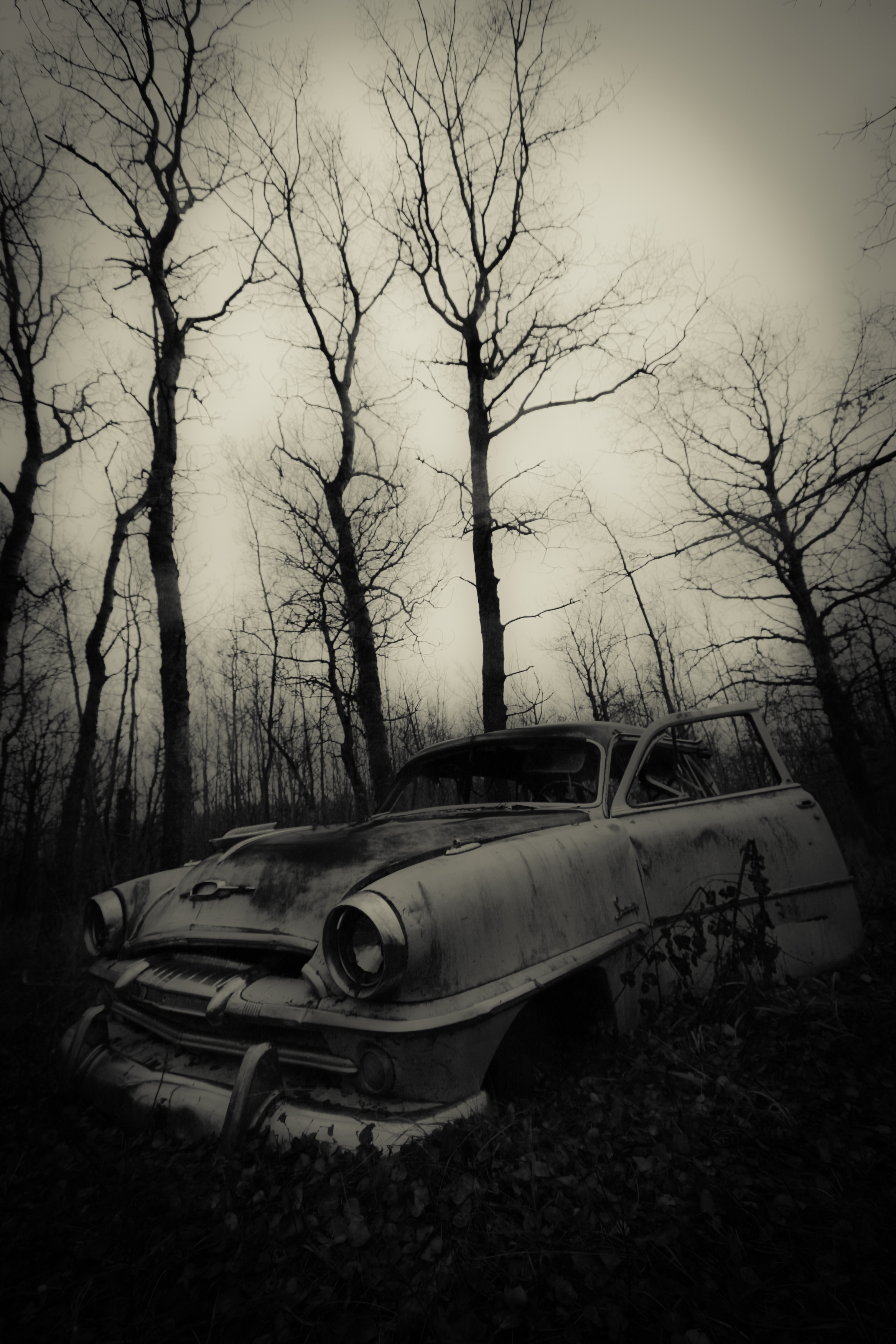
Photography has its learning curves, too. Good photography is about you learning subject and context and about you working to see them well through your camera’s lens. Working together is about you and the camera, it’s about you and the subject, and it’s about you and your environment. The vehicle that serves as subject to these photographs is a 1930’s rusting relic, a sedan with wooden spokes that could be a Chevrolet or a Ford or another make. I saw it last Wednesday in my return journey to Sunrise Beach, near Onoway, Alberta, a trip I was making with a friend to investigate the integrity of a second-hand 2000 GMC Yukon as a possible vehicle to replace my written-off 2000 GMC Sierra.
In photography, it may seem at first glance that it is appropriate to point the camera at anything that is in front of you. However, what is also at play is context and environment. The reality is that context and environment are associated with being property and with ownership. Beyond this, context and environment have intention; people identify what each are to be used for. Here, you’d assume that a vehicle put out for public display would not have any issues associated with it if one were to photograph it. Well, in photographing anyone’s property, there’s the matter of what will the photograph be used for and in this case there was perhaps something more akin to rural crime watch being what was at play, something that should have been anticipated. And, the curious owner who questioned me about my actions was both gracious and concerned. In this instance, I knew better … I could have lessened anxieties and awkwardness by introducing myself, stating my photographic intention and asking permission to photograph the vehicle. Working together, in this best practice for photographers and as one whose been influenced by a lineage of photographers would have had and will now have me working proactively to avoid discomfort and uncertainty for others and myself and work toward ensuring good, productive photographic outcomes … even to the point of accepting the possibility of ‘no’ being an answer to my request to photograph a subject. Proactively seeing things through well for all concerned is a key best practice in photography. This may see me creating a business card that will contain the assurance of contact information for people I deal with. It may even be worth going further and providing them with photographs of the subject as thank you or to create a calendar with my photographs (as bona fide) for this aspect of public relations and good business practice.
Quotes to Inspire – (1) “A definition of a professional photographer: A ‘pro’ NEVER shows anybody the mistakes.” – Anonymous; (2) “The progress of a photographer can often be marked by the accumulated number of mistakes he or she had made along the way.” – Catherine Jo Morgan (3) “Don’t be stupid and remember where you come from.”– Fr. Tony Ricard, NETCA Teacher Convention 2012
Listening to – Patty Griffin’s Long Ride Home, a song about losing a loved-one from the music-filled movie, Elizabethtown, a song followed by You Can’t Hurry Love, by The Concretes from the same movie soundtrack.
Someone’s project, this mauve and mint green 1953 Ford F-100 resides in the industrial area lot across from the Viterra grain elevator, a vehicle waiting for its next drive, more utility upon pavement. The mood of this photograph attracts. Its subject waits upon an earthly creator with abundant resources to transform ‘what was’ into ‘what will be,’ a creator who will set new purpose for this vehicle – breathing life into it, again. What this vehicle will become depends upon the creative imagination of those who will bring restoration.
Listening to U2 sing about INXS lead singer Michael Hutchence in Gone, from Best of 1990-2000 [B-Sides]; then it’s Gillian Welch singing Revelator from her Time – The Revelator album; finally it is Dar Williams singing Mercy of the Fallen from her album The Beauty of the Rain.
Quote to Inspire – “Photography can only represent the present. Once photographed, the subject becomes part of the past.” – Bernice Abbott
One technical aspect of William Faulkner’s novel, The Sound and The Fury, is that one narrative is investigated through active eyes of four different people associated with the story. The story receives telling from the perspective of and with the perceptive capability of each character grappling with what occurs as the narrative unfolds. Something similar occurs with perception when editing one photograph and altering minor elements of brightness, saturation and hue – what is seen and what one experiences in response to each configuration is different.
This evening, I’m looking back to a Friday in June, 2011. It’s after school and a Show and Shine is being held in High Level, Alberta in the Norpine Auto Industrial Supply Retailer parking lot. I’ve got my Canon 30D with me as I depart from school and drive past these pristine vehicles – vintage and current – that someone has enhanced with different rims and tires, that someone has restored and painted, that someone has taken the time to find and connect with memories of a former time. I pull ahead, past Norpine, turning in at the High Level Home Hardware store and park my 2000 GMC Sierra, there. The next three-quarters of an hour is spent photographing cars and trucks from different angles to find good and best shots.
I dialogue with vehicle owners, unleashing narratives associated with each vehicle we look to. Former students, in their first jobs following high school, show me their acquisitions – a Chrysler 300M and a GMC Sierra half-ton, both decked out with rims, fat tires and glossy shine. There’s room in our dialogue to sort through how I used to present cars in my post-high school days at Waterloo Mercury in Edmonton and what could be achieved with different McGuiar’s waxes for paint and a bottle of brake fluid for tires. I share with them that Autoglym Waxes are what I use these days and that Queen Elizabeth II has given royal warrant to the company because the waxes are used on Royal vehicles; while Hondas and Toyotas use the wax, so to does Aston Martin.
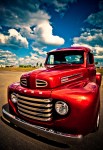
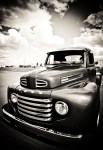
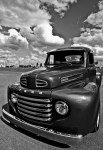
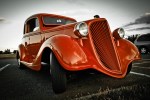
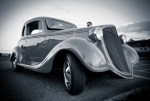
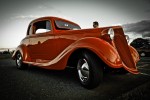
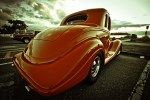
Mounted on my Canon 30D is a Sigma 10-20 mm wide angle lens … with it there’s the opportunity to distort vehicle form in terms of lines and curves … to add the wow factor. One vehicle I come across is this late fifties Ford half-ton painted bittersweet orange and waxed to full gleam to reflect June’s late afternoon sun, clouds and sky. Editing reveals this image in different ways … see which you enjoy best.
Listening to Over the Rhine and Within Without from their Discount Fireworks album; then it’s on to Mindy Smith singing One More Moment from her album with the same name. Later, it’s on to Babylon II by David Gray from the White Ladder album.
Quote to Inspire – “Photography is an immediate reaction, drawing a meditation.” – Henri Cartier Bresson
During evening meals as I and my brothers grew up my father would look back to his boyhood days and share stories and facts about the world surrounding him. Talk would often revolve about different outings and that his mum, my grandmother loved a Sunday drive in the landscape surrounding Moncton, New Brunswick where he grew up. It did her good to be with her family and to see the world beyond her home. A blue 1938 Pontiac transported them – a few years ago my aunt showed me a picture of the car with my Dad and his younger brother eating picnic sandwiches sitting in shade on the car’s running boards. Cars do double as portable homes or perhaps rooms and during transport they group a family together. Everyone has common vision, all staring down the road with the driver. Cars become a place to catch-up on things, a place to talk things through, places to share news – in transport, you’d not be the same person getting out of the car as you were getting in to it.
While cars did seem to be a family thing, a fact that I continue to be amazed at is that my father only learned to drive after completing his Ph.D. at the age of twenty-five or twenty-six; perhaps he anticipated family as his next step. And, maybe there’s some truth in that because during his university years at Mount Allison (Sackville, Nova Scotia) and at St. Mary’s College (London, U.K.), he hadn’t needed a car but had been able to make his way around Europe on train, by bus, on bicycle or hiking. And, it seemed that such travel was much more of a social thing with much more grace being there as fellow-travellers or friends in the act of travel. Perhaps there was that common purpose of travel in that former time – to ‘see’ the world (which also meant to experience it).
Dad had ideas about cars, about how long they should be driven before a new one should be bought. He had ideas and biases about good and better cars. He enjoyed a car that had what he would term ‘pep.’ It’s tempting to look at the cars Dad has owned and driven as associating to different points of development among our family – a 57 Ford Consul (marriage), a 64 Pontiac Beaumont (the family populates), a 69 Pontiac Parisienne (the family’s middle years), a 76 Chevrolet Caprice Classic with 74 Ford Gran Torino (the family’s later middle years), an 81 Oldsmobile Cutlass Supreme (kids almost ready to move out), an Oldsmobile Delta 88 with Dodge Aries K Car (first years of empty-nest), two Nissan Maximas (later empty nest and retirement) and a Nissan Altima (later years of retirement). You could almost use the technology available at each stage to chronicle the evolution of cultural norms within society … possible Masters thesis for someone.
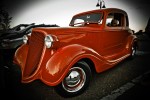
On occasion, cars – what they were about, their history and their potential for each aspiring driver in our family – would be the center of discussion at evening meals. One vehicle Dad commented on with regard to its history was a car alluded in terms of character name in the Disney/Pixar movie, Cars. Paul Newman provided voice-over for that car, now animated, Doc Hudson. Last summer I got to see a Hudson Terraplane, not one from the fifties or forties, but a Hudson Terraplane from the thirties, a pet project for an autobody repairman and tow-truck driver from Nanaimo. These photographs are taken at the end of July, 2011.
Quote to Inspire – “The question is not what you look at but what you see!” – Henry David Thoreau
Listening to John Mayer sing Route 66 from the Cars Soundtrack; the same soundtrack has Rascal Flatts singing Life is a Highway. After that it has been listening to Tom Cochrane and Red Rider in the Edmonton Symphony Sessions recorded at Edmonton’s Jubilee Auditorium – Avenue A, Bird on a Wire, Big League and Boy Inside the Man … all, good, good tunes.
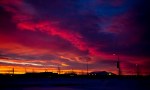
Thursday was a photographer’s morning. A warm change in weather brought colourful, early morning, sustained, sky drama of first light reflected earthward among clouds. Entering school, I set-up my camera, deposited my camera bag and moved out our east doors to click and capture the following images.
Today, being considered is a newer used vehicle. With one household vehicle being all-wheel drive, a fuel-efficient car might be smart (perhaps a VW Golf or Passat). Another consideration would involve spending a minimum of money on a vehicle that is 4×4 and wouldn’t be too much of a loss if it were to break down; here, I’ve owned three early 90s Nissan Pathfinders and they worked for me along the corduroy roads in and out of Wood Buffalo National Park through six years. And, in the back of my mind is the surety I encountered driving a Chevrolet, 2500 series, manual transmission with 4×4 in a snow storm travelling down Alberta Highway 63 from Fort McMurray to Edmonton early-on in the 90s. The overall sensible choice may be a 1999 Toyota 4 Runner with 309000 km that should run for a few more 100000km and can be purchased in a private sale in Peace River. This vehicle should provide safe travel in and out of 4×4 throughout all seasons, no matter who was driving it. It would hold the road well.
Listening to Canadian Melissa McClelland sing Victoria Day (April Showers and May Flowers) from her album of the same name. Other songs standing out this morning have been Snow Patrol’s Lifeboats, Ray Lamontagne’s I Still Care for You and For the Summer. Jack White has featured among the Raconteurs in Steady as She Goes.
Quote to Inspire – “Light glorifies everything. It transforms and ennobles the most commonplace and ordinary subjects. The object is nothing, light is everything.” — Leonard Missone
At an age when wearing glasses assists me in my day, my experience of working with a camera through to editing an image often is about revisiting subject and context to see what else is there; it is actual re-view (review). The process is similar to gleaning feedback in using a personal journal. And, in journaling, one point of revelation has been sorting through the conception that memory, perception, thought and even feeling are only what they were on the day that they occurred. In that portion of experience in which they occurred they were what truth was – they became the facts in response to Life’s events for that duration of time. Without a record, the memory that is carried forward can shift, adjust and change over time … with new thoughts, feelings, perceptions and influences – memory is or becomes malleable. Just like a journaling process, creating a photograph isolates the truth of ‘what was’ for the duration of time in which it occurs. What is also valuable about a journal and photographs produced by the photographer and camera is that you can revisit subject and context to see and appreciate more of what else was there. The journal and photograph inform you and other readers/viewers about the personal narrative of the writer/photographer. The feedback of what else was there, that you now see, informs future action.
Listening to Neil Young’s Old Man and reminded that Lizz Wright also sings this song; there’s not so much experientially that separates us, the older and younger; it does seem to be a father-son song and the son’s revelation of greater similarity than difference.
Quote to Inspire – “Photography, as a powerful medium of expression and communications, offers an infinite variety of perception, interpretation and execution.” — Ansel Adams
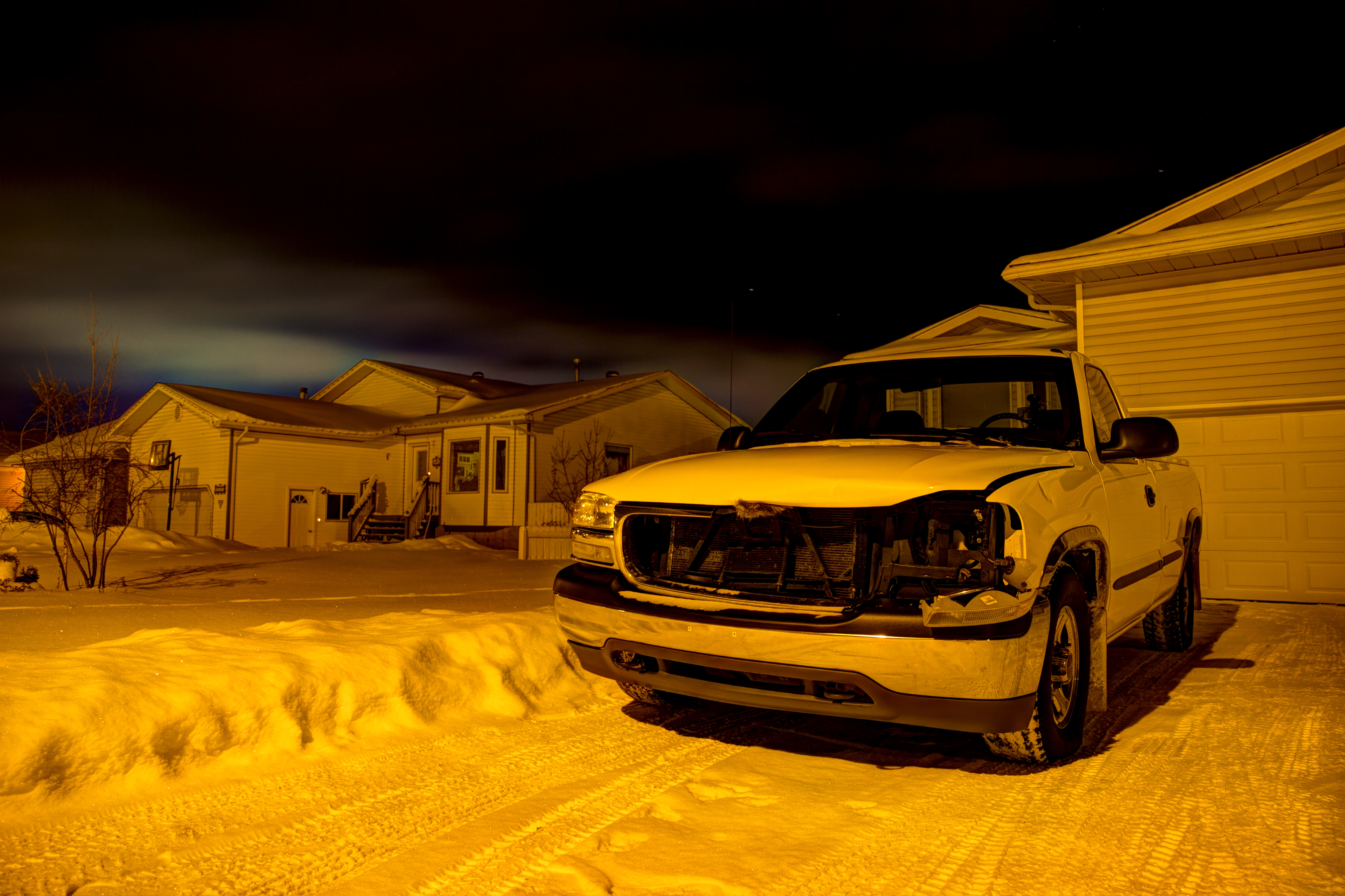
Deer – three does chased by a stag crossed Alberta highway 88 as I traveled eastward from High Level to Fort Vermilion at 8:00 a.m. on January 23, 2012; the three does made it across safely between myself and oncoming vehicles. I slowed my truck down on the icy road but not enough to miss hitting the stag. I stopped further ahead and turned around to see about animal remains that might need to be hauled from the road. Nothing was found. There was a swale in the snow where the deer had drifted into the ditch on the north side of the highway. But, the stag and does had taken off. My truck, on the other hand, received damage – the grill and light housing mainly and the radiator and transmission cooler were pushed back toward the engine. I checked it out and watched the gauges – it held together for another 160 km and still is driveable today. Despite being in immaculate shape, at 286 000 km, this 2000 GMC Sierra is considered a write-off as the cost to repair the truck exceeds the value of the truck.
The antlered stag, imagistically recalls U2’s Electrical Storm video, its being written about Ireland’s Easter Day Accord, and the ghosted image of the stag in the Electrical Storm video – a subject I’ve commented on on the old U2 Zoo Station (Zooropa) website.
Listening to – Impermanent Things by Peter Himmelman from his Stage Diving album.
Quote to Inspire – “There are always two people in every picture: the photographer and the viewer.” -Ansel Adams
























 In My Back Pocket - Photography
You must be logged in to post a comment.