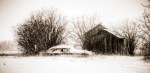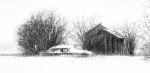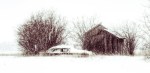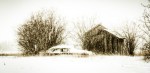
Past Old to Abundant New

Canon 60D, Canon 70-200 mm 2.8 IS L Series Lens, Canon Camera, Canon Live View, Farm, Farmhouse, High Dynamic Range (HDR), Home, Homestead, Photography & Conceptualizing Beauty, Project 365 - Photo-a-day, Still Life, Winter

A homestead, a memory anchor, reminds of former times; its past informs our present.  Any of us can look at what is, what we now have and what we now do from the perspective of what was, what we haven’t had and what used to be done.  With realization, shift and tweak the historical becomes present. One attribute associated with progress is that current effort expended in the practice of living is reduced from former effort yielding smaller result. Transition to better practice comes through good understanding of the past. Such learning is usually associated with overcoming mistakes as well as obstacles. John O’Donohue, a former priest, talks of this process in conversion. For him, one’s walk is only possible by being faithful to one’s mistakes, those points of learning that forward you in your walk.

Similar practice is found in jazz as musicians work to add variation to melody and theme. They hear what works. They hear what does not work. While what does not work, the dissonant note or chord, points to what does work, often jazz players incorporate dissonance into music’s landscape; dissonance is heard and grappled with, creating yearning toward primary melody. The variation becomes one among many that takes the listener’s ear through landscape of the piece returning to primary melody alone.  Jacque Loussier works skillfully with Satie’s Gymnopedies Gnossiennes in creating such variations. Dave Brubeck does the same in all of his work; reminiscence here is drawn to those Saturday nights with my father working through Brubeck on his Heintzman grand piano in vertical form.  Songs included Blue Rondo a la Turk, Bru’s Boogie Woogie and Take Five, all the masterful, ingenious work of Dave Brubeck.

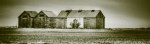
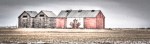
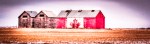
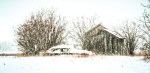
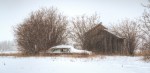
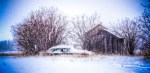
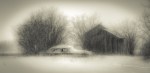
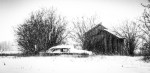
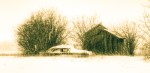
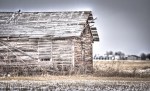
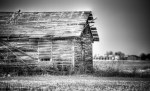
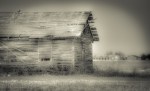
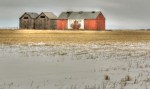
What was and what is, what works and what hasn’t are outcomes found in a Life richly lived.  Mistakes are a part of life; the poignant thing, here, is to let mistakes remain at play within us and to let them inform next action.  Here, in today’s photograph, a third rendering of the Donnelly homestead juxtaposes old homestead against abundant farm operation. I hadn’t thought of it until today, that in the visual memorial that this homestead is, it is in itself a wisdom text, something with story that informs us presently and it does so in the same way a photograph’s narrative will (if we let it).

Listening to – From Don Henley’s Inside Job songs standing out are Annabel, Inside Job, Goodbye to a River (in which he seems to forecast the recession) and For My Wedding; Jesse Cook has been at play with Vertigo, Red and Byzantium Underground from his album Vertigo; as well, Martyn Joseph’s live album, Don’t Talk about Love, has been on my mind with songs like Liberal Backslider, The Good in Me is Dead and Have an Angel Walk with Her.

Quote to Inspire – “For me the printing process is part of the magic of photography. It’s that magic that can be exciting, disappointing, rewarding and frustrating all in the same few moments in the darkroom.” – John Sexton
Collected, Not Yet Discarded – Other Photographs from the Week

Best Practices - Photography, Canon 60D, Canon 70-200 mm 2.8 IS L Series Lens, Canon Camera, Canon Lens, Canon Live View, Combine (Farming), Farm, Farmhouse, Home, Homestead, Light Intensity, Photoblog Intention, Photography & Conceptualizing Beauty, Project 365 - Photo-a-day, Season, Still Life, Vehicle, Vehicle Restoration, Winter

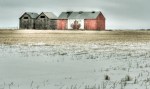
Farms, farm buildings, farm equipment and the occasional treasure of a rusting relic have surfaced within this week’s compiling of photographs.  Rather than let them fall into the discard pile it may be good to give them their due, cluster them into photo gallery format and allow you a look at second, third and even seventh choices.  Below, because this week’s photographs have dealt with farming images, I’m posting the lyrics to Murray MacLauchlan’s Farmer’s Song, a treat to sing and a song that you can find yourself singing with others also around a campfire. Lyrics as found on Lets Sing It http://artists.letssingit.com/murray-mclauchlin-lyrics-farmers-song-2s98rgh#ixzz1nMbsXNcE

Farmer’s Song – Murray McLauchlan

Re-released 9 October 2007 in Songs from the Street: The Best of Murray McLauchlan

Dusty old farmer out working your fields

Hanging down over your tractor wheels

The sun beatin’ down turns the red paint to orange

And rusty old patches of steel

There’s no farmer songs on that car radio

Just cowboys, truck drivers and pain

Well this is my way to say thanks for the meal

And I hope there’s no shortage of rain


Straw hats and old dirty hankies

 Moppin’ a face like a shoe

Thanks for the meal here’s a song that is real

 From a kid from the city to you


The combines gang up, take most of the bread

Things just ain’t like they used to be

Though your kids are out after the American dream

And they’re workin in big factories

Now If I come on by, when you’re out in the sun

Can I wave at you just like a friend

 These days when everyone’s taking so much

There’s somebody giving back in


Straw hats and old dirty hankies

Moppin’ a face like a shoe

Thanks for the meal here’s a song that is real

From a kid from the city to you

Quote to Inspire – “Light glorifies everything. It transforms and ennobles the most commonplace and ordinary subjects. The object is nothing, light is everything.” – Leonard Misone

Listening to – She Walks on Roses by Bill Mallonee & Vigilantes of Love from Audible Sigh, then Mercy of the Fallen by Dar Williams from Beauty of the Rain and then finally Red Clay Halo by Gillian Welch from Time the Revelator.

That Old A&W Shirt and A World Fed

Best Practices - Photography, Canon 60D, Canon 70-200 mm 2.8 IS L Series Lens, Canon Camera, Canon Lens, Canon Live View, Combine (Farming), Farm, Farmhouse, High Dynamic Range (HDR), Home, Light Intensity, Photoblog Intention, Project 365 - Photo-a-day, Winter

Farmhouse, Grain Bins & Combines

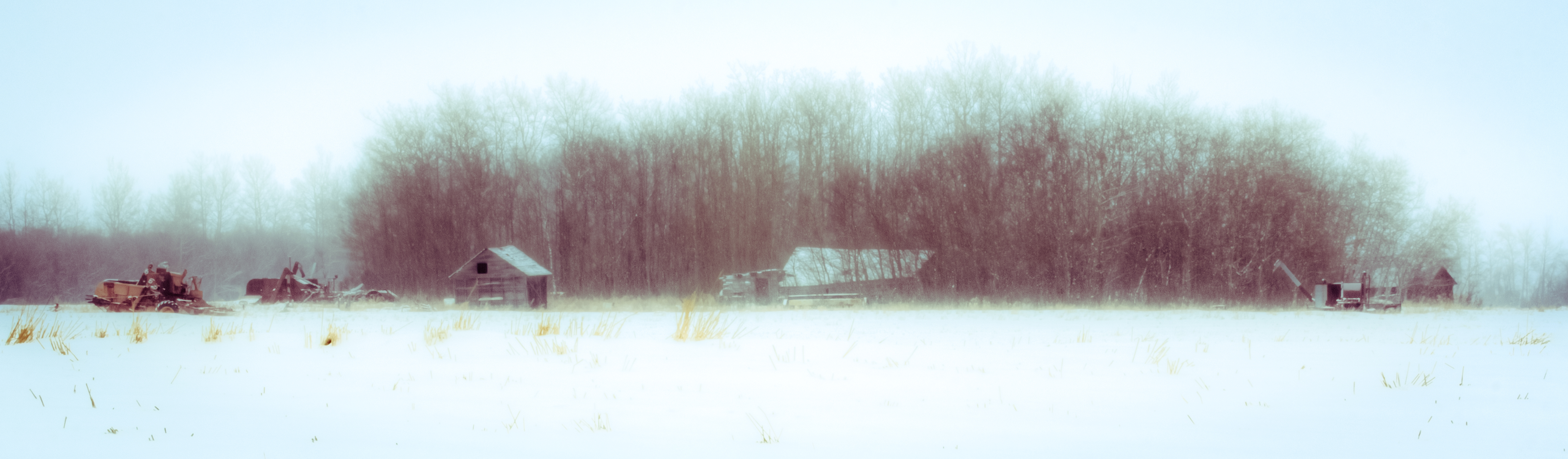
Curiosity surrounds this image.  A derelict farmhouse is at geometric center point for farm buildings and as many as four combines from the fifties and sixties – three on the left (one is hidden behind the darker one) and one on the right, in front of the grain bin.  The buildings have not been burnt off the land and the combines no longer work; again, there’s an air of abandonment as well as reverence for what was a family’s starting point.

My cousin, a farmer, in his first decade of marriage would occasionally wear an A&W shirt from its nation-wide hamburger restaurant chain, something likely found and bought from a Goodwill or Value Village or Thrift Store back in the eighties. I’m not sure if his wearing of this shirt was youthful cynicism or if he was making light of the fact that as a farmer he fed the world – all farmers do this … but role/position in what one does for work as farmer sometimes blurs/shifts to the background what farmers accomplish on a global scale. I don’t know if I’ve ever thought about how many people all his grain and all his cattle could keep alive in one year; I wonder if he has?

My cousin and his wife ran a mixed farming operation in partnership with his father and his mother in Rimbey, Alberta, an area of Alberta situated in a golden triangle blessed with the right combination of rain, sun and cloud for their grain crops, an area of the world that supported a sizeable Hereford cattle operation, as well. The Blindman River runs through their property and while summer was an extremely busy season, my cousin likely looked forward to days when friends and relations would visit, allowing him to break away from heavy or mundane routines. On our visits, we’d go back into the wooded ravine and talk. There’d be good-hearted, entertaining, teasing back and forth as we investigated the currency of each other’s lives in playful interrogation.  A good amount of bull-s**t would extend exaggeration into all that our stories could become. On my cousin’s farm, I watched him grow from a boy building model cars, to a youth with a grain elevator job who was dating (… and owning a black, two-door, 1966 Chevelle), to a young spouse, into a farming partner, to a father, and then two decades later into an innovative entrepreneur with patents for frost-free nose pumps.

In recent years I’ve been struck by how close to the land they may actually have been living and how much their success or failure as farmers depended on their ability to rely upon and support their neighbors; help offered and help received is/was really an investment in community and in each other. I am impressed by the humility they exercised in allowing themselves the help offered by neighbors who took care of them and saw them more as family than neighbors. Likewise I am impressed by the care they showed not only to our family, but towards others by putting something positive in their lives when they needed it … even if this was only done by way of good-hearted humour and teasing during an evening board game.

Stories take me back to this era of time when farms such as this one captured in this image were starting points for Canadian families.  One set of Canadian stories about farm-life were W.O. Mitchell’s Jake and the Kid Stories.  The other story that opened out the time toward moving into the fifties was John Grisham’s A Painted House. The farm I know best, though, is that farm my cousin grew up on; and, then I come back to this image and the questions I have about leaving it in this state – it must be memorial, something that draws memory back to what was and who they were that made things happen, feeding the world.

As I’ve searched through my music for songs associated with Canada and with farms I’ve run into Murray McLauchlan, a singer and songwriter whose album I purchased would have been one of the first three albums I ever purchased.  The one that would have pulled my ear to the radio would have been Hard Rock Town, a song I tried to understand in terms of narrative in grade 8, 9 or 10; the other would have been Farmer’s Song, a song that could be sung around a campfire in unison, a song that could be sung in a prairie tavern when everyone’s collected on a Friday or Saturday night.

Listening to – Murray McLauchlan’s Hard Rock Town from his Songs from the Street album and Farmer’s Song, done I think with Murray McLauchlan et al in Lunch at Allen’s Catch the Moon album. Finally, tonight I purchased Ryan Adam’s Chains of Love from his Ashes & Fire album.

Quotes to Inspire – (1) “A photographer without a magazine behind him is like a farmer without fields.” – Norman Parkinson; (2) “Beauty can be seen in all things, seeing and composing the beauty is what separates the snapshot from the photograph.” – Matt Hardy