
Goethe, Horizons and Thresholds

Backlight, Barn, Best Practices - Photography, Canon 60D, Canon 70-200 mm 2.8 IS L Series Lens, Canon Camera, Canon Lens, Canon Live View, Farmhouse, Flora, Light Intensity, Night, Photography & Conceptualizing Beauty, Project 365 - Photo-a-day, Spring, Still Life, Sunset

Saturday – new horizons await a friend, a colleague and a mentor as he moves on from our school. He is the person who hired me into our school division. And, he’s someone who in action, thought and approach is a character developing leader worthy of Goethe’s quote (below) because he’s able to encourage and bring forth the best contribution people have to offer among our team. He lives this out in practice, “Treat people as if they were what they ought to be, and you help them to become what they are capable of being.” – Johann Wolfgang von Goethe. And, his farewell party – a remembrance and celebration of the impact he’s had on people’s lives – is something I’ve had to miss being a Dad who has needed to bring home his son and his son’s gear from University. My contribution to my colleague’s farewell was an Animoto slideshow, a collection of images taken from various points in his thirty-year career – memorable, memorable times (like the fun we had skidooing and coming upon a saucy lynx that wouldn’t be bothered about getting out of our way). My wife went in my stead with our friends to the farewell celebration.

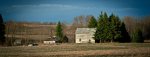
That was Saturday night, a night memorable also because I wasn’t there yet was thinking about all its goings-on.  The photographs, here, are taken roughly at the same time of night that this colleague’s farewell celebration would have been in full swing.  I stopped in my drive to look around with my camera lens because I know my friend and mentor would want me to. This week has been about offering photography as a contribution to the school’s dinner theater. The Northern Actors’ Guild, our school theater troupe, is presenting the musical, Grease. It’s been fun working with students and staff to create a visual record of rehearsals and headshot portraits for foyer display. Students in high school are at the tail-end of adolescence still metamorphosing into adult form – photography, here, along with the actor’s costumes acknowledges state of change, a step closer to or perhaps into adulthood.  It shocks and surprises – the new state does not always assimilate easily in terms of understanding one’s identity.

Perhaps that is something else that photography is – a record of threshold moments.

Listening to – Over the Rhine’s Spark, Patty Griffin’s Tomorrow Night, Mindy Smith’s Train Song and Dar Williams’ Mercy of the Fallen.  I-Nine performs Same in Any Language and Ryan Adams, his She Wants to Play Hearts. Then there’s Bruce Cockburn’s Pacing the Cage and David Gray’s Tidal Wave which rounds out into Over the Rhine’s Born.

Quote to Inspire – “If your photos aren’t good enough, then you’re not close enough.” – Robert Capa

Tougher & Last Man Standing

Barn, Canon 60D, Canon 70-200 mm 2.8 IS L Series Lens, Canon Camera, Canon Lens, Canon Live View, Farm, High Dynamic Range (HDR), Photoblog Intention, Photography & Conceptualizing Beauty, Project 365 - Photo-a-day, Season, Spring, Still Life, Vehicle, Vehicle Restoration, Winter
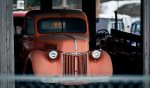
Fifties Flatdeck Truck - Nampa, Alberta

Fifties Flatdeck Truck - Nampa, Alberta

A few things make today a tougher go – not the legitimate student response to spring’s arrival and the fever it’s engendering, nor is it those minds that recognize that their attitudes are blocked, stalemated or closed with the past six months of winter’s interior Life at home and school; at this time of year openness in perception, thought and attitude itches in angst to break free of winter’s constraints of living.  These are all within the arena of Life work in early spring in High Level, Alberta.

At this time of year, it’s too easy to say the wrong thing. It’s too easy to get caught-up in oneself and one’s endeavors. It’s too easy to neglect where one’s care needs legitimate directing.  This season is one in which humour can get you into serious trouble while also being a source of tremendous healing and celebration.  It’s a time of year when it’s good to have a bonfire that is shared among others, a bonfire that extends the day into the wee hours of the night.  It’s a time when strength of body and strength of mind carry you forward into this next season that is spring.  At such a bonfire it’s good to have a keeper of the fire, the last man standing for when the last ember dies, someone we know who will see the night through on our behalf when we find that we should direct ourselves home and to sleep.  And, perhaps that’s it, the toughest part of today is that of helping one’s body overcome extended wakefulness as the season changes from winter to spring.

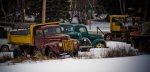
The photograph presented here is that of a late fifties flat-deck truck in Nampa, Alberta.  In Nampa the historical-agricultural museum is in the process of re-locating.  So, farming equipment/implements, vehicles, train cars and buildings are shifting location.  Until the new site is completed these items remain scattered throughout Nampa.  This flat-deck truck sits in someone’s backyard alongside other vehicles and looks to be in readiness for use. This truck has seen perhaps fifty or so years of service and its structure still has integrity.  It seems to be one of the last vehicles standing and seems to have strength associated with preserved shape and ability to function.  Its look is that which we’d find in the wizened face, that face of the last man standing – the keeper of the fire – when we need to direct ourselves to sleep.

Listening to Over the Rhine’s Spark, Joseph Arthur’s In the Sun (with Michael Stipe) and U2’s One;  other songs have included Eric Angus Whyte’s Beggars and Buskers (of Belfast), Liz Longley’s Free and the Steve Miller Band’s Rock’n Me.  My daughter has had me download Young the Giant’s Cough Syrup and Kelly Clarkson’s Stronger (What Doesn’t Kill You);  Demi Lovato’s Skyscraper has also received download tonight.

Quotes to Inspire –  (1) “If I knew how to take a good photograph, I’d do it every time.” –  Robert Doisneau; and, (2) “If I have any ‘message’ worth giving to a beginner it is that there are no short cuts in photography.” – Edward Weston.

Where Are You Going …?

Barn, Canon 60D, Canon 70-200 mm 2.8 IS L Series Lens, Canon Camera, Canon Lens, Canon Live View, Photoblog Intention, Photography & Conceptualizing Beauty, Project 365 - Photo-a-day, Still Life, Vehicle Restoration, Winter

The images I present in this post remind of a time when as a young Dad, I read stories from the Thomas the Tank Engine series to my son and my/our doing so was an enjoyable way to close out each day. Thomas, Percy, Rusty, James et al each had an engineer, each had a conductor, all worked for Sir Topham Hat – each set about to complete a task each day. At the end of each day each engine returned to the engine shed for maintenance and rest. In Sangudo, Alberta, there’s a museum celebrating the vehicles and machinery that were used in the building of the Alaska Highway. Some are scattered within the museum’s yard and some are housed in a roofed shed without walls. The museum has closed and is no longer open to tourists. All vehicles seem to look onto the Alaska Highway they once had a hand in building. The scene is one you might find in a Thomas the Tank Engine story –  vehicles dormant and apparently waiting for a time when they can be re-tasked with new purpose and new life. Curiously, two songs I’m listening to tonight almost personify a state of mind that could lurk, here. One is Dave Matthew’s song Where Are You Going and the other is a Hank William’s song, I’m So Lonesome I Could Cry. Both songs are sung by Martyn Joseph and are found in his Passport Queue album Pq35.

Listening to: Weight of the World, Invisible Angel, Kindness and I Will Follow from Martyn Joseph’s Pq35.

Quote to Inspire: “A family’s photograph album is generally about the extended family—and, often, is all that remains of it.” – Susan Sontag (b. 1933), U.S. essayist. “In Plato’s Cave,” On Photography (1977).

B-Sides, Photographs that Linger

Barn, Best Practices - Photography, Canon 60D, Canon 70-200 mm 2.8 IS L Series Lens, Canon Camera, Canon Lens, Canon Live View, Farm, Farmhouse, High Dynamic Range (HDR), Home, Homestead, Light Intensity, Photoblog Intention, Photography & Conceptualizing Beauty, Project 365 - Photo-a-day, Spring, Still Life, Winter

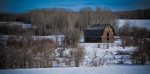
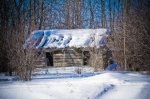
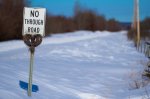
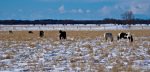
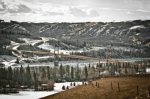
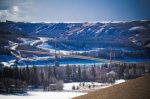
Sunday – photographs that I’d intended to post linger on my computer’s desktop in a file of edited images.  The week has been busy with obligations taking me into my nights. The first image is one of a barn located in a muskeg bog, just south of Figure Eight Lake on Alberta Highway 737; it is out of the weather and close to a water source; no house or homestead is in the immediate vicinity.  One could have burned down. Or, perhaps the barn is associated with the homestead in the second image; this homestead is treed in and built on higher ground a kilometre further south on the west side of the same highway. In another image an inuksuk has been assembled at the southwesternmost corner of someone’s farmland alongside Alberta Highway 685, stating to all comers that others have stood right there, where they now stand. Within metres of the inuksuk, a heart-shaped wreath is fastened below a ‘no through road’ sign, perhaps inviting people to come and investigate. The next photograph presents a second rendering of the Fairview horses and lamas in spring’s sunlight; there’s a glow of sunlight from the animals. Beyond this, are the other b-side renderings of the Dunvegin bridge, photographed last weekend.

Listening to Tonic’s rendition of Fleetwood Mac’s Second Hand News, then there’s Sister Hazel’s take on Gold Dust Woman and Shawn Colvin performs The Chain, all songs are part of Legacy:  A Tribute to Fleetwood Mac’s Rumours’ album.

Quote to Inspire – “I treat the photograph as a work of great complexity in which you can find drama. Add to that a careful composition of landscapes, live photography, the right music and interviews with people, and it becomes a style.” – Ken Burns