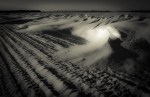
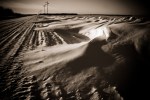
One year ago, late on a Sunday afternoon in February I travelled east from High Level on range roads that service farms in this region. While graders had cleared these roads snow had begun to drift into them from the north. The sun’s light was direct and bright, intense as it was reflected back from the snow. And, the wind blew. From a distance, the shapes of the snow’s drifts were a repetitive pattern blown into the roads – evidence of the wind’s work; more irregular shapes were found as result of the particular way the wind swept through an area. On my return home I photographed Gibson’s farm, 10km east of High Level – a landmark that has served to orient me to how close I was to High Level in my trips in from Garden River, Fox Lake, Fort Vermilion and beyond. After many seasons in many years, my camera allowed me finally to see more of what the Gibson’s farm was about.
Reminded of W.O. Mitchell and his novel, Who Has Seen the Wind – a novel about growing up, a story with teachers and students …. Here’s its poem starting point.
Who Has Seen the Wind? – Christina Georgina Rosetti (1834-1894)
Who has seen the wind?
Neither I nor you.
But when the leaves hang trembling,
The wind is passing through.
Who has seen the wind?
Neither you nor I.
But when the trees bow down their heads,
The wind is passing by.
Listening to Dar Williams’ album The Beauty of the Rain, an album I was drawn to after learning the tablature for her song of the same name. The circumstances of a friend have recalled a song from the album – Fishing in the Morning.
Quote to Inspire – “To photograph truthfully and effectively is to see beneath the surfaces and record the qualities of nature and humanity which live or are latent in all things.” – Ansel Adams.
During evening meals as I and my brothers grew up my father would look back to his boyhood days and share stories and facts about the world surrounding him. Talk would often revolve about different outings and that his mum, my grandmother loved a Sunday drive in the landscape surrounding Moncton, New Brunswick where he grew up. It did her good to be with her family and to see the world beyond her home. A blue 1938 Pontiac transported them – a few years ago my aunt showed me a picture of the car with my Dad and his younger brother eating picnic sandwiches sitting in shade on the car’s running boards. Cars do double as portable homes or perhaps rooms and during transport they group a family together. Everyone has common vision, all staring down the road with the driver. Cars become a place to catch-up on things, a place to talk things through, places to share news – in transport, you’d not be the same person getting out of the car as you were getting in to it.
While cars did seem to be a family thing, a fact that I continue to be amazed at is that my father only learned to drive after completing his Ph.D. at the age of twenty-five or twenty-six; perhaps he anticipated family as his next step. And, maybe there’s some truth in that because during his university years at Mount Allison (Sackville, Nova Scotia) and at St. Mary’s College (London, U.K.), he hadn’t needed a car but had been able to make his way around Europe on train, by bus, on bicycle or hiking. And, it seemed that such travel was much more of a social thing with much more grace being there as fellow-travellers or friends in the act of travel. Perhaps there was that common purpose of travel in that former time – to ‘see’ the world (which also meant to experience it).
Dad had ideas about cars, about how long they should be driven before a new one should be bought. He had ideas and biases about good and better cars. He enjoyed a car that had what he would term ‘pep.’ It’s tempting to look at the cars Dad has owned and driven as associating to different points of development among our family – a 57 Ford Consul (marriage), a 64 Pontiac Beaumont (the family populates), a 69 Pontiac Parisienne (the family’s middle years), a 76 Chevrolet Caprice Classic with 74 Ford Gran Torino (the family’s later middle years), an 81 Oldsmobile Cutlass Supreme (kids almost ready to move out), an Oldsmobile Delta 88 with Dodge Aries K Car (first years of empty-nest), two Nissan Maximas (later empty nest and retirement) and a Nissan Altima (later years of retirement). You could almost use the technology available at each stage to chronicle the evolution of cultural norms within society … possible Masters thesis for someone.
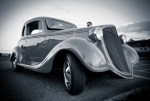
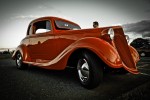
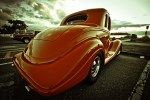
On occasion, cars – what they were about, their history and their potential for each aspiring driver in our family – would be the center of discussion at evening meals. One vehicle Dad commented on with regard to its history was a car alluded in terms of character name in the Disney/Pixar movie, Cars. Paul Newman provided voice-over for that car, now animated, Doc Hudson. Last summer I got to see a Hudson Terraplane, not one from the fifties or forties, but a Hudson Terraplane from the thirties, a pet project for an autobody repairman and tow-truck driver from Nanaimo. These photographs are taken at the end of July, 2011.
Quote to Inspire – “The question is not what you look at but what you see!” – Henry David Thoreau
Listening to John Mayer sing Route 66 from the Cars Soundtrack; the same soundtrack has Rascal Flatts singing Life is a Highway. After that it has been listening to Tom Cochrane and Red Rider in the Edmonton Symphony Sessions recorded at Edmonton’s Jubilee Auditorium – Avenue A, Bird on a Wire, Big League and Boy Inside the Man … all, good, good tunes.
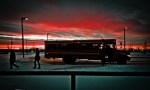
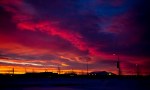
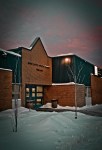
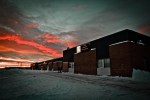
Thursday was a photographer’s morning. A warm change in weather brought colourful, early morning, sustained, sky drama of first light reflected earthward among clouds. Entering school, I set-up my camera, deposited my camera bag and moved out our east doors to click and capture the following images.
Today, being considered is a newer used vehicle. With one household vehicle being all-wheel drive, a fuel-efficient car might be smart (perhaps a VW Golf or Passat). Another consideration would involve spending a minimum of money on a vehicle that is 4×4 and wouldn’t be too much of a loss if it were to break down; here, I’ve owned three early 90s Nissan Pathfinders and they worked for me along the corduroy roads in and out of Wood Buffalo National Park through six years. And, in the back of my mind is the surety I encountered driving a Chevrolet, 2500 series, manual transmission with 4×4 in a snow storm travelling down Alberta Highway 63 from Fort McMurray to Edmonton early-on in the 90s. The overall sensible choice may be a 1999 Toyota 4 Runner with 309000 km that should run for a few more 100000km and can be purchased in a private sale in Peace River. This vehicle should provide safe travel in and out of 4×4 throughout all seasons, no matter who was driving it. It would hold the road well.
Listening to Canadian Melissa McClelland sing Victoria Day (April Showers and May Flowers) from her album of the same name. Other songs standing out this morning have been Snow Patrol’s Lifeboats, Ray Lamontagne’s I Still Care for You and For the Summer. Jack White has featured among the Raconteurs in Steady as She Goes.
Quote to Inspire – “Light glorifies everything. It transforms and ennobles the most commonplace and ordinary subjects. The object is nothing, light is everything.” — Leonard Missone
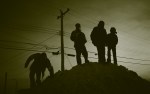
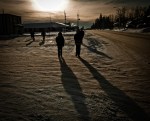
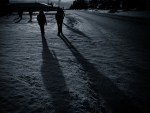
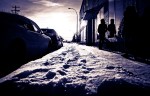
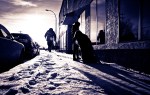
Yesterday contained opportunity for a photowalk with photographers and a chance to witness the world with growing intensity of light and warmth late on a Thursday, winter afternoon in High Level, Alberta – all were giddy with being outside and anticipating spring’s arrival … still a month away.
Listening to several songs this evening. First, my daughter asked me to find and download four Glee tunes (Animal, Dog Days are Over, Bad and Smooth Criminal). Next, we loaded Adele’s 21 album/CD (a Christmas gift) onto our iTunes account; my daughter likes Set Fire to the Rain. Twice this week, I’ve returned home at day’s end to huge decibels of Adele preceding the dinner hour. Beyond this, we’ve downloaded Schubert’s Ave Maria, the music accompaniment to her current ballet performance, music for her to practice with. Of the songs that have played through, tonight, while editing photographs the ones that stand out are those from my father’s time If I didn’t Care, by the Inkspots, I’m Looking Over a Four Leaf Clover, by Bix Beiderbecke. I’ve been listening to the Get Low soundtrack which has eight songs involving Jerry Douglas and his dobro in a Bluegrass sound, one of the primary sound elements undergirding the music of Alison Krauss with Union Station. And, then the iTunes music shifted to Foster the People and Pumped Up Kicks … a catchy tune that stood out for me at West Edmonton Mall’s ice rink as Edmonton youth waited to personally meet Selena Gomez back in October prior to her concert.
Quote to Inspire – “Look and think before opening the shutter. The heart and mind are the true lens of the camera.” — Yousuf Karsh. If you are a photographer in need of inspiration I would point you to a podcast called The Naked Photo offered by Rianne de Beer, a Canadian photographer on Canada’s west coast (between Vancouver and Salt Spring Island); in episode 5 he looks at Yousuf Karsh’s approach to creating a portrait of Winston Churchill, a photograph commissioned by the Canadian government. There is a ton of insight to be gleaned on forethought and the process to capture essence … of the subject. http://thenakedphotopodcast.com/
Cemeteries, for most people, are places of foreboding – we understand that we too shall end-up, here. Beyond the fact that we usually find ourselves at cemeteries on the other side of saying goodbye to loved ones and good friends, cemeteries also point us to the consideration of the life we are living. At our life’s end, we may be more in a state of regret having conformed our lives to the expectations of others, failing fully to step up and into the Life that is truly ours. On the other hand, on our death bed, it would certainly be something to smile, roguishly, and to own to others that we’d certainly taken ‘a good squeeze out of life.’ My wife’s friend from church, Herman Peters, passed away a week or two ago and his funeral and eulogy embraced his feisty, roguish approach to Life and seeing it through well. Herman’s eulogist, throughout his eulogy, would often lean over and look at Herman within his casket and ask, “Do you think it would be okay if I tell them about the time we did…?” Wow! What a way to go! Good schtuff, Herman – thank you to who you have been to all others and the friend and elder you’ve been to my wife. John O’Donohue and his Greenbelt lecture on the Imagination have been much on my mind as I’ve considered this photograph, tonight.
Listening to Pierce Pettis sing Love Will Always Find Its Way from his album,Everything Matters; other good, good songs include Neutral Ground and Just Like Jim Brown (She is History).
Quote to Inspire – “No place is boring, if you’ve had a good night’s sleep and have a pocket full of unexposed film.” – Robert Adams, Darkroom & Creative Camera Techniques, May 1995
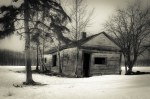
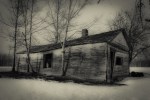
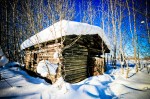
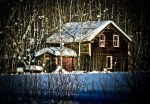
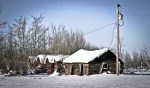
Home and homesteads are the subject of this evening’s perusal through photographs. In the U2 canon, Paul Hewson (Bono), the younger of two siblings asserts lyrically that ‘a house does not make a home,’ something he’s needed his father (Bob Hewson – Catholic) to understand about their shared life, a life without a mother who’s passed on (when Bono was 16 years of age). His lyrics point to the heart of home life – the void Bono’s encountered and what should be there. Another song from the U2 canon references yearning for his mother (Iris Elizabeth Hewson – Protestant) and her example – there’s vertiable duality in his ‘I will follow‘ lyrics – Bono surfaces his mother, here, as well as redemption through saviour and salvation. The essence that’s there, throughout these songs, is that much of what home is about revolves around the care and direction we receive from that parent who is our mother. Here, in tonight’s photographs, more than you’d expect, home is the key anchoring ingredient to Life on our frontier (yours too).
Listening to much of U2’s All That You Can’t Leave Behind album – New York (a secondary home-base for U2 and anchor), Grace (that awkward yet overcoming force/intention) and Kite (that song made gospel in Joey Ramone’s deathbed hearing).
Quote to Inspire (and to chuckle at) – “I shutter to think how many people are underexposed and lacking depth in this field.”










 In My Back Pocket - Photography
You must be logged in to post a comment.