
Success and All Concerned

Best Practices - Photography, Canon 60D, Canon Camera, Canon Lens, Canon Live View, Project 365 - Photo-a-day, Vehicle, Vehicle Restoration, Winter

“Coming together is a beginning. Staying together is progress.  Working together is success.” Leaders use this quote often to enhance organizational teamwork.  Counselors use it to bolster and sustain forward movement among people in relationships who stumble and tumble. The words derive from Henry Ford and their analogy to the work of Life quite likely is taken from first automobiles produced on an assembly line. These words describe that dynamic of steady, determined, hope-directed forward movement towards goals through trial and error and improved performance. The statement articulates the manner of work involved in achieving a productive end through full investment into each learning curve we encounter. We work to understand what’s to be done and how to improve. We act, we work and we utilize feedback about current progress, tweaking action toward better, future performance.

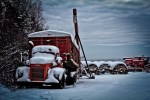
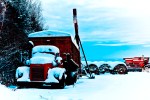
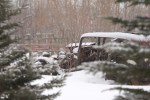
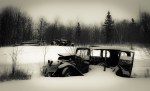
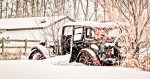
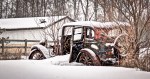
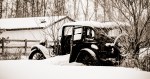
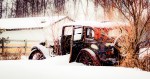
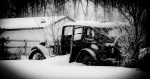
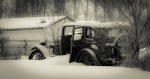
Photography has its learning curves, too.  Good photography is about you learning subject and context and about you working to see them well through your camera’s lens.  Working together is about you and the camera, it’s about you and the subject, and it’s about you and your environment. The vehicle that serves as subject to these photographs is a 1930’s rusting relic, a sedan with wooden spokes that could be a Chevrolet or a Ford or another make. I saw it last Wednesday in my return journey to Sunrise Beach, near Onoway, Alberta, a trip I was making with a friend to investigate the integrity of a second-hand 2000 GMC Yukon as a possible vehicle to replace my written-off 2000 GMC Sierra.

In photography, it may seem at first glance that it is appropriate to point the camera at anything that is in front of you. However, what is also at play is context and environment. The reality is that context and environment are associated with being property and with ownership. Beyond this, context and environment have intention; people identify what each are to be used for. Here, you’d assume that a vehicle put out for public display would not have any issues associated with it if one were to photograph it. Well, in photographing anyone’s property, there’s the matter of what will the photograph be used for and in this case there was perhaps something more akin to rural crime watch being what was at play, something that should have been anticipated. And, the curious owner who questioned me about my actions was both gracious and concerned. In this instance, I knew better … I could have lessened anxieties and awkwardness by introducing myself, stating my photographic intention and asking permission to photograph the vehicle. Working together, in this best practice for photographers and as one whose been influenced by a lineage of photographers would have had and will now have me working proactively to avoid discomfort and uncertainty for others and myself and work toward ensuring good, productive photographic outcomes … even to the point of accepting the possibility of ‘no’ being an answer to my request to photograph a subject. Proactively seeing things through well for all concerned is a key best practice in photography.  This may see me creating a business card that will contain the assurance of contact information for people I deal with.  It may even be worth going further and providing them with photographs of the subject as thank you or to create a calendar with my photographs (as bona fide) for this aspect of public relations and good business practice.

Quotes to Inspire – (1) “A definition of a professional photographer: A ‘pro’ NEVER shows anybody the mistakes.” – Anonymous; (2) “The progress of a photographer can often be marked by the accumulated number of mistakes he or she had made along the way.” – Catherine Jo Morgan (3) “Don’t be stupid and remember where you come from.” – Fr. Tony Ricard, NETCA Teacher Convention 2012

Listening to – Patty Griffin’s Long Ride Home, a song about losing a loved-one from the music-filled movie, Elizabethtown, a song followed by You Can’t Hurry Love, by The Concretes from the same movie soundtrack.
Imagination’s Possibility

Best Practices - Photography, Canon 30D, Canon Camera, Lookback Photos - One Year Ago, Photoblog Intention, Project 365 - Photo-a-day, Winter

I am posting in a rush. Away from computer and the ability to post photos, the next few days will see me hunting for a new vehicle (truck, SUV or car) in central Alberta. The photographs I present, here, are from the solo photowalk from a few posts back – a circuit on top and through Edmonton’s river valley – there’s the Fifth Street Bridge, two photos of the High Level bridge northeast walkway entrance and then photos of the stairway leading from the Grandin park down to the Royal Glenora skating rink – where Alberta’s Olympic hopefuls train.

A current review of John O’Donohue’s work on imagination and beauty has surfaced intriguing thoughts about our subjective world, our subtle life and the curious role imagination plays in accessing and realizing all we are and can be; perhaps these are key ideas for sorting Life through, well.

“Where do all your unlived lives dwell? Go back to [your] threshold moments and see what you didn’t choose; consider what might have happened [there]. Unchosen, unlived lives continue to live themselves out secretly in accompaniment with us …. [It is important to note that] the way that we [can be] viewed is infinitely more subtle and sophisticated and complex than the one-hit look of the human eye [that others see us with]. The only way that you can come in touch with your other [unchosen, unlived] lives is through the power of the imagination because … your imagination is always interested in what’s left out; it’s interested always in the other side of the question; it’s interested in depth and roundness. The most important question for any human [to ask] is ‘how do ‘you’ see yourself?’ Who do ‘you’ think ‘you’ are? And, what do ‘you’ think is going on in ‘you’? You cannot see that with your superficial mind.You can only sense that with your imagination.” ~ John O’Donohue, Beauty – The Divine Embrace, a Greenbelt lecture.

Listening to F. Scott Fitzgerald’s the Great Gatsby, a first listen to an unabridged recording following a first reading of the novel. Jimmy Gatz, Daisy and Tom Buchanan, Jordan Baker, Mr. Wilson and his wife – there’s much there about settling into lives as men and women, husbands and wives. It also contains an element of the modern, self-made man, the man of the times, a Dale Carnegie man able to win friends and influence people. This narrative is a historical complement to Martin Scorsese’s current Atlantic City narrative, a mini-series about Nucky Thompson, Jimmy Dohmarty, Al Capone et al in Boardwalk Empire, now in season 2.

Much of the day has been listening to Sirius Satellite Radio – the Coffee House, BBC World Service, B.B. King’s Bluesville; Ryan Adams has a new song, Chains of Love, that I’ll be checking into.

Quote to Inspire – “The more you photograph, the more you realize what can and what can’t be photographed. You just have to keep doing it.” – Eliot Porter

Vase-lens

Best Practices - Photography, Canon 50mm, Canon 50mm Lens, Canon 60D, Canon Camera, Canon Live View, High Dynamic Range (HDR), Night, Photography & Conceptualizing Beauty, Prime Lens, Project 365 - Photo-a-day, Still Life

A vase and a serving dish, both glass, both transparent yet holding colour, both with shape and form and both reflecting light are subjects in the images presented here. Both glass structures are lenses, the vase, a lens revealing entire beauty of the flower held, the serving dish, a lens to the manna that soon will be eaten. The polished surface’s shape and form reflects light. So too does the interior of the glass.  There’s that place where the glass in being shaped curves or twists receiving form. From that point within there’s reflection, a glint of light from within shining back. Analogy extends forward … what structures hold us that allow us to be seen? Would this be a home?  Would this be a marriage? A vase holds the still-life flower, a living thing of beauty while beautiful. Moving past prime, dying, it is discarded. For us, we each have a rich, subtle life, one that few others really know well.  Is friendship the vase-lens structure allowing for revelation of one’s subtle life? Something in this analogy is truth my mother understood.  Her memory via her paintings prods me forward toward unraveling it.

Listening to Bruce Springsteen from the Tunnel of Love album – One Step Up; Bryan Ferry sings Just Like Tom Thumb’s Blues from Dylanesque.  Amiina from the album Kurr provides a tonal, music box sound in Rugla.  Rugla reminds of another ambient mix by Sigur Ros from the Takk album – Glosoli.  Later, I’m listening to Last Thoughts on Woody Guthrie, thoughts Bob Dylan offers – The Bootleg Series, Vols. 1-3 (Rare and Unreleased) 1961-1991.

Quote to Inspire – “Photography is only intuition, a perpetual interrogation – everything except a stage set.” – Henri Cartier-Bresson – Photography Year 1975 – Life Library of Photography, page: 216

What Happened Here ….

Best Practices - Photography, Canon 50mm, Canon 50mm Lens, Canon 60D, Canon Camera, Canon Live View, High Dynamic Range (HDR), Photoblog Intention, Photography & Conceptualizing Beauty, Prime Lens, Project 365 - Photo-a-day, Still Life, Winter

Early Fifties Two-door Sedan - Blue Hills

Car photography especially of early fifties vehicles, for me, derives from my learning to steer a car and then to drive one sitting next to a favourite, older cousin in his copper brown and white 1951 Mercury four-door.  Strong-arm steering meant that effort was needed to guide the Mercury down dusty gravel roads. These drives usually followed Sunday get-togethers of my family from Edmonton with his in Rimbey, Alberta. The event, recalled to memory is that of a late spring or early summer drive, following an evening meal and Walt Disney.  I might have been nine or ten years old when I first took the wheel for some good, adventure-filled times before saying our goodbyes, parting company and returning home in an hour-long drive to Edmonton.  Always, my aunt, uncle and three cousins would wave to us from their porch as we left. Our families might see each other again in a month or two. Those were good times.

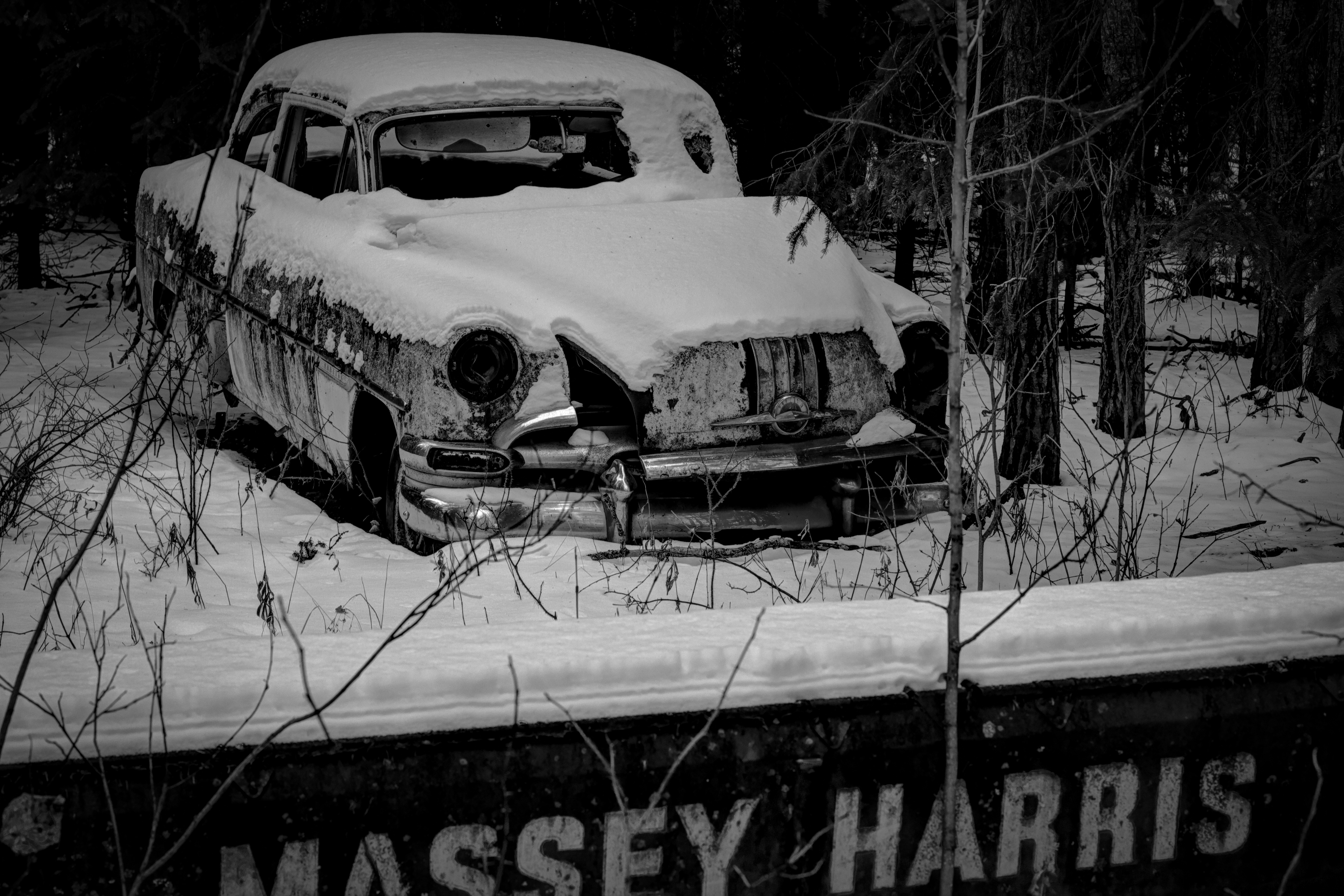
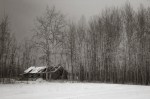
My starting point for this photograph is curious. I am unable to determine the make of this early fifties two-door sedan. Given that this Blue Hills’ farm and its woods have seemingly been left as if in the middle of things, its abandonment indicates something unfinished in not just one life but in the lives of a few. Here, what is sacred is often about the conception of ‘what-has-happened-here.’  It associates to memory that will not fade and cannot be left. With this image, just as in no-trace camping the art is to pass through an area without disturbing it, this photograph presents the necessity of capturing something seemingly sacred without disturbance – reverence and respect are needed.

Listening to the Dave Matthews Band from the album Stand Up and the childhood/teen reminiscences of Old Dirt Hill, a song that recalls my go-cart, our garage and back alley … and friends at Easter break in Edmonton in grade 5 – 1972 … what a week (and to be grounded part-way through).

Quote to Inspire – “A photograph is a secret about a secret. The more it tells you the less you know.” —Diane Arbus

Saturday’s Afternoon Drive

Best Practices - Photography, Canon 60D, Canon 75-300 mm, Canon Camera, Canon Lens, Canon Live View, Gas Station, High Dynamic Range (HDR), Prime Lens, Project 365 - Photo-a-day, Winter

Wife at school, prepping; daughter at dance, dancing – this Saturday seems to be mine, a day before me to use at my discretion, and, certainly not a day to pass in front of a computer screen. A breakfast out takes me to the Flamingo Restaurant where my Photo Plus magazine becomes object of discussion between fellow Canon photographer (my cashier) and me; I point him to the Zinio iPad app as the best means to download the Photo Plus, easily, here in High Level.

Onward – my outerwear consists of several items purchased over the years from Mountain Equipment Co-op – ski pants (10 years old), Salomon winter trainers (new, this year) and a down-filled jacket with hood. Set for warmth at -22C, today, I point my GMC Sierra (without grill or driver’s side headlamp) toward Fort Vermilion and La Crete. Music is part of what this Saturday afternoon is about – Sirius Satellite Radio allows for tuning into folk music on Coffee House, news at the top of the hour from CBC and BBC, jazz music and an interview with the bass player working with Miles Davis. Comedy does not attract my attention, today. I had had thoughts of listening to Sid and Mac’s Shuttertime Podcast; but, their podcast is good to digest while out on a walk around High Level … I let the podcast wait.

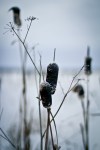
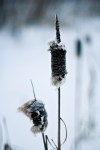
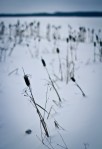
In Fort Vermilion, Shirley’s Snack Shack allows for purchase of coffee and something unseen before, a Reese’s Peanut Butter chocolate bar. The truck rolls south on the Red Earth road. The first photographs are of a red, mid-sixties, FORD, three-tonne grain truck; the vehicle remains active – it has current plates and tires are full. The next photographs are of cattails, at the northeast corner of a massive field – land, newly broken and newly farmed; the wind stirs the cattails enough that Automatic Exposure Bracketing, while tried, will not allow for HDR results.

La Crete has Quality Motors to check out, a used car lot and a new Subway restaurant. Moving southward from La Crete, Buffalo Head Prairie is next.  A chain of hills loom in the distance, a blue backdrop to this settlement and extends to another thirty kilometres away called Blue Hills. Along the way, different untried back roads are taken and they return to the Blue Hills highway.  A derelict farm house is discovered.  Doubling back, a place to park the truck off the highway is found; there, two relics from the fifties are found among old disused farming machinery (Massey Harris is the emblem on a seed drill, not Massey Ferguson). With so much left scattered around, the farm seems to be left medias res (in the middle of things); has there been a family death? There’s a story of a car that drove onto the Tompkin’s Landing ferry many years ago; its brakes failed and one or all occupants of the car drowned.

The final part of the journey involves crossing the Peace River over an ice bridge at Tompkin’s landing; signs are there to direct vehicles and to advise of a maximum speed of 10 km/h for crossing the kilometre-wide river. Another forty minutes in night’s darkness with only a passenger headlight to alert oncoming highway traffic of my presence sees me home before 7:00 p.m..  Supper is grilled cheese sandwiches.

Listening to Miles Davis from his Kind of Blue album and So What; reminds that I first seriously listened to Miles Davis within the Finding Forrester soundtrack … Bill Frisell is also there with Over the Rainbow and Under a Golden Sky.

Quote to Inspire – “While there is perhaps a province in which the photograph can tell us nothing more than what we see with our own eyes, there is another in which it proves to us how little our eyes permit us to see.” — Dorothea Lange

Looking Up – Time for Macro

Best Practices - Photography, Canon 60D, Canon Camera, Photoblog Intention, Project 365 - Photo-a-day, Still Life, Winter

Winter Greenery - Along a High Level Photowalk

Again, today – out and about on a photowalk … others’ fresh perspective has me looking up and looking at things. Green needles of a conifer remind and point towards spring … loving the colour and background, here.

Listening to U2’s Mysterious Ways … the subject and content of the lyrics are something good to unravel, in their unraveling.  Coldplay’s In My Place, is up next, reminding of U2, Paul McCartney, Coldplay and the Verve’s Richard Ashcroft (Bittersweet Symphony) and the world-wide Live 8 concert and the Gleneagles decisions made by G8 leaders … some good, that day!  Brian Adams kicked things off in Toronto followed in the day by The Tragically Hip and Great Big Sea.

Curious Quote to Inspire – “In photography there is a reality so subtle that it becomes more real than reality.” – Alfred Stieglitz

The Photographer’s Photo

Best Practices - Photography, Canon 60D, Canon Camera, Project 365 - Photo-a-day, Winter

Photowalk - Photographer's Photo

Today – out with fellow photographers, a first cluster together.  Some creatives among the group, ones willing to experiment with perspective and their subject.  Totally cool to be a part of things today and to capture this photographer’s photo in the making.  Good schtuff!

Listening to How Soon Is Now by the Smiths, as found on The Wedding Singer Soundtrack.
Quote to Inspire – “Which of my photographs is my favorite? The one I’m going to take tomorrow.” – Imogen Cunningham

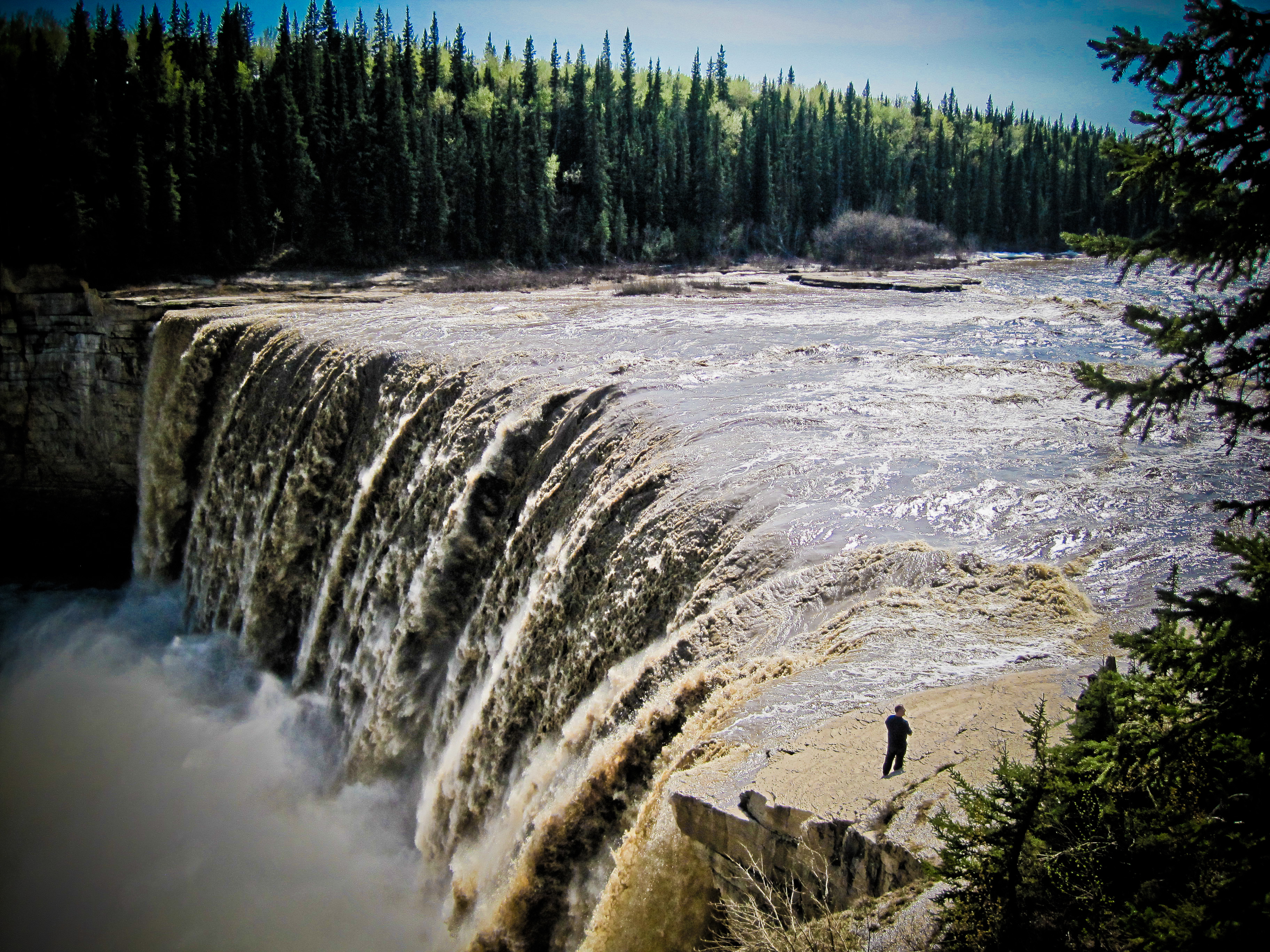
Alexandra Falls – Scale

Best Practices - Photography, Canon 30D, Canon Camera, Lookback Photos - One Year Ago, Photography & Conceptualizing Beauty, Project 365 - Photo-a-day

Within a photograph appreciation for proportion is found by relating a known object to something recognizable in the photograph – scale is established within such comparison. Here, the summer photograph of the Alexandra Falls contains a person standing on top of the west edge of the falls. In comparison with yesterday’s ice-filled Alexandra Falls, the person in the summer photograph provides a basis from which to consider the actual size of the ice pile collecting below the falls, in the gorge.

Listening to Rondo-Allegro, a Mozart Clarinet and Oboe Quartet (music that organizes and shapes the mind – one of my father’s contributions to our growing up).

Quote to Inspire “Sometimes you need to take a little holiday away from yourself – negativity; and call off the Rottweiler’s of analysis and accusation and give yourself a free space; and say for the next week I will give myself a free break and do nothing against myself until my old sense of myself builds up – be courteous to yourself.” ~ John O’Donohue, Divine Beauty – The Invisible Embrace, a Greenbelt lecture

Summer - Alexandra Falls (proportion by comparison to known object ... the person)

On My Mind – Intended Practice for Photography

Best Practices - Photography, Christmas, Photoblog Intention, Project 365 - Photo-a-day, Season, Winter

23 December 2011

With photography, because assets are invested in capturing images, it is likely a good thing to create a system of ‘intended practice’ so that time and resources are not wasted. While image capture can occur anywhere within any environment, determining what images to capture within available time requires good understanding, judgment and planning. These develop noting how success occurred with previous images. Beyond this, such discernment also develops recognizing what possibilities were available within unsuccessful images.

Some photographs are best considered first photographs, images that are test shots or scouting shots, images that allow you to understand the subject and its environment and possibilities for future shots. Working with such photographs acquaints you with what else is possible and becomes your intention for subsequent photographs. Subsequent photographs can be approached directly – “I will go to the site/subject and try such and such.” Or, subsequent photographs can be approached indirectly, returning to the site/subject in the mindset that “If I’m there again I will take advantage of the situation to create this result.”

Because the timeline between initial, scouting photographs and subsequent photographs can be great, record keeping regarding intentions is needed. The record considers the initial photograph – what was happening with light, composition, camera angle and camera settings. And, the record considers intention – what you intend for the image now that you’ve edited it, thought about it and recognized its other possibilities; the record notes conditions that would be present were subsequent shots to be attempted. In both cases, whatever the image is about holds something that draws you back; this is the other important variable about the subject that needs to be articulated and noted.  It is the quality you want to be revealed in subsequent photographs.

While gathering intentions for upcoming photographs does require record keeping, being able to seize the opportunity for that photograph needs to be immediately available, something more than returning to a notebook. A map of the region to be photographed is a good collecting point for intentions in upcoming photographs; a map can be hung on a wall and sticky notes containing brief notes can be attached to it in terms of intended/upcoming photographs. The sticky note can contain information about the upcoming photographs and can point you back to your notebook for intentions.

Snap shots are images taken when someone stands up, clicks the shutter and most likely repeats with little or no intention. Photography, on the other hand, is about seeing and understanding the world through the camera lens with intention. In the next few days I will most likely hang a map of our municipal district on my study wall and use a moleskin and sticky notes to articulate what I would like to see happen in those photographs I take that are beyond the initial scouting photographs.

I M A G E STrinkets and bobbles upon our Christmas tree are today’s colourful subject; ‘bokeh’ is explored.